Credit: by Wu Zhang, Haizeng Li, William W. Yu, Abdulhakem Y. Elezzabi
Multicolour electrochromic displays are one of the most versatile applications because they can retain their coloured states without the need to supply electrical power. However, the simultaneous colouration of the counter layer when operating a conventional electrochromic display restricts the colour overlay effects. Additionally, the operation of conventional electrochromic displays requires external voltages to trigger the colouration/bleaching processes, which makes the conventional electrochromic displays far from a net-zero energy consumption technology.
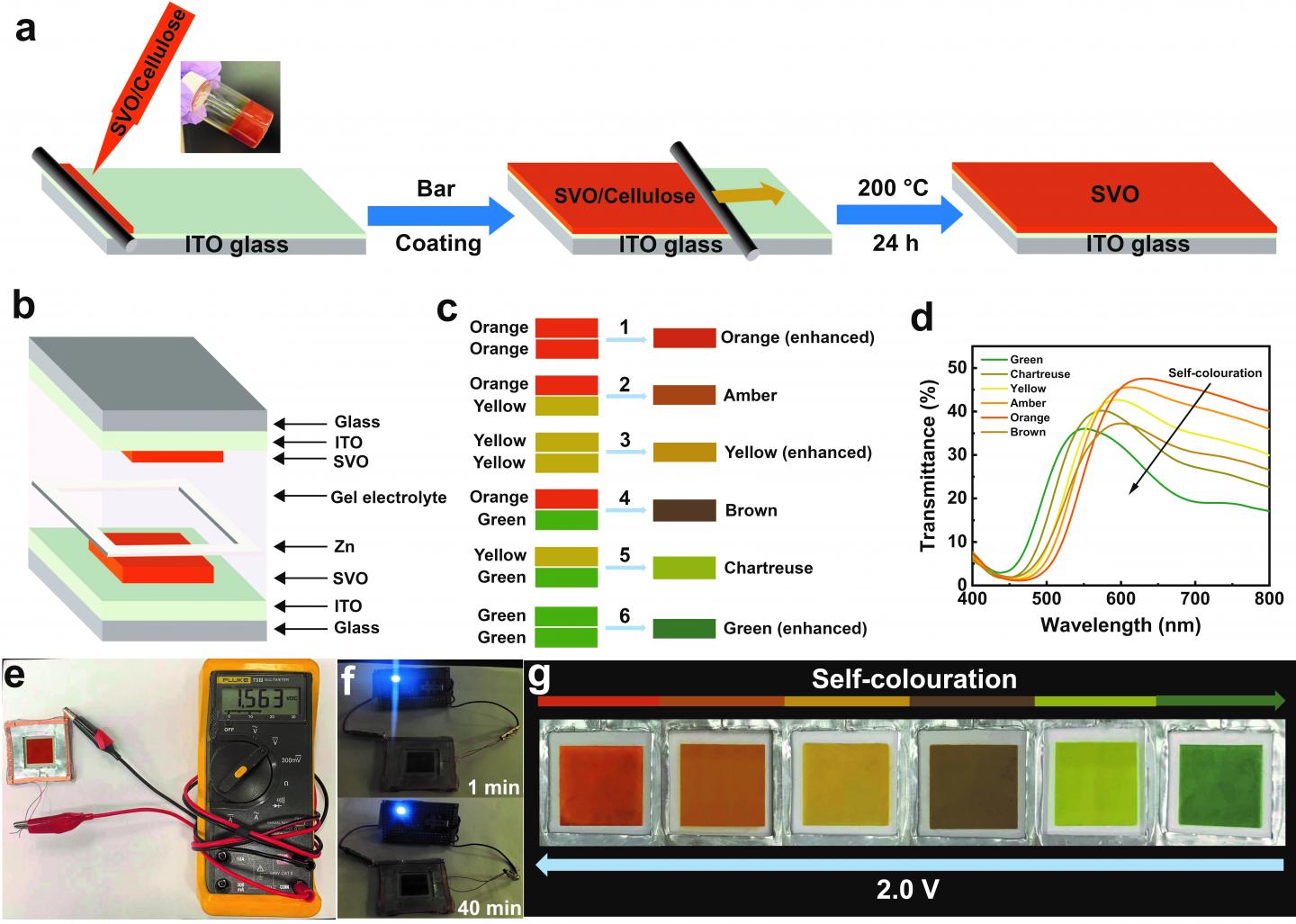
In a new paper published in Light Science & Application, a team of scientists, led by Professor Abdulhakem Y. Elezzabi and Dr. Haizeng Li from Ultrafast Optics and Nanophotonics Laboratory, Department of Electrical and Computer Engineering, University of Alberta, Canada, and co-workers have developed a novel concept for transparent multicolour electrochromic displays by employing sodium ion stabilized vanadium oxide (SVO) nanorods as the electrochromic material. The SVO nanorods are compatible with a simple bar-coating method for fabricating electrochromic films when mixed with cellulose (Fig. 1a). Due to the oxidation nature of SVO, the added cellulose can be fully decomposed under a low temperature (200 °C) to prevent its influence on the conductivity.
The SVO film exhibits reversible multicolour switching (orange ? yellow ? green) during the Zn2+ insertion (self-colouring/discharging) and extraction (bleaching/charging). By taking advantage of the three-colour (orange ? yellow ? green) electrochromic response of the SVO film, an electrochromic display was constructed by sandwiching zinc foil between two SVO electrodes (Fig. 1b). This display enables independent operation of top and bottom electrochromic electrodes, thus providing additional configuration flexibility of the devices through the utilization of dual electrochromic layers under the same or different colour states (Fig. 1c). As such, the colour overlay effect can greatly broaden the colour palette. Using the colour overlay effect, the constructed Zn-SVO electrochromic display shows switching between the multiple colours (orange, amber, yellow, brown, chartreuse and green) while maintaining semitransparency of >30% (Fig. 1d).
More interestingly, the Zn-SVO electrochromic display possesses an open-circuit potential (OCP) of 1.56 V (Fig. 1e), which enables a self-colouration behaviour and energy retrieval functionality. This OCP stems from the redox potential difference between the zinc foil and the SVO electrode, which provides the driving force that activates oxidation of Zn (i.e., stripping of Zn into the electrolyte) and reduction of the SVO film (i.e., intercalation of Zn2+ into SVO). Thus, the built-in voltage allows the display to switch its colour from orange to green (including the four intermediate colours) due to the reduction of the SVO film while powering an LED (Figs. 1f, g).
These key properties mark a significant improvement over reported electrochromic displays, making the Zn-SVO electrochromic displays promising for switchable optical filters, electrochromic tuneable micro-optics, and transparent displays. This study represents a new paradigm in electrochromic displays that can potentially facilitate new opportunities for the development of high transparency, high energy efficiency, and large-area multicolour displays.
###
Media Contact
Haizeng Li
[email protected]
Related Journal Article
http://dx.