Finding has implications for combating tumor growth and disease
Credit: Daisuke Yoshino, TUAT
Blood vessels are the body’s transportation system, carrying oxygen and nutrients to cells and whisking away waste. But this vital mission can also be co-opted by tumors or break down as a result of disease, and this process has been poorly understood. An international collaborative team led by a scientist at Tokyo University of Agriculture and Technology (TUAT) in Japan has discovered a mechanism by which the growth of these vessels’ inner liner is stimulated, which may lead to therapeutics that could cut vessels off from tumors or help rebuild vessels in degenerative diseases.
The results were published on April 2 in Communications Biology, a Nature journal.
The researchers studied how the endothelial cells lining the inside of blood vessels respond to hydrostatic pressure, which is the pressure that forces blood through the vessels. The single layer of these cells forms a barrier between vessels and tissue, which controls fluid’s flow in the blood vessel walls.
“Blood vessels are constantly exposed to stimuli such as fluid shear stress, cyclic tensile force and hydrostatic pressure,” said Daisuke Yoshino, paper author and associate professor at the TUAT.
“Although the detailed mechanisms about cellular responses to shear stress and tensile force have been studied, we have not well understood how hydrostatic pressure affects vascular function.”
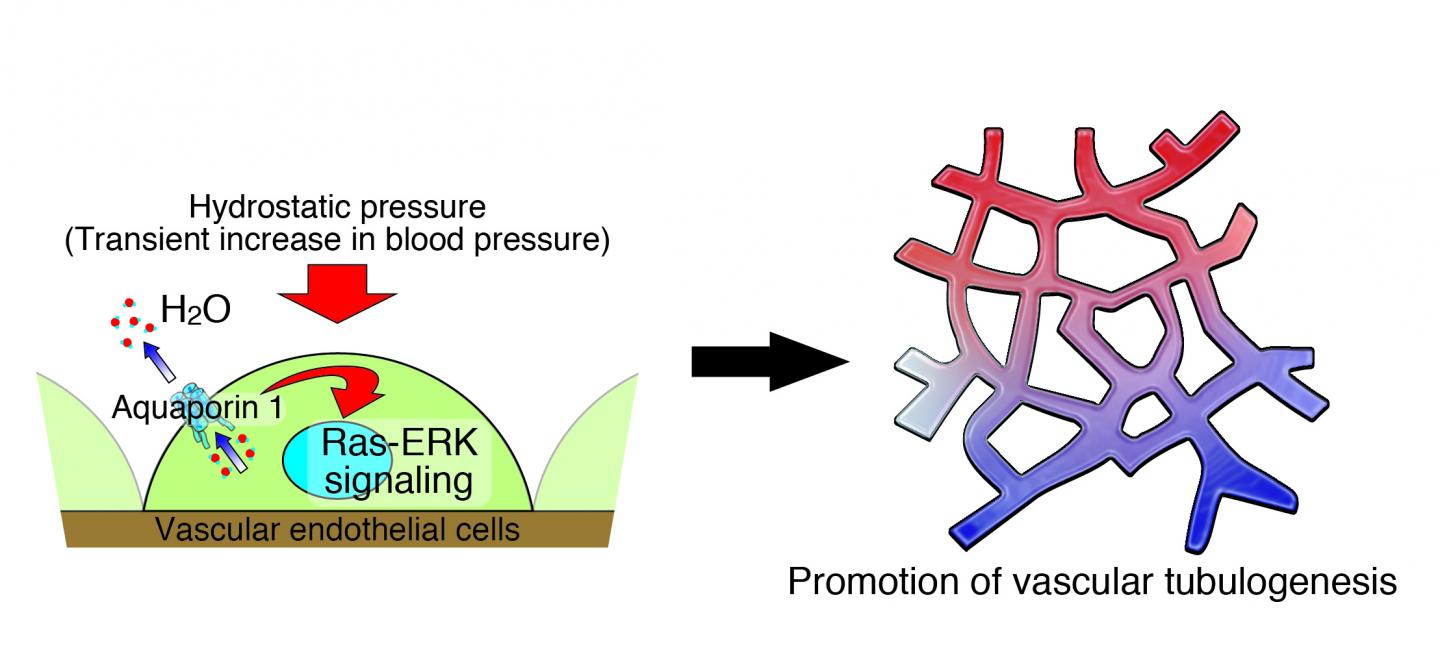
Yoshino and his team applied the pressure to endothelial cells, equivalent of a person working out, to investigate how they sense hydrostatic pressure and convert it into biochemical signals, inducing vascular responses. They found that the increase in pressure triggered a water transfer through a channel called aquaporin 1, which activated a protein signaling channel called Ras-ERK. This process induced endothelial cell growth, indicating a clear connection between pressure stimulation and intracellular biochemical signals, according to Yoshino.
“Our ultimate goal is to comprehensively clarify how the mechanisms described in this study are altered by differences in the blood pressure conditions, such as local conditions, magnitude and mode by which it is exerted,” Yoshino said. “We hope the clarified mechanisms will lead to the development of new treatments for diseases invoking abnormalities in vascular formation, such as venous malformations.”
This work was supported in part by the Japan Society for the Promotion of Science, the Japan Science and Technology Agency and the Mechanobiology Institute at the National University of Singapore.
Yoshino holds appointments in the Division of Advanced Applied Physics at the Institute of Engineering, in the Department of Biomedical Engineering in the Faculty of Engineering and in the Department of Applied Physics in the Graduate School of Engineering at TUAT. Other contributors include Kenichi Funamoto and Masaaki Sato, both of whom are affiliated with the Frontier Research Institute for Interdisciplinary Sciences at Tokyo University. Funamoto is also affiliated with the Institute of Fluid Science at Tohoku University. Other authors include Kakeru Sato, previously of the Graduate School of Engineering at Tohoku University and now at the Tokyo Gas Co., Kenry of the Department of Biomedical Engineering at National University of Singapore and Chwee Teck Lim of Mechanobiology Institute, the Department of Biomedical Engineering and the Institute for Health Innovation and Technology at the National University of Singapore.
###
Original publication:
Hydrostatic pressure promotes endothelial tube formation through aquaporin 1 and Ras-ERK signaling. Daisuke Yoshino*, Kenichi Funamoto, Kakeru Sato, Kenry, Masaaki Sato & Chwee Teck Lim*. Commun Biol 3, 152 (2020).
DOI 10.1038/s42003-020-0881-9
https:/
*: corresponding author
About Tokyo University of Agriculture and Technology (TUAT):
TUAT is a distinguished university in Japan dedicated to science and technology. TUAT focuses on agriculture and engineering that form the foundation of industry, and promotes education and research fields that incorporate them. Boasting a history of over 140 years since our founding in 1874, TUAT continues to boldly take on new challenges and steadily promote fields. With high ethics, TUAT fulfills social responsibility in the capacity of transmitting science and technology information towards the construction of a sustainable society where both human beings and nature can thrive in a symbiotic relationship. For more information, please visit http://www.
Contact:
Daisuke Yoshino, Ph.D.
Associate Professor
Division of Advanced Applied Physics, Institute of Engineering,
Department of Biomedical Engineering, Faculty of Engineering,
Department of Applied Physics, Graduate School of Engineering,
TUAT, Japan
Mail: [email protected]
Media Contact
Yutaka Nibu, Ph.D.
[email protected]
Related Journal Article
http://dx.