In a groundbreaking study published in the prestigious journal Biochar X on March 20, 2026, researchers from Morgan State University have unveiled critical insights into the production and utilization of poultry litter biochar as a sustainable soil amendment. Led by Dong Hee Kang, the research team explored how varying pyrolysis conditions and application rates affect the agronomic potential of this waste-derived biochar, offering promising directions for circular agriculture in regions burdened by intensive poultry production.
Poultry farming not only generates vast quantities of nutrient-rich litter but also presents significant environmental challenges. In densely farmed regions like Maryland’s Delmarva Peninsula, repeated application of raw poultry litter to fields contributes to phosphorus accumulation, nutrient runoff, and water quality degradation. Innovations that can transform this litter into stable, soil-amending products are urgently needed to mitigate these impacts, and biochar—a carbon-rich material produced through pyrolysis—has emerged as a viable candidate.
The team’s research focused on evaluating poultry litter biochar produced at two distinct pyrolysis temperatures, 300 and 500 °C. Pyrolysis, the thermo-chemical decomposition of organic materials in the absence of oxygen, strongly influences biochar’s physical and chemical characteristics. Lower temperatures tend to preserve more labile nutrients and functional surface groups, whereas higher temperatures enhance biochar stability and carbon content but may reduce nutrient availability. Understanding this trade-off is vital for optimizing biochar’s agronomic efficacy.
Additionally, the researchers incorporated variations in feedstock composition by including poultry litter alone, poultry litter mixed with 10% pine shavings, and poultry litter with 10% rice hulls. These bedding materials are commonly used in poultry operations and can influence the nutrient profile, porosity, and salinity of the resulting biochar. Accounting for these variables provided a comprehensive assessment of how feedstock heterogeneity shapes biochar properties and subsequent plant responses.
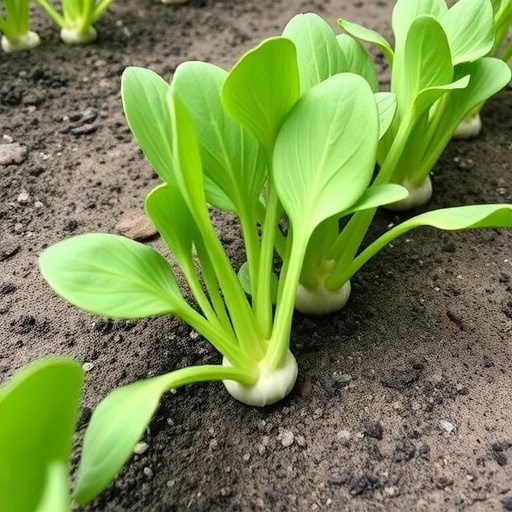
Application rates were tested at both 2% and 5% by weight to elucidate dose-dependent effects on soil chemistry and plant growth. The biochars were integrated into a sandy loam soil characteristic of the Delmarva Peninsula, followed by seed germination assays and six-week radish growth trials conducted under controlled greenhouse conditions. Radish was selected as the bioindicator species due to its rapid germination, sensitivity to soil properties, and well-characterized root architecture.
Initial germination tests revealed no phytotoxic effects across all biochar treatments, affirming the material’s early-stage safety and compatibility with radish cultivation. However, subsequent evaluations of biomass accumulation, leaf area, chlorophyll indices, and root morphology highlighted stark contrasts dependent on pyrolysis temperature and amendment dose.
Lower-temperature biochar (300 °C) consistently outperformed the 500 °C counterpart in promoting shoot development and biomass accumulation. This performance is attributed to the retention of plant-available nutrients, such as nitrogen and phosphorus, as well as reactive surface functional groups that facilitate nutrient exchange and soil microbial activity. Conversely, higher-temperature biochars exhibited reduced nutrient availability, likely due to nutrient volatilization during pyrolysis.
Application at 2% by weight struck an optimal balance, enhancing soil fertility metrics and maintaining electrical conductivity within ranges conducive to radish growth. Under these conditions, plants exhibited robust leaf expansion and well-developed root networks characterized by longer roots with increased tip density. These morphological traits are indicative of improved nutrient and water uptake efficiency, critical for early plant vigor.
In contrast, the 5% application rate led to excessive salinity and nutrient loading, significantly elevating soil electrical conductivity and creating osmotic stress. The biochar-amended soils at this rate showed marked increases in nitrogen, phosphorus, and potassium concentrations, tipping the nutrient balance beyond optimal thresholds. The resulting cation antagonism and physiological stress manifested in suppressed root biomass, shorter root systems, and diminished root tip development despite the surplus of nutrients.
The inclusion of bedding materials, particularly pine shavings and rice hulls, proved beneficial in mitigating some negative effects of increased salinity. These organic additives helped to lower sodium concentrations and enhance the potassium-to-sodium ratio in the soil, buffering plants against salt-induced oxidative and osmotic stress. This finding underscores the complexity of biochar feedstock interactions and highlights the potential for strategic feedstock blending to tailor biochar properties for specific agronomic contexts.
This study elucidates that the effectiveness of poultry litter biochar is not a fixed attribute but a function of production parameters and application strategies. Producing biochar at lower pyrolysis temperatures combined with prudent application rates of no more than 2%, especially with bedding material inclusion, appears to offer the most advantageous outcomes for crop growth enhancement and soil quality improvement.
Beyond greenhouse-scale experiments, the research advocates for extended field studies to comprehensively assess long-term nutrient cycling, microbial community dynamics, and cumulative effects of repeated biochar amendments under real agricultural conditions. Such investigations are critical to translating laboratory insights into scalable solutions for sustainable poultry waste management and soil fertility enhancement.
The potential of poultry litter biochar as a tool for closing nutrient loops, mitigating environmental pollution, and fostering resilient agricultural systems aligns well with the urgent global need for sustainable intensification practices. By refining biochar production and application protocols, farmers and extension services may soon have access to an effective, circular bioresource that simultaneously addresses waste disposal challenges and soil degradation.
Supported by the National Science Foundation’s Excellence in Research Program (grant number 2200616), this work contributes valuable empirical data and mechanistic understanding to the burgeoning field of biochar science. As the community advances, targeted innovations based on such rigorous experimental frameworks will be pivotal to unlocking the full agronomic potential of biochar amendments derived from diverse waste streams.
As the biosphere faces increasing constraints from population growth, climate variability, and resource depletion, integrating biochar technologies into agricultural landscapes offers a promising pathway to enhance carbon sequestration, improve soil health, and promote sustainable food production. This timely study highlights the nuanced interplay between biochar physicochemical properties and plant responses, emphasizing the importance of deliberate engineering to optimize environmental and agronomic benefits.
In conclusion, this research marks a significant step forward in the responsible valorization of poultry litter through biochar transformation. It not only demonstrates the feasibility of converting a problematic waste into a valuable soil amendment but also pinpoints the conditions under which this transformation maximizes benefits and minimizes risks. These findings pave the way for more sustainable agricultural paradigms that reconcile productivity with environmental stewardship in poultry-intensive regions and beyond.
Subject of Research: Not applicable
Article Title: The effect of poultry litter biochar generated at different pyrolysis conditions on radish germination and growth
News Publication Date: 20-Mar-2026
References:
DOI: 10.48130/bchax-0026-0009
Keywords:
Agriculture, Biochar, Poultry litter, Pyrolysis, Soil amendment, Plant growth, Nutrient cycling, Sustainable agriculture, Soil salinity, Root morphology
Tags: biochar application ratesbiochar impact on radish growthcarbon-rich soil conditionerscircular agriculture practicesenvironmental challenges in poultry farmingnutrient management in agriculturephosphorus runoff mitigationpoultry litter biochar productionpyrolysis temperature effects on biocharsoil quality improvement with biocharsustainable soil amendmentsthermo-chemical decomposition of organic waste