• HOME
  • NEWS
  • EXPLORE
    • CAREER
      • Companies
      • Jobs
    • EVENTS
    • iGEM
      • News
      • Team
    • PHOTOS
    • VIDEO
    • WIKI
  • BLOG
  • COMMUNITY
    • FACEBOOK
    • INSTAGRAM
    • TWITTER
Monday, October 5, 2026
BIOENGINEER.ORG
No Result
View All Result
  • Login
  • HOME
  • NEWS
  • EXPLORE
    • CAREER
      • Companies
      • Jobs
        • Lecturer
        • PhD Studentship
        • Postdoc
        • Research Assistant
    • EVENTS
    • iGEM
      • News
      • Team
    • PHOTOS
    • VIDEO
    • WIKI
  • BLOG
  • COMMUNITY
    • FACEBOOK
    • INSTAGRAM
    • TWITTER
  • HOME
  • NEWS
  • EXPLORE
    • CAREER
      • Companies
      • Jobs
        • Lecturer
        • PhD Studentship
        • Postdoc
        • Research Assistant
    • EVENTS
    • iGEM
      • News
      • Team
    • PHOTOS
    • VIDEO
    • WIKI
  • BLOG
  • COMMUNITY
    • FACEBOOK
    • INSTAGRAM
    • TWITTER
No Result
View All Result
Bioengineer.org
No Result
View All Result
Home NEWS Science News Chemistry

Transforming e-waste into a strong, protective coating for metal

Bioengineer by Bioengineer
July 29, 2020
in Chemistry
Reading Time: 3 mins read
0
IMAGE
Share on FacebookShare on TwitterShare on LinkedinShare on RedditShare on Telegram

IMAGE

Credit: Adapted from ACS Omega 2020, DOI: 10.1021/acsomega.0c00485

A typical recycling process converts large quantities of items made of a single material into more of the same. However, this approach isn’t feasible for old electronic devices, or “e-waste,” because they contain small amounts of many different materials that cannot be readily separated. Now, in ACS Omega, researchers report a selective, small-scale microrecycling strategy, which they use to convert old printed circuit boards and monitor components into a new type of strong metal coating.

In spite of the difficulty, there’s plenty of reason to recycle e-waste: It contains many potentially valuable substances that can be used to modify the performance of other materials or to manufacture new, valuable materials. Previous research has shown that carefully calibrated high temperature-based processing can selectively break and reform chemical bonds in waste to form new, environmentally friendly materials. In this way, researchers have already turned a mix of glass and plastic into valuable, silica-containing ceramics. They’ve also used this process to recover copper, which is widely used in electronics and elsewhere, from circuit boards. Based on the properties of copper and silica compounds, Veena Sahajwalla and Rumana Hossain suspected that, after extracting them from e-waste, they could combine them to create a durable new hybrid material ideal for protecting metal surfaces.

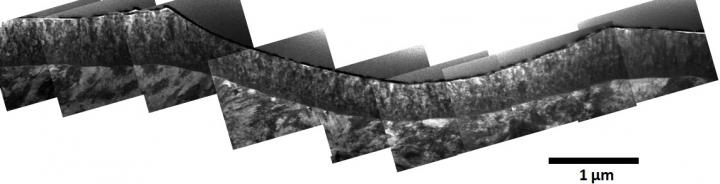
To do so, the researchers first heated glass and plastic powder from old computer monitors to 2,732 F, generating silicon carbide nanowires. They then combined the nanowires with ground-up circuit boards, put the mix on a steel substrate then heated it up again. This time the thermal transformation temperature selected was 1,832 F, melting the copper to form a silicon-carbide enriched hybrid layer atop the steel. Microscope images revealed that, when struck with a nanoscale indenter, the hybrid layer remained firmly affixed to the steel, without cracking or chipping. It also increased the steel’s hardness by 125%. The team refers to this targeted, selective microrecycling process as “material microsurgery,” and say that it has the potential to transform e-waste into advanced new surface coatings without the use of expensive raw materials. 

###

The authors acknowledge funding from the Australian Research Council’s Australian Laureate Fellowship.

The article is freely available as an ACS AuthorChoice article here.

The American Chemical Society (ACS) is a nonprofit organization chartered by the U.S. Congress. ACS’ mission is to advance the broader chemistry enterprise and its practitioners for the benefit of Earth and its people. The Society is a global leader in providing access to chemistry-related information and research through its multiple research solutions, peer-reviewed journals, scientific conferences, eBooks and weekly news periodical Chemical & Engineering News. ACS journals are among the most cited, most trusted and most read within the scientific literature; however, ACS itself does not conduct chemical research. As a specialist in scientific information solutions (including SciFinder® and STN®), its CAS division powers global research, discovery and innovation. ACS’ main offices are in Washington, D.C., and Columbus, Ohio.

To automatically receive press releases from the American Chemical Society, contact [email protected].

Follow us: Twitter | Facebook

Media Contact
Katie Cottingham
[email protected]

Tags: Chemistry/Physics/Materials SciencesElectrical Engineering/ElectronicsHardwareMaterialsNanotechnology/MicromachinesTechnology/Engineering/Computer Science
Share12Tweet8Share2ShareShareShare2

Related Posts

New HPLC Method Simultaneously Tracks Three Diabetes Drugs in One Pill

New HPLC Method Simultaneously Tracks Three Diabetes Drugs in One Pill

October 5, 2026
Tiny Cellulose Rods Keep Pea Starch Gels Fresh by Locking Up Water

Tiny Cellulose Rods Keep Pea Starch Gels Fresh by Locking Up Water

October 5, 2026

Silver Framework and Carbon Black Team Up to Detect Heart Drug Ticagrelor at Trillionth-of-a-Mole Levels

October 5, 2026

Molten Salt Electrochemistry Turns CO2 Into Carbon That Steels Itself Away

October 5, 2026
Please login to join discussion

POPULAR NEWS

  • Alloys That Shrink Their Own Grains: New PIX Mechanism Refines Metals With Heat Alone

    Alloys That Shrink Their Own Grains: New PIX Mechanism Refines Metals With Heat Alone

    29 shares
    Share 12 Tweet 7
  • Endurance Exercise Reshapes the Liver in Males and Females Through Distinct Molecular Routes

    29 shares
    Share 12 Tweet 7
  • Single Transcription Factor PU.1 Rapidly Converts Fibroblasts into Macrophage-Lineage Cells

    29 shares
    Share 12 Tweet 7
  • New Scale Measures How Ready Nurse Educators Really Are for the AI Era

    29 shares
    Share 12 Tweet 7

About

We bring you the latest biotechnology news from best research centers and universities around the world. Check our website.

Follow us

Recent News

Alloys That Shrink Their Own Grains: New PIX Mechanism Refines Metals With Heat Alone

Endurance Exercise Reshapes the Liver in Males and Females Through Distinct Molecular Routes

Single Transcription Factor PU.1 Rapidly Converts Fibroblasts into Macrophage-Lineage Cells

Subscribe to Blog via Email

Success! An email was just sent to confirm your subscription. Please find the email now and click 'Confirm' to start subscribing.

Join 85 other subscribers
  • Contact Us

Bioengineer.org © Copyright 2023 All Rights Reserved.

Welcome Back!

Login to your account below

Forgotten Password?

Retrieve your password

Please enter your username or email address to reset your password.

Log In
No Result
View All Result
  • Homepages
    • Home Page 1
    • Home Page 2
  • News
  • National
  • Business
  • Health
  • Lifestyle
  • Science

Bioengineer.org © Copyright 2023 All Rights Reserved.