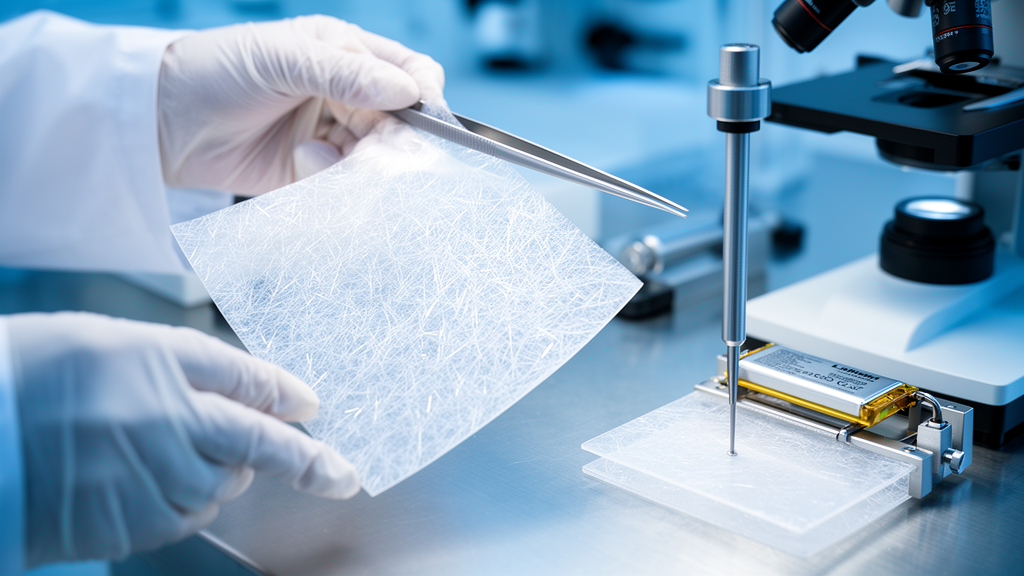
A lithium-ion battery separator made from a polypropylene membrane with an engineered crystal texture has shown markedly better mechanical, thermal and electrochemical performance than a conventionally structured counterpart, according to a study published open access in Advanced Composites and Hybrid Materials on 26 October 2026. The research team, including Guixue Liang, Qipeng Guo, Deliang Wang and colleagues, fabricated a microporous membrane from a precursor film containing continuous and ordered β-transcrystallinity, then evaluated it against a membrane derived from conventional β-spherocrystalline material using synchronous biaxial stretching.
The mechanical results were among the most striking in the study. The β-transcrystalline separator exhibited greater elongation at break than the β-spherocrystalline comparison sample, along with favorable elastic recovery under compressive stress. Its maximum puncture force was approximately twice that of the conventional membrane. Thermal behavior also favored the new membrane: the β-transcrystalline separator maintained both its structural integrity and its microporosity to higher temperatures, and it showed a considerably lower degree of thermal shrinkage than the β-spherocrystalline counterpart.
Electrochemical impedance spectroscopy measurements revealed that the β-transcrystalline separator possessed higher ionic conductivity and lower bulk resistance than its counterpart. These bulk transport properties were reflected in cell-level behavior: in LiFePO₄/Li half-cells, the β-transcrystalline separator delivered superior rate capability, with the capacity gap between the two membranes widening at elevated C-rates.
Cycling stability showed a similarly clear separation between the two materials. Over 200 cycles, the β-transcrystalline separator retained 78.6% of its capacity, compared with 54.0% for the β-spherocrystalline separator, a retention difference of nearly 25 percentage points in the half-cell tests.
The authors attribute these performance advantages to the membrane’s microstructure. The β-transcrystalline membrane forms a uniformly fine fibrillar network with a narrow pore size distribution, which provides more efficient ion transport pathways and consequently enables the superior rate capability and cycling stability observed in the cells. Because the study was conducted on half-cells with LiFePO₄ cathodes, the reported capacity retention and rate results describe performance in that specific test configuration rather than in full commercial cells. Even so, the combination of doubled puncture force, reduced thermal shrinkage, higher ionic conductivity and markedly improved cycle retention positions the β-transcrystalline precursor route as a promising strategy for next-generation polypropylene battery separators, achieved through crystal-structure control in the precursor film rather than through entirely new polymer chemistry.
Subject of Research: β-transcrystalline polypropylene microporous membranes as lithium-ion battery separators
Article Title: Structure and performance study of iPP microporous membrane derived from β-transcrystalline precursor for lithium-ion battery separators
Article References: Liang, G., Guo, Q., Wang, D., Lei, J., Li, H., Li, J., & Guo, S. (2026). Structure and performance study of iPP microporous membrane derived from β-transcrystalline precursor for lithium-ion battery separators. Advanced Composites and Hybrid Materials. https://doi.org/10.1007/s42114-026-02159-x
Image Credits: AI Generated
DOI: 10.1007/s42114-026-02159-x
Keywords: lithium-ion battery, battery separator, polypropylene membrane, β-transcrystallinity, biaxial stretching, microporous membrane, ionic conductivity, puncture resistance, thermal shrinkage, LiFePO4 half-cell, cycle retention, Structure
News Source: Faith Mcneil. (October 26, 2026). Transcrystalline Polypropylene Membrane Doubles Puncture Strength for Battery Separators. Scienmag.