Dispersion of large, medium, small airborne cough droplets in various outdoor conditions
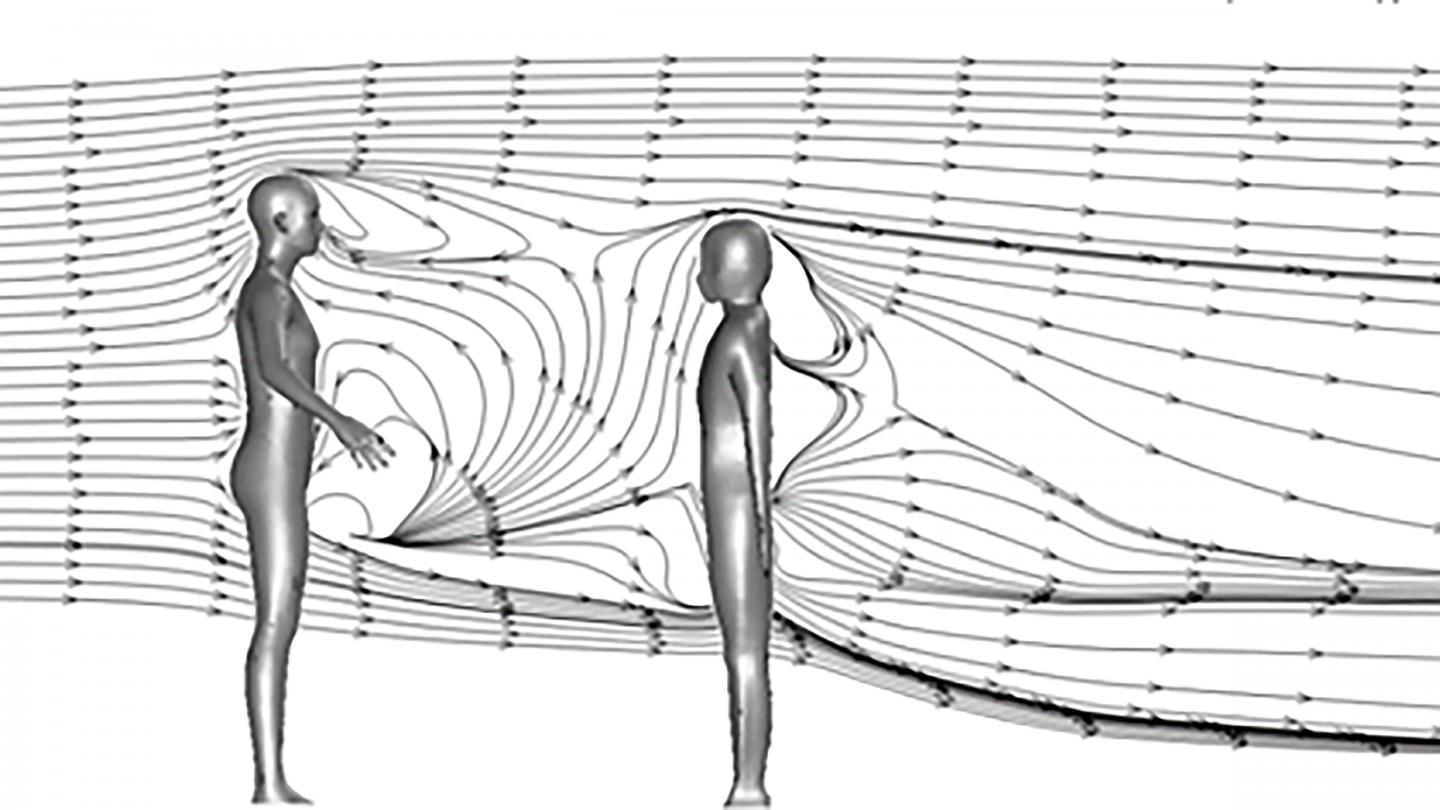
Credit: A*STAR Institute of High Performance Computing
WASHINGTON, November 3, 2020 — The ongoing COVID-19 pandemic has led many researchers to study airborne droplet transmission in different conditions and environments. The latest studies are starting to incorporate important aspects of fluid physics to deepen our understanding of viral transmission.
In a new paper in Physics of Fluids, by AIP Publishing, researchers from A*STAR’s Institute of High Performance Computing conducted a numerical study on droplet dispersion using high fidelity air flow simulation. The scientists found a single 100-micrometer cough droplet under wind speed of 2 meters per second can travel up to 6.6 meters and even further under dry air conditions due to droplet evaporation.
“In addition to wearing a mask, we found social distancing to be generally effective, as droplet deposition is shown to be reduced on a person who is at least 1 meter from the cough,” said author Fong Yew Leong.
The researchers used computational tools to solve complex mathematical formulations representing air flow and the airborne cough droplets around human bodies at various wind speeds and when impacted by other environmental factors. They also assessed the deposition profile on a person at a certain proximity.
A typical cough emits thousands of droplets across a wide size range. The scientists found large droplets settled on the ground quickly due to gravity but could be projected 1 meter by the cough jet even without wind. Medium-sized droplets could evaporate into smaller droplets, which are lighter and more easily borne by the wind, and these traveled further.
The researchers offer a more detailed picture of droplet dispersion as they incorporated the biological considerations of the virus, such as the nonvolatile content in droplet evaporation, into the modelling of the airborne dispersion of droplets.
“An evaporating droplet retains the nonvolatile viral content, so the viral loading is effectively increased,” said author Hongying Li. “This means that evaporated droplets that become aerosols are more susceptible to be inhaled deep into the lung, which causes infection lower down the respiratory tract, than larger unevaporated droplets.”
These findings are also greatly dependent on the environmental conditions, such as wind speed, humidity levels, and ambient air temperature, and based on assumptions made from existing scientific literature on the viability of the COVID-19 virus.
While this research focused on outdoor airborne transmission in a tropical context, the scientists plan to apply their findings to assess risk in indoor and outdoor settings where crowds gather, such as conference halls or amphitheaters. The research could also be applied to designing environments that optimize comfort and safety, such as hospital rooms that account for indoor airflow and airborne pathogen transmission.
###
The article “Dispersion of evaporating cough droplets in tropical outdoor environment,” is authored by Hongying Li, Fong Yew Leong, George Xu, Zhengwei Ge, Chang Wei Kang, and Keng Hui Lim. The article will appear in Physics of Fluids on Nov. 3, 2020 (DOI: 10.1063/5.0026360). After that date, it can be accessed at https:/
ABOUT THE JOURNAL
Physics of Fluids is devoted to the publication of original theoretical, computational, and experimental contributions to the dynamics of gases, liquids, and complex fluids. See https:/
Media Contact
Larry Frum
[email protected]
Related Journal Article
http://dx.