• HOME
  • NEWS
  • EXPLORE
    • CAREER
      • Companies
      • Jobs
    • EVENTS
    • iGEM
      • News
      • Team
    • PHOTOS
    • VIDEO
    • WIKI
  • BLOG
  • COMMUNITY
    • FACEBOOK
    • INSTAGRAM
    • TWITTER
Friday, November 20, 2026
BIOENGINEER.ORG
No Result
View All Result
  • Login
  • HOME
  • NEWS
  • EXPLORE
    • CAREER
      • Companies
      • Jobs
        • Lecturer
        • PhD Studentship
        • Postdoc
        • Research Assistant
    • EVENTS
    • iGEM
      • News
      • Team
    • PHOTOS
    • VIDEO
    • WIKI
  • BLOG
  • COMMUNITY
    • FACEBOOK
    • INSTAGRAM
    • TWITTER
No Result
View All Result
Bioengineer.org
No Result
View All Result
Home NEWS Science News Chemistry

Trace vapor generator for detecting explosives, narcotics

Bioengineer by Bioengineer
August 18, 2020
in Chemistry
Reading Time: 3 mins read
0
IMAGE
Share on FacebookShare on TwitterShare on LinkedinShare on RedditShare on Telegram

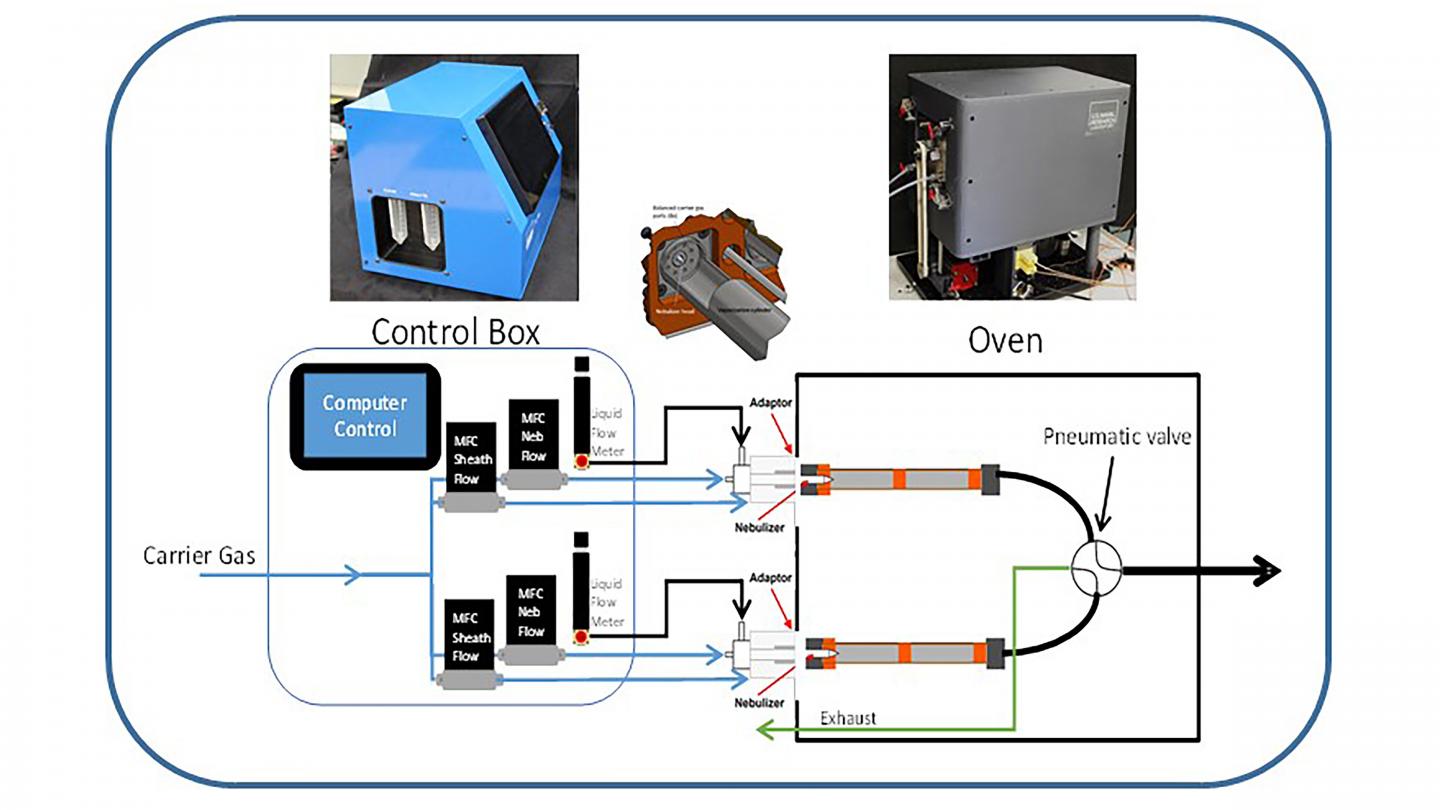
A small trace vapor generator is developed for noncontact sensing of explosives and narcotics
IMAGE

Credit: Diagram provided by U.S. Naval Research Laboratory

WASHINGTON, August 18, 2020 — Trace vapor detection technologies are crucial for ensuring reliable and safe detection of explosives and illegal drugs. Researchers from the U.S. Naval Research Laboratory have developed a compact testing device called the Trace Vapor Generator for Explosives and Narcotics (TV-Gen), which is portable and can be used for non-contact sampling of these vapors.

In the journal Review of Scientific Instruments, published by AIP Publishing, the team reports the TV-Gen can accurately generate trace vapors of low vapor pressure compounds, such as explosives or narcotics, and can produce vapors in complex backgrounds.

“We can use the TV-Gen in the early stages of sensor development, where the developer is just determining if their proposed sensing material responds to a target analyte, all the way to determining instrument and assay limits of detection for hand-held trace detectors and hyphenated instrumentation,” said author Braden Giordano.

This device is the next generation of the Test Explosive Sensor (TESTbed) developed for the Department of Homeland Security, with advanced vapor mixing and a smaller footprint, making transport to other laboratories or into the field possible.

“The TV-Gen is significantly smaller than the TESTbed, and while providing only a single sample port for device evaluation, it maintains or improves upon the older systems’ performance metrics,” said Giordano. “It can fit on a small cart, so you can bring the vapor source to your technology, not the technology to the vapor source.”

The device can provide a stable vapor for several hours and can rapidly switch between a clean vapor stream and an analyte vapor stream while matching humidity.

“An interesting application that will be taking place this year is testing detector canines to get quantitative measurements of olfactory detection threshold and, potentially in the future, be able to compare canines directly to instrument for the first time,” said Giordano.

The researchers hope to continue meeting the needs of the vapor detection community by expanding the library of vapors and exploring methods to maximize vapor generation efficacy at lower operating temperatures.

###

The article, “Trace Vapor Generator for Explosives and Narcotics (TV-Gen),” is authored by Braden C. Giordano, Lauryn E. DeGreeff, Michael Malito, Mark Hammond, Christopher Katilie, Matthew Mullen, Greg E. Collins and Susan L. Rose-Pehrsson. The article will appear in Review of Scientific Instruments on Aug. 18, 2020 (DOI: 10.1063/1.5142385). After that date, it can be accessed at https://aip.scitation.org/doi/10.1063/1.5142385.

ABOUT THE JOURNAL

Review of Scientific Instruments publishes novel advancements in scientific instrumentation, apparatuses, techniques of experimental measurement, and related mathematical analysis. Its content includes publication on instruments covering all areas of science including physics, chemistry, materials science, and biology. See https://aip.scitation.org/journal/rsi

Media Contact
Larry Frum
media@aip.org

Related Journal Article

http://dx.doi.org/10.1063/1.5142385

Tags: Chemistry/Physics/Materials SciencesResearch/DevelopmentScience/Health and the LawTechnology/Engineering/Computer Science
Share12Tweet8Share2ShareShareShare2

Related Posts

Cattail Roots Release Oxygen into Wetland Sediments During Active Growth Pulses

Cattail Roots Release Oxygen into Wetland Sediments During Active Growth Pulses

November 19, 2026
Six UT Knoxville Faculty Named to 2026 Highly Cited List

Six UT Knoxville Faculty Named to 2026 Highly Cited List

November 19, 2026

X-Ray Measurements Detect Fleeting Intermediate State in Light-Excited Iron Molecule

November 19, 2026

Direct Electric Current Guides Carbon Through Solid Metals to Grow Graphite

November 19, 2026
Please login to join discussion

POPULAR NEWS

  • Evidence on Glucose-Based ICU Fluids and Blood Sugar Control Remains Inconclusive

    Evidence on Glucose-Based ICU Fluids and Blood Sugar Control Remains Inconclusive

    29 shares
    Share 12 Tweet 7
  • DNA Computing and Bio-Robotics Revolutionize Biological Data Storage and Automation

    29 shares
    Share 12 Tweet 7
  • Multi-Stream Vision System Evaluates Classroom Teaching Behaviors With High Accuracy

    29 shares
    Share 12 Tweet 7
  • Five Clinicoradiological Markers Predict Progression-Free Survival in Advanced EGFR-Mutant Lung Adenocarcinoma

    29 shares
    Share 12 Tweet 7

About

We bring you the latest biotechnology news from best research centers and universities around the world. Check our website.

Follow us

Recent News

Network Meta-Analysis Evaluates Distinct Exercise Interventions for Stem Cell Transplant Patients

Review Highlights Natural Compounds Modulating Ferroptosis Pathways in Preclinical Parkinson’s Models

Novel Gallium-68 Molecular Imaging Tracks Active Heart Fibrosis in Anderson–Fabry Disease

Subscribe to Blog via Email

Enter your email address to subscribe to this blog and receive notifications of new posts by email.

Join 89 other subscribers
  • Contact Us

Bioengineer.org © Copyright 2023 All Rights Reserved.

Welcome Back!

Login to your account below

Forgotten Password?

Retrieve your password

Please enter your username or email address to reset your password.

Log In
No Result
View All Result
  • Homepages
    • Home Page 1
    • Home Page 2
  • News
  • National
  • Business
  • Health
  • Lifestyle
  • Science

Bioengineer.org © Copyright 2023 All Rights Reserved.