
In a groundbreaking development within the realm of precision measurement, scientists have unveiled a new generation of atomic clocks that significantly outpaces traditional cesium-based clocks in accuracy and speed. This advancement brings us closer to a refined standard for defining the second, one of the fundamental units of time in the International System of Units (SI). Unlike their predecessors, which operate on microwave frequencies, these new optical clocks operate at frequencies that are approximately 100,000 times faster, offering unprecedented capabilities for temporal measurements.
The Physikalisch-Technische Bundesanstalt (PTB), Germany’s national metrology institute, has made substantial strides in the development of various types of optical clocks, demonstrating remarkable precision in timekeeping. Amongst these innovations is a novel ion crystal clock that showcases the capability to measure time and frequency with a potential accuracy 1,000 times greater than that of the currently employed cesium clocks. This significant leap forward could redefine the global standard for the second, ushering in a new era of temporal precision.
At the core of optical atomic clocks lies the interaction between laser light and atoms. When these atoms are irradiated at a specific laser frequency, they undergo quantum transitions, changing their state in a predictable manner. To achieve optimal results, it is critical to shield the atoms from external perturbations, while also meticulously measuring any remaining influences. Achieving this level of control is particularly effective in optical clocks that utilize trapped ions, which can be confined within a few nanometers in a vacuum through the application of electrical fields. This controlled environment allows researchers to approach an ideal quantum state, extracting exceptional accuracy from the system.
Currently, most optical clocks employ a single ion, whose faint signal necessitates extensive measurement durations to ascertain its frequency with minimal uncertainty. In fact, measurements can extend over weeks, and in some cases, it may require up to three years to harness the clock’s full potential. Under these circumstances, clock accuracy is effectively determined by the thoroughness of the measurement process itself.
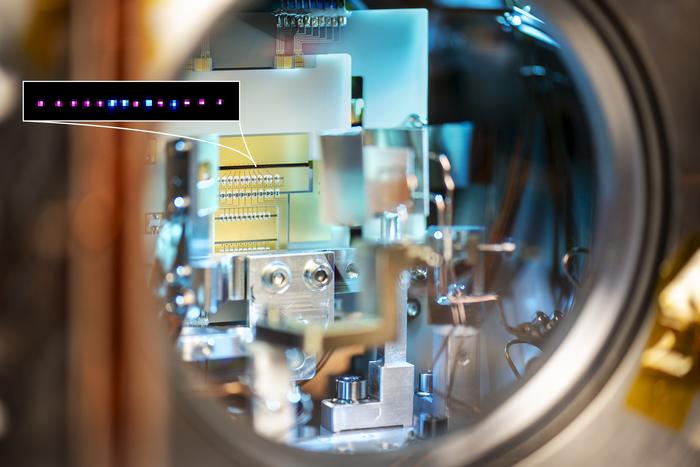
The newly developed ion crystal clock represents a transformative departure from this one-atom approach. By facilitating the simultaneous trapping of multiple ions, often of varying kinds, within a single trap, the researchers can establish a crystalline structure through their interactive dynamics. Notably, the choice of ion plays a pivotal role, with indium ions selected for their advantageous properties to attain high accuracy. The inclusion of ytterbium ions aids in efficient cooling, enhancing the clock’s overall stability and performance.
One of the paramount challenges faced during the development of this ion crystal clock was engineering a trapping mechanism capable of sustaining high-accuracy conditions for a spatially extended crystal configuration—transcending the traditional single-ion confines. Additionally, precise experimental methodologies for positioning the cooling ions within this broader crystal structure had to be innovated. Research group leader Tanja Mehlstäubler and her team successfully confronted and solved these challenges, achieving a remarkable accuracy close to the 18th decimal place.
In evaluating the new ion clock’s reliability and accuracy, PTB compared it against several other optical and microwave clock systems. Among those included were a single-ion ytterbium clock, a strontium lattice clock, and a conventional cesium fountain clock—the benchmarks of modern timekeeping. The indium clock’s performance showcased an overall uncertainty lower than previously established limits, fulfilling the criteria necessitated for redefinition of the second in worldwide comparisons.
This pioneering research lays the groundwork for a new lineage of highly stable and accurate optical ion clocks, with potential applications extending even beyond the current scope. The underlying principles guiding this new clock design can be adapted for various ions, unlocking fresh avenues of exploration in clock technology. This encompasses prospects for implementing quantum many-body states and exploring cascaded interrogation for multiple atom ensembles, potentially revolutionizing the landscape of precision time measurement.
Furthermore, the findings and methodologies derived from this research not only pave the way for groundbreaking advancements in metrology but also enrich the fundamental understanding of quantum mechanics as they apply to real-world devices. The rigorous testing and evaluation required to establish this clock’s superiority will position Germany at the forefront of metrological research, contributing significantly to advancements in various scientific fields.
The implications of this development extend beyond mere timekeeping; they traverse into areas such as global navigation systems, telecommunications, and fundamental physics research. With reliable time measurements being essential for alignment across these frameworks, the introduction of more accurate atomic clocks could enhance synchronization and collaboration across diverse technological systems.
By refining the SI units utilized worldwide, researchers aim to cement the principles of measurement within a quantum framework, providing a more stable and precise foundation for scientific inquiry and technological advancement. The transition towards optical clocks exemplifies the relentless pursuit of precision in science and the continual improvement of measurement techniques.
In summary, the evolution of atomic clocks is not just an incremental improvement but rather a paradigm shift in understanding and measuring time. The potential accuracy and reliability showcased by the new ion crystal clock stand to redefine our approach and assumptions about timekeeping in science and everyday life. As this technology matures, it could indeed herald a new chapter in the story of how humanity perceives and interacts with the dimension of time.
Subject of Research:
Atomic clocks with improved accuracy and reliability.
Article Title:
New Generation of Atomic Clocks: The Ion Crystal Clock with 1000 Times Higher Accuracy
News Publication Date:
16-Jan-2025
Web References:
DOI
References:
H. N. Hausser, J. Keller, T. Nordmann, N. M. Bhatt, J. Kiethe, H. Liu, I. M. Richter, M. von Boehn, J. Rahm et al.: 115In+−172Yb+ Coulomb Crystal Clock with 2.5 × 10⁻¹⁸ Systematic Uncertainty. Phys. Rev. Lett. 134, 023201.
Image Credits:
Physikalisch-Technische Bundesanstalt (PTB)
Keywords
Atomic clocks, optical clocks, ion crystals, precision measurement, timekeeping, quantum mechanics, metrology, Physikalisch-Technische Bundesanstalt, atomic time standards, high accuracy clocks, time measurement revolution, cesium clocks.