• HOME
  • NEWS
  • EXPLORE
    • CAREER
      • Companies
      • Jobs
    • EVENTS
    • iGEM
      • News
      • Team
    • PHOTOS
    • VIDEO
    • WIKI
  • BLOG
  • COMMUNITY
    • FACEBOOK
    • INSTAGRAM
    • TWITTER
Tuesday, May 19, 2026
BIOENGINEER.ORG
No Result
View All Result
  • Login
  • HOME
  • NEWS
  • EXPLORE
    • CAREER
      • Companies
      • Jobs
        • Lecturer
        • PhD Studentship
        • Postdoc
        • Research Assistant
    • EVENTS
    • iGEM
      • News
      • Team
    • PHOTOS
    • VIDEO
    • WIKI
  • BLOG
  • COMMUNITY
    • FACEBOOK
    • INSTAGRAM
    • TWITTER
  • HOME
  • NEWS
  • EXPLORE
    • CAREER
      • Companies
      • Jobs
        • Lecturer
        • PhD Studentship
        • Postdoc
        • Research Assistant
    • EVENTS
    • iGEM
      • News
      • Team
    • PHOTOS
    • VIDEO
    • WIKI
  • BLOG
  • COMMUNITY
    • FACEBOOK
    • INSTAGRAM
    • TWITTER
No Result
View All Result
Bioengineer.org
No Result
View All Result
Home NEWS Science News

Toward a ‘smart’ patch that automatically delivers insulin when needed

Bioengineer by Bioengineer
January 18, 2017
in Science News
Reading Time: 2 mins read
0
Share on FacebookShare on TwitterShare on LinkedinShare on RedditShare on Telegram
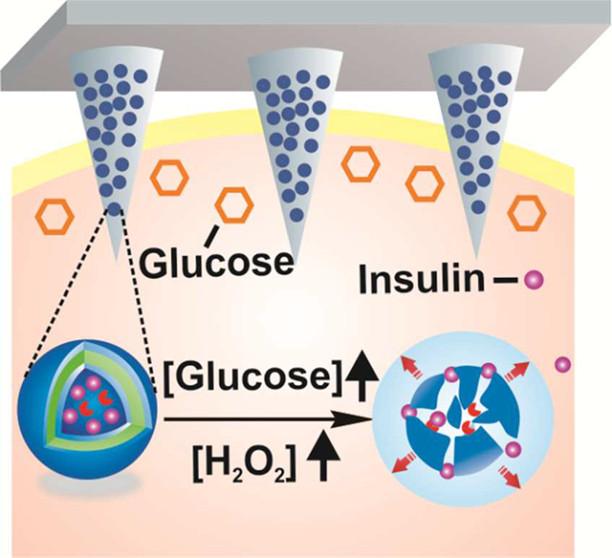
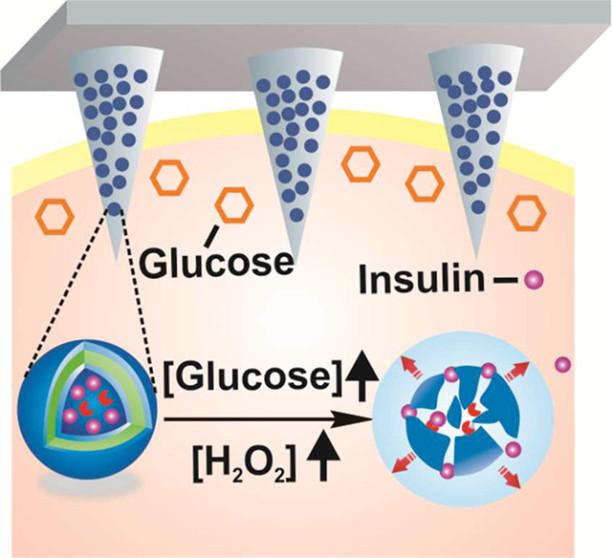
IMAGE

Credit: American Chemical Society

Treatment for certain diabetes cases involves constant monitoring of blood-glucose levels and daily insulin shots. But scientists are now developing a painless "smart" patch that monitors blood glucose and releases insulin when levels climb too high. The report on the device, which has been tested on mice, appears in the journal ACS Nano.

People with Type 1 diabetes don't make insulin — a hormone that regulates blood glucose, or sugar. Those with Type 2 diabetes can't use insulin effectively. Either way, glucose builds up in the blood, which can lead to a host of health problems, including heart disease, stroke, blindness and amputation of toes, feet or legs. To avoid these outcomes, people with Type 1 or advanced Type 2 diabetes regularly prick their fingers to measure blood-sugar levels, and some patients must inject themselves with insulin when needed. But sometimes, despite a person's vigilance, glucose levels can still get out of whack. Zhen Gu and colleagues wanted to come up with a simpler, more effective, shot-free way to manage diabetes.

The researchers developed a skin patch covered in painless microneedles that are loaded with tiny insulin-carrying pouches. The pouches are engineered to break apart rapidly and release the insulin in response to rising glucose levels. Diabetic mice wearing the patch maintained consistent concentrations of insulin in their blood. When these mice received a shot of glucose, their blood sugar levels spiked initially, but then fell to normal levels within two hours.

###

The authors acknowledge funding from the American Diabetes Association, National Institutes of Health and the National Science Foundation.

The abstract that accompanies this study is available here.

The American Chemical Society is a nonprofit organization chartered by the U.S. Congress. With nearly 157,000 members, ACS is the world's largest scientific society and a global leader in providing access to chemistry-related research through its multiple databases, peer-reviewed journals and scientific conferences. ACS does not conduct research, but publishes and publicizes peer-reviewed scientific studies. Its main offices are in Washington, D.C., and Columbus, Ohio.

To automatically receive news releases from the American Chemical Society, contact [email protected].

Follow us: Twitter | Facebook

Media Contact

Katie Cottingham
[email protected]
301-775-8455
@ACSpressroom

http://www.acs.org

############

Story Source: Materials provided by Scienmag

Share12Tweet8Share2ShareShareShare2

Related Posts

Full-Body Head-Up Tilt Sleep Aids Parkinson’s, MSA

May 19, 2026

Myelin Damage in Donor Skin Distinguishes Synucleinopathies

May 19, 2026

FGFR1, Not S6K1/2, Fuels BRAF Resistance

May 19, 2026

Fischer’s Blue Butterflies Less Attractive on Non-Native Diet, Study Finds

May 19, 2026
Please login to join discussion

POPULAR NEWS

  • Research Indicates Potential Connection Between Prenatal Medication Exposure and Elevated Autism Risk

    845 shares
    Share 338 Tweet 211
  • New Study Reveals Plants Can Detect the Sound of Rain

    731 shares
    Share 292 Tweet 182
  • Salmonella Haem Blocks Macrophages, Boosts Infection

    62 shares
    Share 25 Tweet 16
  • Breastmilk Balances E. coli and Beneficial Bacteria in Infant Gut Microbiomes

    58 shares
    Share 23 Tweet 15

About

We bring you the latest biotechnology news from best research centers and universities around the world. Check our website.

Follow us

Recent News

Full-Body Head-Up Tilt Sleep Aids Parkinson’s, MSA

Myelin Damage in Donor Skin Distinguishes Synucleinopathies

FGFR1, Not S6K1/2, Fuels BRAF Resistance

Subscribe to Blog via Email

Enter your email address to subscribe to this blog and receive notifications of new posts by email.

Join 82 other subscribers
  • Contact Us

Bioengineer.org © Copyright 2023 All Rights Reserved.

Welcome Back!

Login to your account below

Forgotten Password?

Retrieve your password

Please enter your username or email address to reset your password.

Log In
No Result
View All Result
  • Homepages
    • Home Page 1
    • Home Page 2
  • News
  • National
  • Business
  • Health
  • Lifestyle
  • Science

Bioengineer.org © Copyright 2023 All Rights Reserved.