Scientists distinguish between the brain activities of right-handers and left-handers by noninvasively monitoring asymmetric brain responses to passive touch stimulations
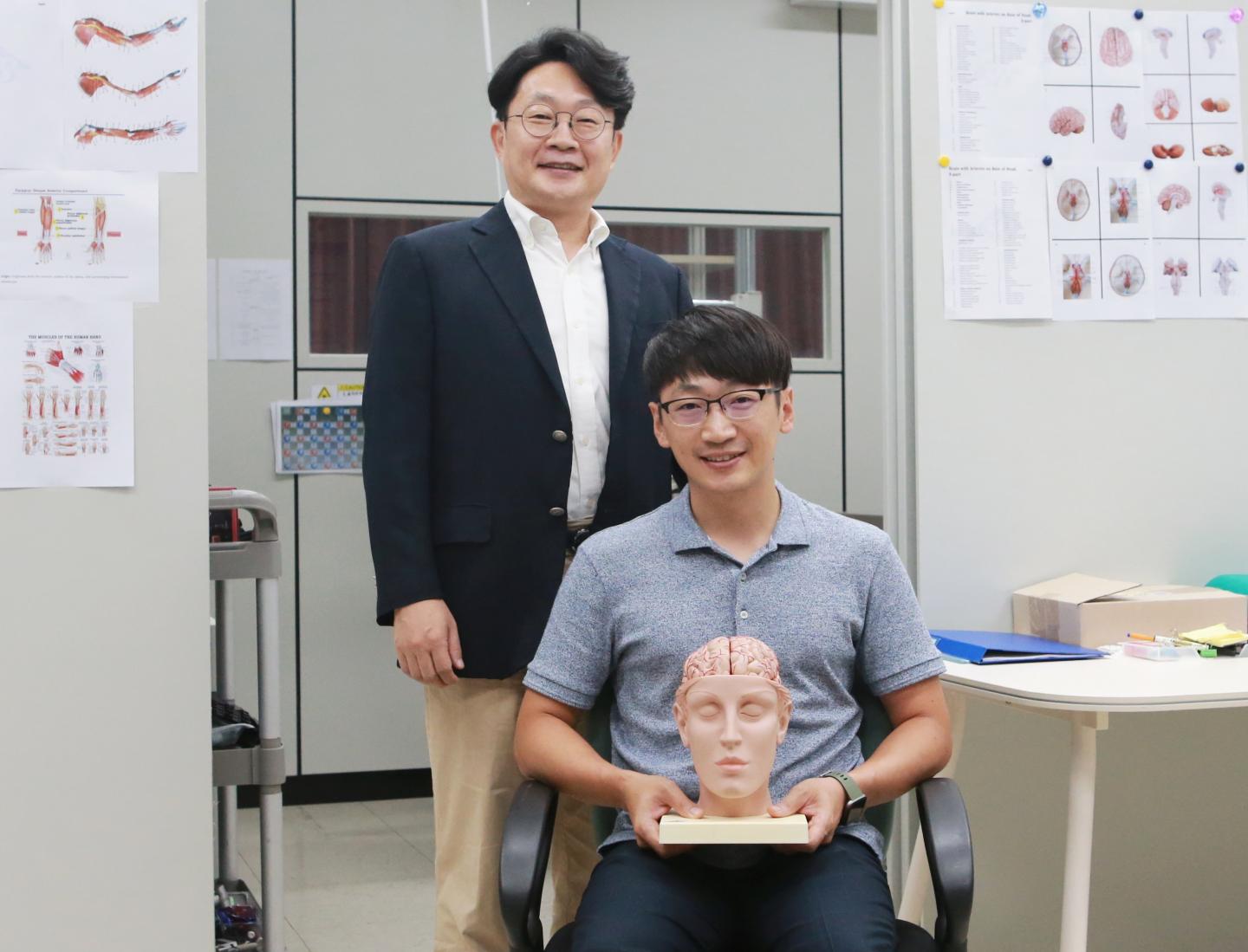
Credit: DGIST
Have you ever wondered whether the brains of right-handed people work differently from those of left-handers? Is it possible to distinguish between them by observing their brain activity in response to stimuli or tasks? These are important questions from the perspectives of both basic sciences and application-based fields such as brain-computer interfaces, rehabilitation robotics, and augmented reality.
Since the past few years, a team of scientists at Daegu Gyeongbuk Institute of Science and Technology (DGIST), Korea, has been actively conducting fundamental research to answer these questions. Led by Principal Scientist Dr Jinung An, their initial focus was on finding a method to objectively evaluate haptic devices, which provide tactile feedback simulating textures and surfaces, based on user responses at the brain level.
In a previous study, they had found that the brains of right-handers responded differently from those of left-handers when performing complicated manipulation tasks. In short, when a right-hander uses their preferred hand, specific areas within the left-brain hemisphere are activated. In contrast, when they use their left hand, a much larger area spanning both brain hemispheres is used. Surprisingly, this asymmetry was significantly more pronounced in right-handers than in left-handers.
In their latest study published in Scientific Reports, Dr An and his colleagues show that this asymmetry in right-handers was also evident during passive tactile stimulation of the fingers. They used a technique called functional near-infrared spectroscopy to noninvasively monitor changes in the oxygenation of red blood cells in the brain, which reflect its local activation patterns. Excited about the results, Dr An remarks, “We present the possibility of distinguishing left-handed and right-handed people using passive touch alone, which reveals functional cortical differences. Our outcomes can be immediately used to quantitatively evaluate hand preference and may also be useful for brain-computer interfaces that connect tactile displays to brain signals in augmented reality.”
These findings are also relevant for developing cognitive enhancement treatments for autism and brain-mimicking artificial intelligence. Additionally, this approach could be a turning point in haptics–the study of sensing through touch. “Although existing haptic research has mainly focused on the peripheral nervous system, I hope that our study will serve as the starting point for a paradigm shift involving central nervous system-oriented research,” concludes Dr An.
The outcomes of this study may truly have consequences left and right!
###
Reference
Authors: Sang Hyeon Jin1, Seung Hyun Lee2, Seung TaeYang3 and Jinung An1*
Title of original paper: Hemispheric asymmetry in hand preference of right?handers for passive vibrotactile perception: an fNIRS study
Journal: Scientific Reports
DOI: 10.1038/s41598-020-70496-y
Affiliations: 1Division of Intelligent Robot, DGIST
2Institute of Global Health Technology, College of Health Science, Korea University
3School of Mechanical Engineering, Chung-Ang University
*Corresponding author’s email: [email protected]
About Daegu Gyeongbuk Institute of Science and Technology (DGIST)
Daegu Gyeongbuk Institute of Science and Technology (DGIST) is a well-known and respected research institute located in Daegu, Republic of Korea. Established in 2004 by the Korean Government, the main aim of DGIST is to promote national science and technology, as well as to boost the local economy.
With a vision of “Changing the world through convergence”, DGIST has undertaken a wide range of research in various fields of science and technology. DGIST has embraced a multidisciplinary approach to research and undertaken intensive studies in some of today’s most vital fields. DGIST also has state-of-the-art-infrastructure to enable cutting-edge research in materials science, robotics, cognitive sciences, and communication engineering.
Website: https:/
About the author
Dr Jinung An is currently a Principal Scientist at DGIST and an Adjunct Professor in the Department of Biomedical Science and Engineering at GIST. He obtained a PhD in Robotics from KAIST in 2005 and was an Assistant Professor at Kwangwoon University from 2005 to 2008. He then joined DGIST, where he was Director of the Pragmatic Applied Robot Institute from 2009 to 2012 and of the Wellness Research Center from 2017 to 2018. His main research areas include neurohaptics, brain-computer interfaces, noninvasive brain stimulation, brain-driven artificial intelligence, and rehabilitation robotics.
Media Contact
Kwanghoon Choi
[email protected]
Original Source
https:/
Related Journal Article
http://dx.