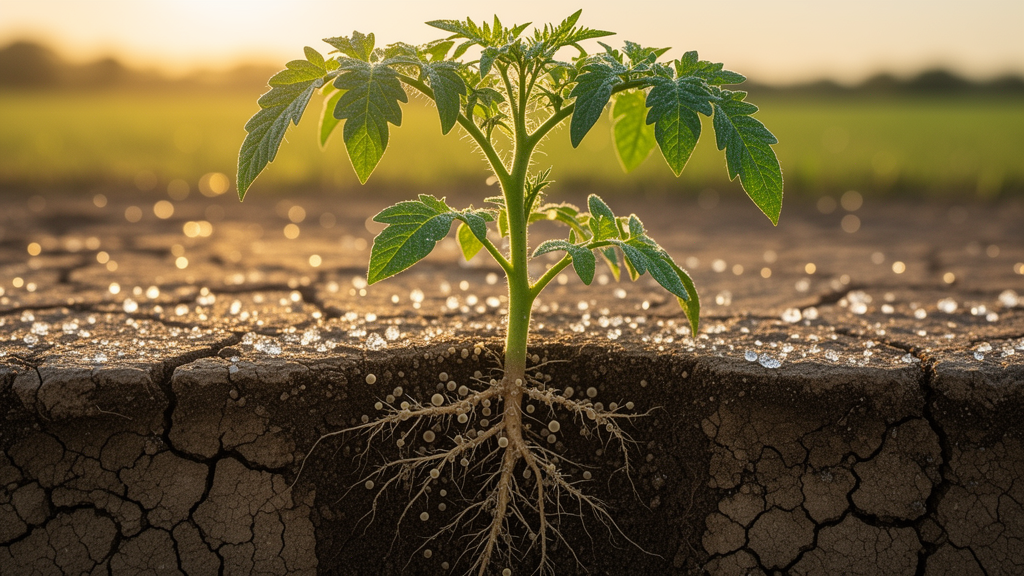
Tomato plants grown under salinity and drought selectively enrich distinct communities of stress-adapted bacteria in the rhizosphere, and a combined sequencing-and-cultivation strategy can recover many of these microbes as living isolates, according to a study published in Environmental Microbiome. The researchers used tomato plants as “biological traps” to recruit bacteria under control, salt-stress, and drought conditions, then profiled the resulting communities with 16S rRNA gene amplicon sequencing and cultured bacteria on selective media to test their taxonomic identity and plant growth-promoting traits.
The sequencing results showed that both stresses substantially reshaped the rhizosphere bacterial community. Treatment type explained 31 percent of the variation in community composition (PERMANOVA, R² = 0.31, p = 2 × 10⁻⁴). Pairwise comparisons confirmed significant differences between control and drought (R² = 0.27, p = 0.0070), control and salinity (R² = 0.21, p = 0.0082), and salinity and drought (R² = 0.26, p = 0.0082), indicating that the two stresses recruit overlapping but distinct microbial assemblages.
Among the discriminant genera, salinity-enriched taxa included Nitrosarchaeum, Nitrosospira, Phenylobacterium, and Hydrogenophaga, while drought-enriched taxa included Massilia, Paenarthrobacter, Pseudonocardia, and Rhodoplanes.
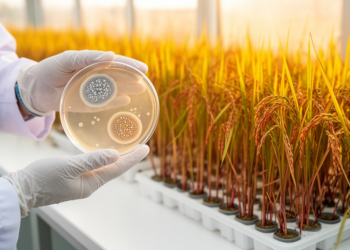
The cultivation arm of the study bridged the gap between community profiles and usable strains. Selective media yielded 127 bacterial isolates, which were grouped into 83 distinct ARDRA profiles. One representative of each profile was then identified by 16S rRNA gene sequencing, revealing 20 bacterial genera in the collection. Notably, several of the recovered genera mirrored the stress-enriched taxa seen in the sequencing data, including Arthrobacter, Paenarthrobacter, and Streptomyces under salinity, and Massilia, Microbacterium, and Lysinibacillus under drought.
Many of the isolates carried multiple plant growth-promoting traits measured in vitro. These included nutrient-solubilizing activities, production of indole-3-acetic acid (IAA) and siderophores, ACC deaminase activity, nitrogen fixation potential, and sulfur oxidation. Such traits are commonly associated with mechanisms that could, in principle, help plants acquire nutrients or modulate stress responses, but the authors emphasize that these were laboratory assays on the bacteria themselves, not tests of plant performance.
The study’s framing is deliberately cautious about what the collection can and cannot do. The authors describe the work as demonstrating that plant-mediated recruitment under abiotic stress can serve as a targeted bioprospecting strategy to recover candidate stress-associated culturable bacteria with in vitro plant growth-promoting traits. The isolates are presented as candidates for subsequent functional validation and potential development as bioinoculants for crops exposed to salinity and drought — a pipeline stage, not a proven inoculant technology.
That distinction matters for interpreting the findings. Soil salinity and drought are major environmental constraints that increasingly threaten agricultural productivity by altering plant performance and rhizosphere microbial communities, and exploiting plant-mediated microbial recruitment under stress may offer an effective way to identify beneficial microorganisms already adapted to adverse conditions. Because the bacteria were recovered from the tomato rhizosphere under the very stresses of interest, they are, by construction, survivors of those conditions — but whether they actually improve tomato or other crop performance when reapplied as inoculants remains to be tested.
Methodologically, the combined approach has clear strengths. The ARDRA grouping step reduced 127 isolates to 83 representative profiles before full sequencing, an efficient way to capture diversity without redundant identification of near-identical strains.
The result is a curated collection weighted toward genera that the sequencing data independently flagged as stress-responsive, providing a shortlist of candidates whose stress association is supported by two independent lines of evidence.
For agricultural microbiology, the work offers a replicable framework: grow a target crop under the stress of interest, sequence the recruited rhizosphere community to identify enriched taxa, and culture representatives of those taxa for trait screening. The next steps, according to the authors, are functional validation of the candidates and, ultimately, evaluation as bioinoculants for crops facing salinity and drought — validation that will determine whether the stress-adapted bacteria recovered here can translate from in vitro traits into field-relevant benefits.
Subject of Research: Plant-mediated recruitment of stress-adapted rhizobacteria in tomato under salinity and drought
Article Title: Tomato-mediated enrichment of stress-adapted rhizobacteria under salinity and drought: a combined microbiome and cultivation-based approach
Article References: Chaudhry, A., Alzate Zuluaga, M. Y., Monterisi, S., Cesco, S., & Pii, Y. (2026). Tomato-mediated enrichment of stress-adapted rhizobacteria under salinity and drought: a combined microbiome and cultivation-based approach. Environmental Microbiome. https://doi.org/10.1186/s40793-026-00970-z
Image Credits: AI Generated
DOI: 10.1186/s40793-026-00970-z
Keywords: tomato, rhizosphere, salinity, drought, 16S rRNA sequencing, plant growth-promoting bacteria, bioprospecting, microbiome, ARDRA, bioinoculants, abiotic stress, Tomato-mediated
News Source: Morgan Morrow. (October 29, 2026). Tomato Plants Enlist Stress-Adapted Root Bacteria Under Salinity and Drought. Scienmag.