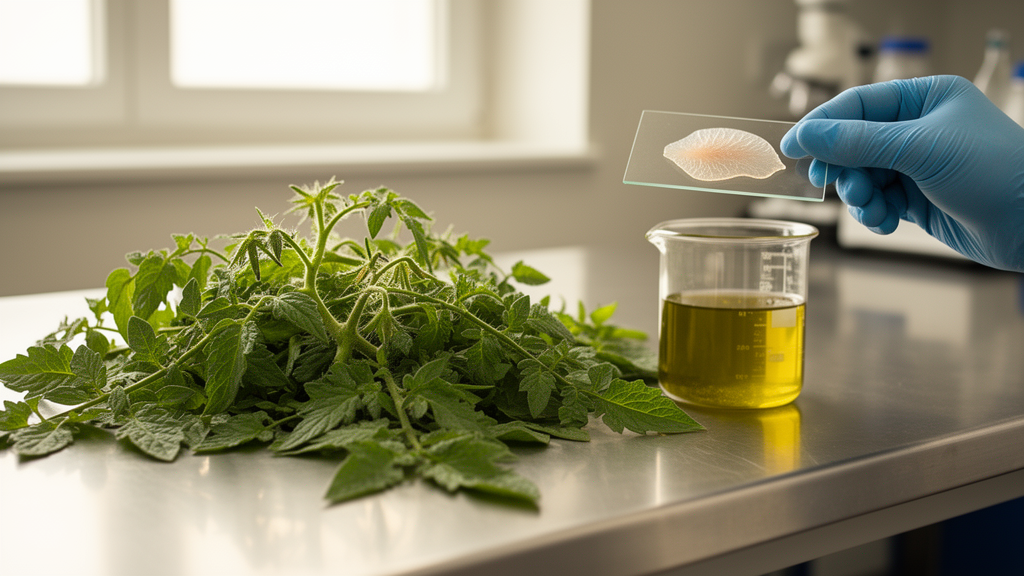
Farmers growing the Vesuvian Piennolo cherry tomato, an ancient variety protected by a European Union designation of origin, harvest the fruit and typically discard the leafy biomass that remains on the plants. A new study argues that this agricultural residue is anything but waste. Researchers report that leaves from ‘Principe Borghese’ Piennolo plants, collected after fruit harvesting from three certified farms in the Vesuvian area of Campania, Italy, can be processed with a mild, food-grade extraction into a rutin-enriched extract whose antiglycation activity and skin distribution they characterized in laboratory and ex vivo models.
The team’s target molecule, rutin, is quercetin-3-O-rutinoside, a flavonol glycoside already known from comparative studies to show marked antiglycation activity, partly through its ability to trap reactive dicarbonyl intermediates such as methylglyoxal. Those dicarbonyls matter because they are key precursors of advanced glycation end products, or AGEs, the heterogeneous group of irreversible compounds formed when reducing sugars react non-enzymatically with proteins, lipids, and nucleic acids. AGEs accumulate progressively in tissues because of their chemical stability and resistance to enzymatic degradation, and their effects run through two main channels: direct cross-linking of extracellular matrix proteins and interaction with the receptor for advanced glycation end products, which triggers signalling that promotes oxidative stress, inflammation, and fibrosis.
Skin is a particularly vulnerable target. Structural proteins such as collagen and elastin have long half-lives, giving sugar-derived cross-links time to build up. Cutaneous AGE accumulation has been closely associated with both intrinsic and extrinsic skin ageing and with dermatological complications of metabolic disorders, notably impaired wound healing in diabetic patients. In the epidermis, AGEs can impair keratinocyte proliferation and differentiation, weakening the skin barrier; in the dermis, glycation-induced cross-linking of collagen and elastin reduces tissue elasticity and mechanical resilience, contributing to wrinkle formation and loss of firmness. That mechanistic backdrop is what makes a rutin-rich plant extract interesting for topical research, although the new study stops well short of demonstrating any clinical benefit.
To obtain the extract, the researchers turned to response surface methodology, a statistical framework that maps how multiple experimental variables jointly influence an outcome and identifies the conditions that optimize it. In a preliminary three-factor design spanning 36 experimental conditions, they varied ethanol concentration from 0 to 40 percent, extraction time from 10 to 80 minutes, and temperature from 25 to 45 degrees Celsius, with rutin yield in milligrams per gram of dry weight as the response. The analysis showed that solvent composition exerted the strongest influence on yield, followed by extraction time, while temperature had no statistically significant main effect within the narrow range tested. Significant quadratic effects for solvent composition and time confirmed a nonlinear relationship, and the temperature-by-solvent interaction reached significance even though temperature alone did not move the needle.
With temperature fixed at the mild intermediate value of 35 degrees Celsius, a second-stage model focused on solvent composition and time. The final second-order polynomial model was highly significant and explained 90.62 percent of the variance in rutin yield, with a predicted R-squared of 86.71 percent. Response optimization pointed to 34.9 percent ethanol, rounded to 35 percent for practical use, and an extraction time of 70.8 minutes, predicting a yield of 8.45 milligrams of rutin per gram of dry leaf. Three independent confirmation extractions delivered 8.22 plus or minus 0.01 milligrams per gram, an absolute prediction error of roughly three percent. The authors note that a recent microwave-assisted study on tomato axillary shoots reached a comparable 8.61 milligrams per gram, but only at 550 watts with temperatures of 70 to 125 degrees Celsius and 50 to 100 percent ethanol; the new conventional process achieves similar recovery under considerably milder conditions, though the authors caution that larger-scale validation is still needed to assess industrial applicability.
Chemical profiling of the optimized extract, designated OPTL, combined HPLC-DAD quantification with HPLC-HESI-MS/MS identification, yielding 24 compounds in total, 13 of them confirmed against analytical standards. Flavonols dominated the profile. Rutin itself measured 8.22 milligrams per gram of dry weight, essentially matching the extraction yield, followed closely by kaempferol-3-O-glucoside at 8.16 and quercetin-3-O-glucoside at 5.05, with quercetin O-xylosyl-rutinoside, quercetin-3-O-galactoside, and free quercetin trailing behind. Among the phenolic acids, chlorogenic acid led at 9.35 milligrams per gram, ahead of gallic acid at 4.55 and neochlorogenic acid at 4.20. The authors attribute the distinctive flavonol pattern partly to the cultivar’s growing conditions: semi-arid Mediterranean climate on well-drained volcanic soils, which imposes moderate, recurrent abiotic stress that may stimulate the phenylpropanoid pathway and promote flavonol accumulation in leaves.
Functional testing followed two tracks. In cell-free DPPH and ABTS radical-scavenging assays, the extract showed concentration-dependent activity, with an IC50 of 0.981 milligrams per millilitre in DPPH and 1.36 milligrams per millilitre in ABTS. The authors frame this as a complementary chemical property rather than a biological effect, noting that reactive oxygen species can promote glycoxidation and the oxidative degradation of Amadori products, increasing the generation of dicarbonyl AGE precursors. In the more directly relevant test, a bovine serum albumin model with glucose and fructose incubated for seven days at 37 degrees Celsius, the OPTL extract inhibited fluorescent AGE formation in a concentration-dependent manner with an IC50 of 3.62 milligrams per millilitre. Pure rutin, used as the reference standard, was far more potent at 0.126 milligrams per millilitre, consistent with published work showing that rutin can reduce residual methylglyoxal to 6.4 percent after 24 hours by forming stable mono- and di-MGO adducts at its flavonol A-ring.
The most visually striking part of the study is the ex vivo skin experiment. Using porcine ear skin mounted in Franz diffusion cells, the team applied the OPTL extract at 250 micrograms per millilitre, corresponding to a rutin concentration of 2.8 micrograms per millilitre, and tracked the molecule across donor, epidermal, dermal, and receptor compartments at one, four, and eight hours, with three cells per time point plus three untreated blanks. Rutin accumulated in both skin layers at every time point. After one hour, the epidermis held 173.24 nanograms per square centimetre and the dermis 106.01. At four hours, dermal rutin peaked at 482.69 nanograms per square centimetre, about 17.10 percent of the applied dose, while epidermal levels stayed comparatively stable. By eight hours, dermal content had fallen to 285.32 nanograms per square centimetre and epidermal content had edged up to 242.12. Meanwhile the donor compartment retained roughly 63 to 75 percent of the applied rutin across the time points, and the receptor fluid stayed below the limit of quantification until the eight-hour mark.
A linear mixed-effects analysis confirmed that distribution depended strongly on compartment: the donor held significantly more rutin than either skin layer at all time points, and at eight hours it also exceeded the receptor fluid, while epidermal and dermal values did not differ significantly from each other. The authors interpret this as a preferential skin-retention profile rather than a failure, arguing that dermal localization places rutin in the collagen-rich extracellular compartment that glycation targets most directly. The behaviour also fits rutin’s physicochemistry: at roughly 610.5 daltons and with low lipophilicity, the molecule sits above the empirical size threshold generally associated with efficient passive skin permeation. Comparable retention patterns have been reported for other rutin-containing botanical extracts in membrane and porcine skin models, including a Prunus cerasifera leaf extract cream that left rutin undetected in the receptor compartment after eight hours.
The researchers are careful about what the study does and does not establish. This is a proof-of-concept built on in vitro chemistry and an ex vivo diffusion model, not evidence of efficacy in human skin. No safety assessment of the extract was performed; tomato-leaf glycoalkaloids and pesticide residues were not investigated, and the safety, compatibility, and stability of the extract in a finished topical formulation remain open questions. The authors also acknowledge that fluorescence-based glycation assays are vulnerable to inner-filter effects that were not separately quantified, so the IC50 values should be read with that caveat. Next steps they identify include testing human dermal fibroblasts under glycation-inducing conditions to confirm the cell-free findings, further work to verify biological efficacy within skin tissues, and pilot-scale validation of the extraction process together with batch-to-batch standardization. If those hurdles are cleared, the broader payoff may extend beyond cosmetics: giving functional value to the by-products of minor traditional cultivars could, the authors suggest, help sustain the cultivation and preservation of local agrobiodiversity in the Mediterranean.
Subject of Research: Extraction optimization, antiglycation activity, and ex vivo skin distribution of rutin from Vesuvian Piennolo tomato leaf by-products
Article Title: Sustainable valorization of Piennolo tomato leaves ( Solanum lycopersicum L.) as a source of rutin: extraction optimization, antiglycation activity, and ex vivo skin distribution
Article References: Piccolo, V., Di Lorenzo, R., De Vivo, M., Marzocchi, A., Ricci, L., Laneri, S., Summa, V., Tenore, G. C., & Maisto, M. (2026). Sustainable valorization of Piennolo tomato leaves (Solanum lycopersicum L.) as a source of rutin: extraction optimization, antiglycation activity, and ex vivo skin distribution. Food Chemistry: X, 40, Article 104687. https://doi.org/10.1016/j.fochx.2026.104687
Image Credits: AI Generated
DOI: 10.1016/j.fochx.2026.104687
Keywords: rutin, Piennolo tomato, tomato leaves, advanced glycation end products, response surface methodology, HPLC-DAD, HPLC-MS/MS, Franz diffusion cells, skin ageing, agro-industrial by-products, polyphenols, antiglycation activity
News Source: Bethany Barker. (October 28, 2026). Tomato leaves discarded after harvest yield rutin-rich extract that lingers in skin layers. Scienmag.