A recent study by researchers from China, the UK and the Netherlands indicates habitat loss may impact the diversity of bees more than increased pesticide exposure.
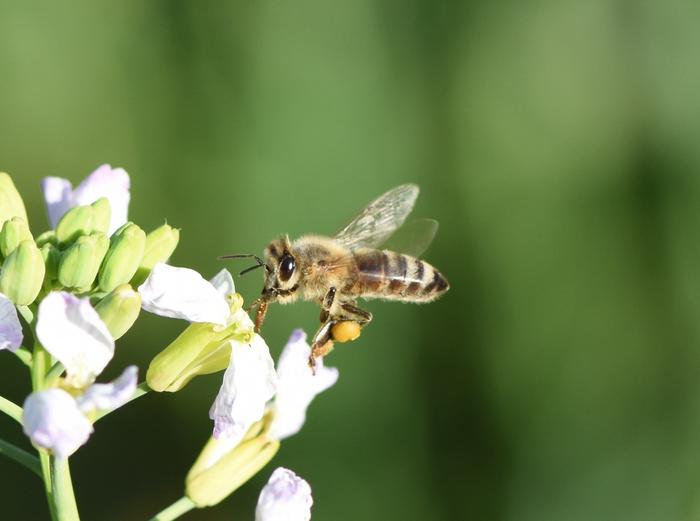
Credit: Changsheng Ma
A recent study by researchers from China, the UK and the Netherlands indicates habitat loss may impact the diversity of bees more than increased pesticide exposure.
Worldwide, hedgerows and wild grass in field margins which previously served as semi-natural habitats are being swallowed up into agricultural production. While scientists have suggested both pesticide use and habitat loss are detrimental to pollinators, their relative impacts have been unclear.
A recent study published in the Journal of Applied Ecology offers insight. Its findings indicate semi-natural habitats play a more important role than pesticide use in rice fields, in efforts to stem the decline in pollinator diversity.
The researchers studied honeybees (Apis mellifera) and a mason bee (Osmia excavata) across 20 rice fields within the Yangtze River Valley in China.
Dr Yi Zou, an associate professor at Xi’an Jiaotong-Liverpool University (XJTLU), China, who co-led the team, says: “Non-crop habitats are important for pollinators in agricultural fields as these provide essential resources and nesting sites.
“Although the impact of pesticides cannot be ignored in efforts to reduce the decline in pollinator diversity, our results suggest it would be better to concentrate on conservation of semi-natural habitat than on reduction of pesticide use in rice fields.”
One of the resources these habitats provide is food, says Dr XiaoYu Shi, the study’s first author and a postdoctoral researcher at the Chinese Academy of Sciences, China.
“Our study shows that in regions with a lower percentage of rice fields and more semi-natural habitat, there was more food available for female mason bees to feed their larvae with,” he says.
The team believes this is the first study to include O.excavata, a native species of China, as an indicator of pesticide levels and food acquisition in an agricultural landscape. This species is used commercially in orchard pollination.
Dr Zou says: “Pollinator diversity in Chinese small-holder agricultural ecosystems is very high, likely due to the diverse and complex landscape. Therefore, conserving semi-natural habitats in these agricultural systems is crucial.
“However, the impact of pesticides is still an important consideration. We found honey bees have a higher pesticide exposure risk in more intensified rice field,” Dr Zou says.
“Many aspects remain poorly understood. We need long-term monitoring of pollinator populations and their exposure to pesticides to better inform conservation efforts.”
About the researchers:
Dr XiaoYu Shi completed his PhD under the guidance of Dr Yi Zou, an associate professor at Xi’an Jiaotong-Liverpool University (XJTLU), China, and Dr Jenny Hodgson from the University of Liverpool, UK. Dr Shi is now a postdoctoral researcher at the Chinese Academy of Sciences, China.
Dr Yi Zou, an associate professor at Xi’an Jiaotong-Liverpool University (XJTLU), China, is an ecologist and entomologist studying conservation biology, landscape ecology and ecosystem services in agricultural and forest ecosystems. His research interests also include how to effectively measure biodiversity at different dimensions by model simulation and empirical studies.
Journal
Journal of Applied Ecology
DOI
10.1111/1365-2664.14701
Method of Research
Experimental study
Subject of Research
Animals
Article Title
Influence ofagricultural intensification on pollinator pesticide exposure,food acquisition and diversity
Article Publication Date
4-Jul-2024
COI Statement
The authors declare no conflict of interest. Yi Zou is an Associate Editor of Journal of Applied Ecology but took no part in the peer review and decision-making processes for this paper.