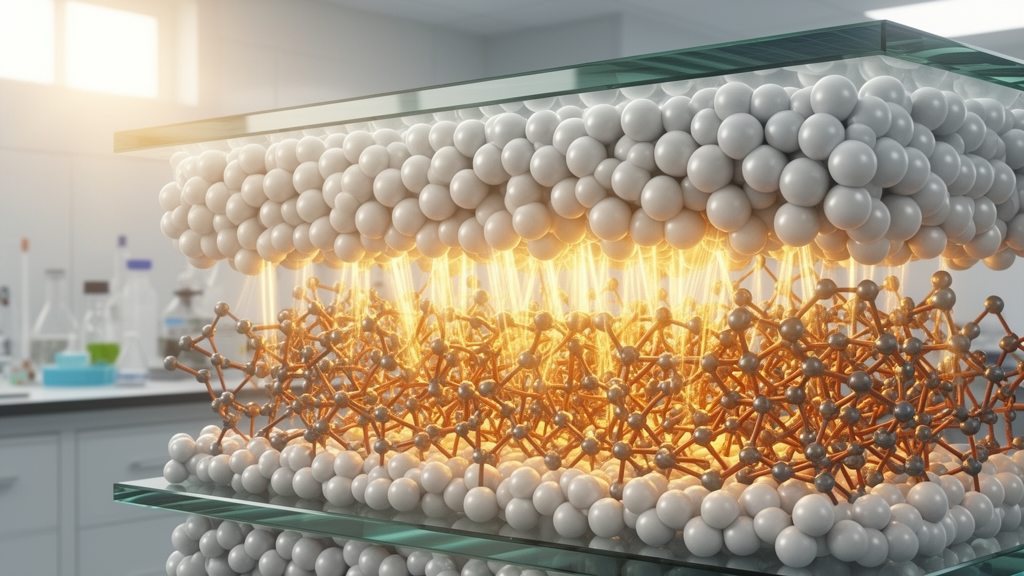
Researchers report that a top layer of hydrothermally synthesized titanium dioxide (TiO2) microspheres can act as an effective light-scattering layer in bilayer photoanodes for dye-sensitized solar cells (DSSCs), raising both photocurrent and overall power conversion efficiency compared with conventional single-layer electrodes. In the study, published as an open-access article in Scientific Reports, the microsphere layer redirects photons that the cell has not absorbed on the first pass back into the photoanode, giving the sensitizing dye a second chance to capture them.
The bilayer design combines two structurally different TiO2 materials with complementary roles. The bottom layer uses commercial TiO2 nanoparticles (P25), which the authors describe as ensuring improved dye uptake and efficient electron transport, while the overlying microsphere layer serves as the light-scattering element. The team characterized the synthesized TiO2 microspheres before integrating them as the scattering layer and then evaluated complete cells sensitized with four ruthenium-based dyes: N3, N719, 520 DN, and Black dye.
The measured performance gains were consistent across the dye series, with elevated short-circuit current density (Jsc) and overall power conversion efficiency (η) relative to single-layer reference electrodes. Incident photon-to-current conversion efficiency (IPCE) spectra agreed with the current-density improvements, supporting the interpretation that the microsphere scattering layer enhances light harvesting rather than producing an artifact. The best results came from the bilayer photoanode sensitized with N3 dye, which delivered a short-circuit current density of 4.308 mA/cm2, a power conversion efficiency of 1.59 percent, and a mean electron lifetime of 43.53 milliseconds.
The electron-lifetime measurement is notable because DSSC performance is often limited by two linked problems: incomplete light harvesting and recombination losses, in which photogenerated electrons recombine before being collected. The authors frame the microsphere scattering layer as addressing the first of these, while the P25 underlayer addresses charge transport and dye loading. A longer mean electron lifetime in the N3-based bilayer cell suggests that recombination was not accelerated by the added layer, although the abstract does not report comparative lifetime values for the other dyes or for single-layer controls.
DSSCs attract attention for both indoor and outdoor light-harvesting applications, and the authors state that the results demonstrate the potential of TiO2 microspheres to enhance light harvesting in these devices. They also suggest that the microsphere-based scattering approach may be explored for future transparent dye-sensitized solar cell (T-DSSC) applications, where managing how light passes through and within the photoanode is particularly important. The findings come from a single laboratory study of hydrothermally synthesized microspheres under the dye and cell configurations tested, so broader performance claims would require further validation. Within that scope, the work adds a comparatively simple structural strategy—layering a scattering layer of larger microspheres over a nanoparticle charge-transport layer—that measurably improved photocurrent and efficiency in the tested devices.
Subject of Research: TiO2 microsphere scattering layers in bilayer photoanodes for dye-sensitized solar cells
Article Title: TiO2 nanocrystalline microspheres as an effective scattering layer in bilayer photoanodes for DSSCs
Article References: More, P. B., Mujawar, A., Salunke, S., Kim, J. M., Bulakhe, R. N., & Pathan, H. M. (2026). TiO2 nanocrystalline microspheres as an effective scattering layer in bilayer photoanodes for DSSCs. Scientific Reports. https://doi.org/10.1038/s41598-026-76770-9
Image Credits: AI Generated
DOI: 10.1038/s41598-026-76770-9
Keywords: TiO2, nanocrystalline, microspheres, effective, scattering, layer, bilayer, photoanodes, DSSCs, scientific research
News Source: Denise Maddox. (October 26, 2026). Titanium Dioxide Microsphere Scattering Layer Boosts Dye-Sensitized Solar Cell Efficiency. Scienmag.