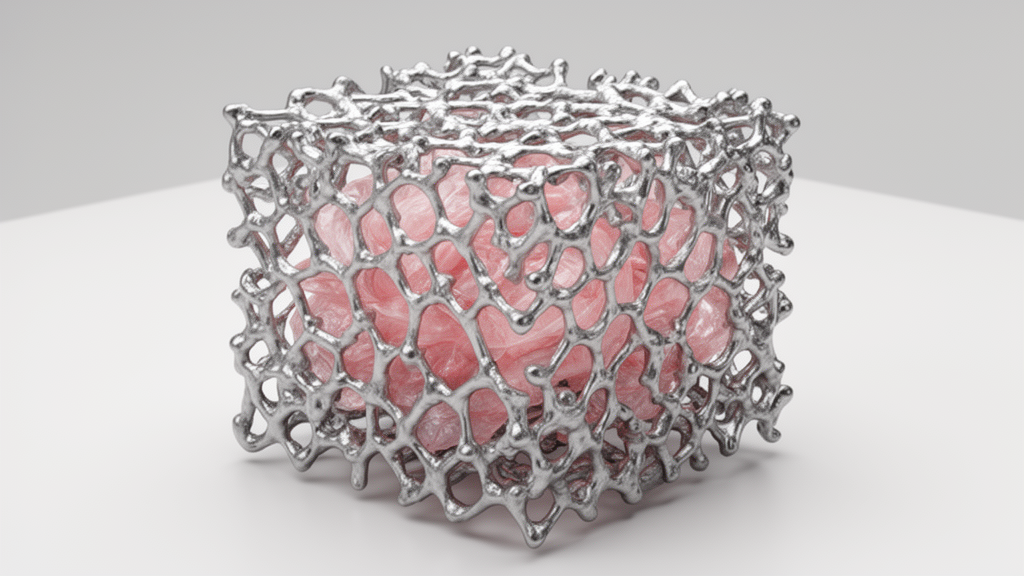
Researchers have developed a method to create three-dimensional titanium-spongin composites by metallizing naturally structured marine sponge scaffolds. Published in Discover Materials, the study demonstrates that purified spongin from Hippospongia communis sponges can be functionalized with titanium and subsequently carbonized without losing their native porous architecture. This approach offers a sustainable platform for bioinspired functional scaffolds intended for tissue engineering applications, specifically targeting bone-relevant in vitro models.
The study, led by Igor Smirnov and colleagues, utilized ion-plasma vacuum arc deposition to apply a titanium layer to the spongin scaffolds. This process introduced an alpha-titanium nanostructured surface layer while preserving the hierarchical, open-cell structure of the natural biomaterial. Following metallization, the composites underwent high-temperature carbonization at 1,200 degrees Celsius. This step resulted in the formation of turbostratic carbon and crystalline titanium carbide and oxycarbide phases, as confirmed through multiple spectroscopic and microscopic techniques.
The research team employed several advanced characterization methods to verify the structural and chemical changes in the composites. High-resolution transmission electron microscopy (HRTEM), X-ray diffraction (XRD), and Raman spectroscopy provided detailed insights into the crystalline phases and carbon structures formed during carbonization. These analyses confirmed that the metallization process did not compromise the structural integrity of the spongin scaffolds.
To assess the biological compatibility of the new materials, the researchers evaluated the response of MG-63 osteoblast-like cells. This cell line was selected to provide a bone-relevant in vitro model for studying cell-material interactions on titanium-containing spongin-based scaffolds. The evaluation included indirect cytocompatibility screening, Live/Dead confocal microscopy, WST-1 metabolic activity analysis, and protein-normalized alkaline phosphatase (ALP)-associated activity. Additionally, immunofluorescence staining was performed to detect osteoblast- and adhesion-associated markers, including RUNX2, osteopontin (OPN), and focal adhesion kinase (FAK).
The results indicated that the titanium-spongin (Ti-Spg) and carbonized titanium-spongin (C-Ti-Spg) scaffolds demonstrated enhanced cell coverage after seven days of culture compared to native spongin. By day 14, the C-Ti-Spg scaffolds exhibited the highest protein-normalized ALP-associated activity. This composite also showed the most extensive immunostaining pattern for RUNX2, OPN, and FAK, suggesting enhanced osteoblast-related activity and stronger adhesion and matrix-associated cell-scaffold interactions under basal culture conditions.
Complementary metabolic readouts from WST-1 assays and FDA/PI confocal imaging did not indicate material-induced cytotoxicity. However, the researchers noted that WST-1 data should be interpreted as relative metabolic indicators. Colorimetric assays in three-dimensional porous scaffolds can be influenced by reagent diffusion and scaffold architecture, which may affect the accuracy of metabolic measurements.
The study concludes that naturally prefabricated 3D spongin scaffolds can be successfully metallized with titanium and converted into titanium carbide-containing carbonized composites without loss of structural integrity or cytocompatibility. The combination of preserved hierarchical architecture with titanium-based surface chemistry provides a sustainable platform for further development of bioinspired functional scaffolds. This work represents the first instance of purified spongin scaffolds being functionalized via ion-plasma vacuum arc deposition of titanium followed by high-temperature carbonization.
Subject of Research: Creation and functionalization of 3D titanium-spongin composites for tissue engineering
Article Title: Creation and functionalization of 3D titanium–spongin composites
Article References: Smirnov, I., Petrov, S., Sieliverstov, I., Litowczenko, J., Simon, P., Przymuszała, M., Flont, A., Springer, A., Szczurek, A., Galli, R., Leśniewski, B., Souiba, Z., Jesionowski, T., & Ehrlich, H. (2026). Creation and functionalization of 3D titanium–spongin composites. Discover Materials. https://doi.org/10.1007/s43939-026-01066-8
Image Credits: AI Generated
DOI: 10.1007/s43939-026-01066-8
Keywords: titanium-spongin composites, tissue engineering, marine sponges, biomaterials, osteoblasts, ion-plasma deposition, carbonization, scaffolds, bone regeneration, Discover Materials, Creation, functionalization
News Source: Denise Maddox. (November 8, 2026). Titanium-Coated Sponge Scaffolds Show Promise for Bone Tissue Engineering. Scienmag.