The seagrass beds and coral reefs surrounding the Japanese sub-tropical islands of Okinawa are some of the most biodiverse ecosystems on the planet. Home to more than 360 species of coral alone, these beautiful yet fragile underwater groves provide the habitat for countless species of animals. Now, researchers from Okinawa Institute of Science and Technology (OIST), as well as other universities in Japan and Australia, have made headway in cataloging this abundance of life by describing two new species of pygmy squid – the Ryukyuan Pygmy Squid (scientific name Idiosepius kijimuna, Ryukyu-himeika1 in Japanese) and Hannan’s Pygmy Squid (Kodama jujutsu, Tsuno-himeika).
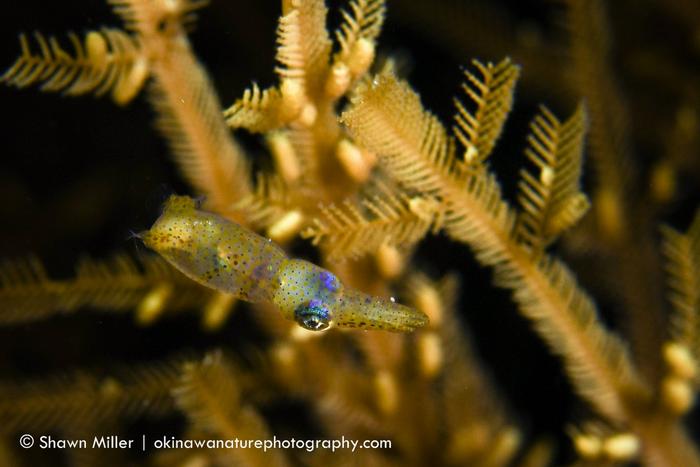
Credit: Shawn Miller
The seagrass beds and coral reefs surrounding the Japanese sub-tropical islands of Okinawa are some of the most biodiverse ecosystems on the planet. Home to more than 360 species of coral alone, these beautiful yet fragile underwater groves provide the habitat for countless species of animals. Now, researchers from Okinawa Institute of Science and Technology (OIST), as well as other universities in Japan and Australia, have made headway in cataloging this abundance of life by describing two new species of pygmy squid – the Ryukyuan Pygmy Squid (scientific name Idiosepius kijimuna, Ryukyu-himeika1 in Japanese) and Hannan’s Pygmy Squid (Kodama jujutsu, Tsuno-himeika).
Feisty forest fey
The scientific names of the two new species take inspiration from Japanese folklore, owing to their appearance and behavior. The Ryukyuan Pygmy Squid, Idiosepius kijimuna, is named after the short, red-haired forest fairies that are said to live in the banyan trees of Okinawa. Like their namesake, the squids are tiny, feature red coloration and spend most of their time in their forest habitat, attached to vegetation in shallow seagrass beds close to the coast.
Hannan’s Pygmy Squid, Kodama jujutsu, is a newly discovered species within a whole new genus. The Kodama genus is named after the round-headed spirits that supposedly live in ancient trees, whose presence indicate a healthy forest.
The perhaps unusual species name of jujutsu alludes to the preying behavior of the squid, which resembles the Japanese martial art: “Jiu-jitsu revolves around grappling and using your opponent’s strength, and the Kodama jujutsu preys on shrimp larger than itself by grappling with its small arms”, says Jeffrey Jolly from the Marine Climate Change Unit at OIST, who co-authored the paper detailing the discovery of the two species in the Journal Marine Biology. The squid has also been observed with its arms raised and curled above its head, reminiscent of a martial arts pose.
Needles in a haystack
Finding the squids was no easy feat. Both species live up to their names, as they truly are miniscule – the largest specimen examined measured just 12 millimeters in length, shorter than a sewing needle.
Adding to this, both species are only active at night, and the Ryukyuan only appears in winter. Even then, this species has been caught and (incorrectly) identified many times before, being found in the relatively accessible, shallow seagrass beds. This is in contrast to the more elusive Hannan’s, which is only found in coral reefs, where, as Jeffrey Jolly puts it, “there are so many other things to look at, that finding a small squid the size of a pinky fingernail is not easy”, even for experienced ocean photographers.
The discovery and documentation of the two species was made possible through collaboration between scientists and underwater photographers. Jeffrey Jolly initially began his work on cataloging the species in the Molecular Genetics Unit at OIST, and the project spanned researchers from both units, as well as from Australian universities.
It is especially the work of underwater photographers and naturalists Shawn Miller, Keishu Asada, and Brandon Ryan Hannan, who Kodama jujutsu takes its common name after, that made the research possible, as their photos kickstarted the initial interest in cataloging the species.
Ecologies under threat
Like their mythical namesakes, these pygmy squids are intimately connected with their natural environments in the emerald waters of Okinawa. These habitats are, unfortunately, under threat from human activity, especially due to climate change heating up the ocean waters, which may cause coral bleaching. Overfishing, land reclamation, and soil runoff also threaten the underwater homes of the critters, no matter how large or miniscule they may be.
For Jeffrey Jolly, this is one of the many reasons why the science of taxonomy remains important: “Taxonomy is not as flashy as other sciences, but through naming and characterizing species, it both highlights the amazing diversity of life in the oceans, and it is a reminder that there is so much that we don’t know yet.”
Journal
Marine Biology
DOI
10.1007/s00227-023-04305-1
Article Title
Two new pygmy squids, Idiosepius kijimuna n. sp. and Kodama jujutsu n. gen., n. sp. (Cephalopoda: Idiosepiidae) from the Ryukyu Islands, Japan
Article Publication Date
21-Oct-2023