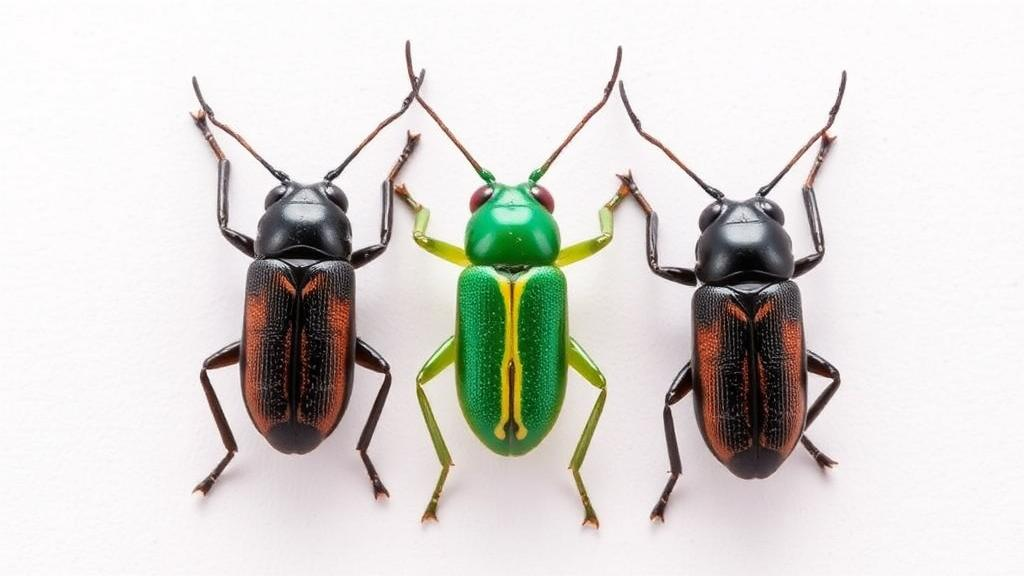
Deep in the leaf litter and decomposing wood of the Neotropics lives a group of beetles so small that most people will never notice them, yet a new taxonomic revision has just reshaped what scientists know about their diversity and distribution. In a study published in the journal Evolutionary Systematics, researchers re-examined the paederine rove beetle genus Lypeticus Sharp, 1886 and reached a striking conclusion: a genus described more than a century ago, Leiporaphes Bernhauer, 1912, does not deserve recognition at all. Instead, it is sunk into synonymy with Lypeticus, and its single species is transferred as the new combination Lypeticus attarum. The same revision describes three species entirely new to science, reports the first records of the genus from Bolivia, Costa Rica, Mexico, and Paraguay, and provides the modern diagnostic toolkit needed to identify these cryptic beetles.
The story begins in the nineteenth century. David Sharp established Lypeticus in 1886 and placed it between the genera Orus and Neomedon, initially including two species: L. celatus from Guatemala and L. mundus, originally described in 1876 as Lithocharis munda from the Tapajós basin in Brazil. For decades the genus remained obscure, with confirmed records from only Brazil, Guatemala, and possibly Colombia. In 1912, Max Bernhauer described Leiporaphes attarum from Argentina as a separate taxon, notably without ever comparing his new genus with Lypeticus in the original description. That historical oversight proved consequential. According to the revision, the apparent absence of the gular suture—the paired lines on the underside of the head—was the feature on which Bernhauer particularly relied, and it turned out to be an artifact of misinterpretation rather than a genuine distinguishing character.
When the authors examined the type specimen of Leiporaphes attarum, they found clearly separated gular sutures, immediately undermining the original diagnosis. More importantly, a comparative analysis of type material from both genera revealed no morphological characters that justify keeping them apart. The decisive evidence is a distinctive form of surface sculpture: longitudinal wavy microsculpture located on both sides behind the eyes, a feature not known from any other genus of Paederinae. Combined with shared traits such as setae between the facets of the compound eyes, bead-like antennal segments, an emarginate posterior margin of the head, and the general architecture of the male genitalia, the case for merging the two genera became overwhelming. Leiporaphes Bernhauer, 1912 is therefore placed in synonymy with Lypeticus Sharp, 1886, eliminating unnecessary taxonomic redundancy while expanding both the morphological concept and the known geographic range of the genus.
The revision required hands-on work with museum specimens rather than field surveys alone. The authors studied forty dry, card-mounted specimens drawn from major collections, including the American Museum of Natural History, the Field Museum in Chicago, the Natural History Museum in London, the Natural History Museum in Vienna, the Moravian Museum in Brno, the Geneva Natural History Museum, the museum in Santa Cruz de la Sierra, Bolivia, and the Museum of Nature Hamburg. To dissect fragile genitalia, specimens were soaked off their cards in warm water and, where necessary, softened in a warm five percent potassium hydroxide solution before the aedeagus was removed. Imaging combined a KEYENCE VHX-7000 digital microscope with a Hitachi TM4000Plus tabletop scanning electron microscope, allowing researchers to document microsculpture and fine structures at resolutions impossible for the original describers.
Such technical effort matters because Lypeticus species are externally very similar. The genus is diagnosed by small body size, with the forebody at most 1.5 millimetres long, and by that signature wavy microsculpture behind the eyes. Other defining characters include a slightly trimarginate labrum with two lobes separated by a broad median emargination, bidentate mandibles, a fusiform third maxillary palpomere with a minute needle-like fourth segment, a narrow neck, obtuse pronotal angles, and slender metatarsi. The redescription also codifies an array of thoracic characters—the ridges, carinae, and sclerotisations of the prosternum, mesoventrite, and prepectus—that future workers can use to separate species reliably, alongside the shape of the male aedeagus, which varies in the form of its ventral process and in the paired internal sac sclerites visible through it.
The three newly described species each carry memorable names. Lypeticus nori, from Bolivia, is named after Nori, a fictional dwarf from J. R. R. Tolkien’s The Hobbit, a nod to the generally tiny body size of the genus; it is actually the largest species in the group and was collected by sifting litter on a forest stream bank in the Serranía de Santiago and near Amboró National Park. Lypeticus paraguayensis, described from Itapúa and Central departments in Paraguay, is unusual among its relatives because the male sternite VIII bears three emarginations, giving its posterior margin a wavy outline, and its internal sac sclerites are robust and pointed without protruding. Lypeticus plaumanni, from Nova Teutônia in Santa Catarina, southern Brazil, honors the German-Brazilian entomologist Fritz Plaumann, who collected the type specimens; it lacks the ridge behind the antennal insertions that characterises most of its congeners.
The revision also tidies up historical nomenclature. For Lypeticus attarum, Bernhauer had not designated a holotype, and two syntypes with identical collection data from Buenos Aires province, collected by C. Bruch in 1911, survive in the Field Museum. To stabilise the name, the authors designated the male labelled as the typus as the lectotype, with the second specimen becoming a paralectotype. Similarly, Sharp’s Lithocharis munda was based on six syntypes annotated in his hand with individuum typicum, all females from the Tapajós basin; because lectotype designation would offer no diagnostic advantage, the authors refrained from selecting one. The holotype of L. celatus, which Sharp himself described as being in poor condition, was dissected for the first time, yielding the first-ever description and illustrations of the male genitalia of that species.
Perhaps the most eye-catching result is the dramatic expansion of the genus’s known range. Where Lypeticus was previously confirmed from only a handful of countries, the study now records it from Argentina, Bolivia, Brazil, Costa Rica, Guatemala, Mexico, and Paraguay, spanning the Neotropical region from Mexico and Central America down to southern South America. The Bolivian, Costa Rican, Mexican, and Paraguayan records are all firsts for the genus. Additional material from Costa Rica and Mexico shows intermediate characters between L. celatus and L. mundus and is tentatively assigned to L. celatus pending further study. Despite this broad distribution, specimens remain rare in collections, which the authors suggest reflects either naturally low abundance or under-sampling of the forest microhabitats these beetles prefer.
Ecological clues remain fragmentary but tantalising. Lypeticus celatus was originally collected on sandy stream banks, a habitat that L. mundus likely shares. The Bolivian specimens of the new species were found in decomposing wood, while the Paraguayan material came from sifting dead wood and leaf litter in forest habitats, and earlier reports also link the genus to pine–oak forest. Most intriguingly, L. attarum was originally reported from a nest of the leafcutter ant Acromyrmus hystrix, although it remains unclear whether the beetles were collected inside the nest or merely nearby, and the authors caution that the evidence is insufficient to infer a true myrmecophilous relationship. With three new species recovered from relatively limited material, the authors argue that the diversity of Lypeticus is still underestimated, and they provide an identification key to all six species so that future collectors can recognise these minute beetles when they next turn up in a Winkler extractor or a handful of forest litter.
Subject of Research: Taxonomic revision of the Neotropical rove beetle genus Lypeticus, including synonymy with Leiporaphes and the description of three new species
Article Title: Revised concept of the paederine rove beetle genus Lypeticus Sharp, 1886 with the genus Leiporaphes Bernhauer, 1912 as a synonym and three species new to science ( Coleoptera , Staphylinidae )
Article References: Revised concept of the paederine rove beetle genus Lypeticus Sharp, 1886 with the genus Leiporaphes Bernhauer, 1912 as a synonym and three species new to science ( Coleoptera , Staphylinidae ). (n.d.). https://doi.org/10.3897/evolsyst.10.206974
Image Credits: AI Generated
DOI: 10.3897/evolsyst.10.206974
Keywords: Lypeticus, Leiporaphes, Rove beetles, Staphylinidae, Paederinae, Taxonomy, New species, Neotropics, Bolivia, Paraguay, Aedeagus, Museum specimens
News Source: Gavin Prescott. (October 15, 2026). Tiny Rove Beetles Rewritten: One Genus Sunk and Three New Species Unveiled. Scienmag.