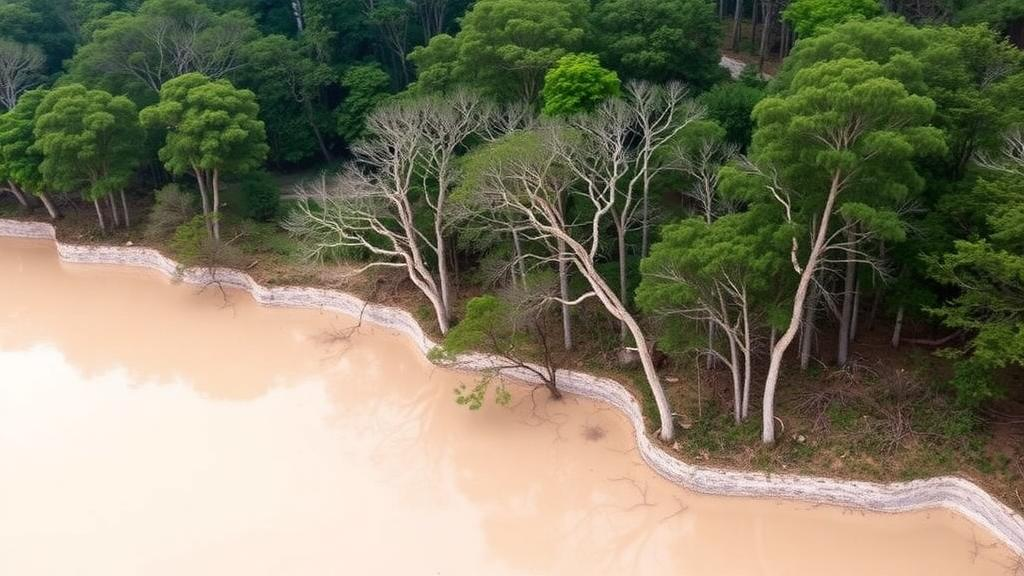
Deep in the forested hills of Nanyang City, in China’s Henan Province, ecologists have been quietly counting trees. The forests they surveyed sit at the intake area of the South-to-North Water Diversion Project, the colossal engineering scheme that channels water from the Yangtze basin to the thirsty north of the country. These woodlands are not just scenic backdrop; they filter and stabilize the water that flows into the Middle Route canal, making their ecological health a matter of national water security. A new study published in Frontiers in Ecology and Evolution reveals that within these forests, a silent divide runs between the abundant trees that dominate the landscape and the rare species that linger at the margins, and that divide has consequences for how the whole ecosystem will fare in the decades ahead.
The research team, led by Xiang-peng Liang of Xinyang Agriculture and Forestry University together with colleagues from Dongzhai National Nature Reserve, established 36 permanent plots, each measuring 20 by 20 meters, across the counties of Xixia, Neixiang, and Xichuan. Within every plot they measured every woody stem with a diameter at breast height of at least 3 centimeters, recording species identity, trunk diameter, and height. The decision to exclude smaller stems was deliberate: young shoots in these forests are often multiple branches of the same clonal individual, and counting them would have inflated the numbers and obscured the true structural patterns of the stand.
The tally came to 2,210 woody individuals belonging to 39 species, 33 genera, and 26 families. Oak and pine led the cast: Quercus variabilis, the Chinese cork oak, and Pinus massoniana, Masson’s pine, emerged as the two most important species by a wide margin, followed by Pistacia chinensis, Albizia kalkora, and Platycarya strobilacea. The flora is characteristic of a transitional zone between the northern subtropical and warm-temperate climatic regions, with temperate deciduous species making up 34 of the 39 recorded species. Families such as Fagaceae, Pinaceae, Juglandaceae, Cupressaceae, and Fabaceae contributed the largest numbers of individuals, reflecting the mixed broadleaf-conifer character of these central Chinese foothills.
What makes the study distinctive is its explicit partitioning of the community into common, occasional, and rare species. Using local density thresholds, the researchers classified species with more than 10 individuals per hectare as common, those between 1 and 10 as occasional, and those at or below 1 individual per hectare as rare. The result was striking: of the 39 species, 11 were common, 18 occasional, and 10 rare. Yet the 11 common species accounted for 2,117 of the 2,210 individuals, a staggering 95.8 percent of all stems. Occasional and rare species, despite making up nearly three-quarters of the species pool, contributed only a trickle of individuals. The rank-abundance curve for the community was steep, a classic signature of dominance by a handful of species.
Importance value, a composite metric combining relative abundance, relative frequency, and relative basal area, told the same story in sharper relief. Quercus variabilis alone scored an importance value of 55.55 percent, with a relative abundance of 76.61 percent and a relative basal area of 66.39 percent, meaning that roughly two-thirds of the total cross-sectional wood area in these plots belongs to a single oak species. The importance values of all common species together summed to 76.5 percent of the community total. At the other extreme, the top five rare species each registered an importance value of just 0.25 percent, with equal relative abundance and relative frequency, a mathematical fingerprint of species represented by only one or two scattered individuals.
The structural analysis revealed what the researchers describe as a conspicuous growth-stage bottleneck for rare species. Common species dominated every diameter and height class, with peak abundance in diameter class II, trees between 5 and 10 centimeters in trunk diameter, corresponding to heights of 6 to 9 meters. Rare species, by contrast, were largely confined to that same intermediate diameter class and the middle height classes, with a complete absence of individuals in the largest size class of 30 centimeters or more and none in the upper height strata above 12 meters. The consistency between the upper limits of their diameter and height distributions suggests that rare species face dual constraints in vertical space: they cannot reach the canopy through either girth or growth.
The authors interpret this pattern not as simple competitive suppression by shading from the dominant canopy, but as evidence that these rare taxa behave as gap-dependent or mid-successional species. Under a closed canopy, such species may persist as static remnants, maintaining a limited number of intermediate-sized individuals without producing new recruits or advancing into the upper strata. The complete absence of rare species from both the smallest and largest size classes supports this reading. Meanwhile, the relatively low abundance of common species in the smallest diameter class may reflect pressure from a dense and diverse understory shrub layer, which competes with saplings for the light and resources needed during early regeneration.
Perhaps the most unexpected finding concerns plant sex. Among the 2,210 individuals, monoecious plants, those bearing separate male and female flowers on the same individual, dominated overwhelmingly, accounting for 1,972 stems or 89.2 percent of the total. Dioecious species, with male and female flowers on separate plants, contributed 142 individuals, and hermaphroditic species just 16, though hermaphroditic and monoecious taxa each comprised 13 of the 39 species. The distribution across abundance classes was anything but random: common species were predominantly monoecious, occasional species showed a relative surplus of dioecious individuals, and rare species were characterized chiefly by hermaphroditic sexual systems.
The researchers argue that these sexual system patterns reflect divergent reproductive strategies shaped by population density. Monoecy, with its capacity for self-compatibility, allows rapid population establishment during early colonization and confers advantages under intense resource competition, helping common species build and maintain large populations. For rare species, whose small populations and low densities make cross-pollination between distinct individuals risky, hermaphroditism functions as a bet-hedging strategy: when conspecific pollen is scarce or pollinators are absent, self-compatibility offers reproductive assurance. This advantage, however, may be offset by limited understory light beneath the closed canopy, which suppresses photosynthesis and reproductive output, compounding the regeneration difficulties that already constrain these sparse populations.
The conservation implications reach well beyond academic interest. Rare species often occupy unique positions in community functional space, contributing disproportionately to functional diversity relative to their numbers, and previous work has shown that they tend to have lower functional redundancy and higher functional vulnerability than common species. Their loss, the study’s authors note, is therefore more likely to erode ecosystem functions and resilience, a concern of particular weight in a water source region where forest communities underpin water quality and regional environmental stability. The team recommends that management in the intake area prioritize the maintenance of canopy heterogeneity and the retention of rare species’ microhabitats, and they call for functional trait measurements and long-term demographic monitoring to clarify how plant sexual systems, community assembly, and ecosystem services are linked in this strategically vital landscape. Occasional species, which form the largest share of the local species pool yet remain numerically minor, may represent a reservoir of opportunistic taxa whose expansion depends on future disturbance events, a hypothesis that only sustained observation can test.
Subject of Research: Species composition and sexual systems of common and rare woody plants in the intake area of the South-to-North Water Diversion Project
Article Title: Contrasting species composition between common and rare woody species in the intake area of the South-to-North Water Diversion Project
Article References: Liang, X.-P., Yu, J.-L., Peng, C., & Zhu, J. (2026). Contrasting species composition between common and rare woody species in the intake area of the South-to-North Water Diversion Project. Frontiers in Ecology and Evolution, 14, Article 1971552. https://doi.org/10.3389/fevo.2026.1971552
Image Credits: AI Generated
DOI: 10.3389/fevo.2026.1971552
Keywords: forest ecology, rare species, common species, South-to-North Water Diversion Project, species composition, sexual systems, monoecy, hermaphroditism, biodiversity conservation, Nanyang, Henan, community assembly
News Source: Gavin Prescott. (October 15, 2026). Rare Trees Tell a Hidden Story in China’s Giant Water Diversion Forests. Scienmag.