• HOME
  • NEWS
  • EXPLORE
    • CAREER
      • Companies
      • Jobs
    • EVENTS
    • iGEM
      • News
      • Team
    • PHOTOS
    • VIDEO
    • WIKI
  • BLOG
  • COMMUNITY
    • FACEBOOK
    • INSTAGRAM
    • TWITTER
Saturday, September 26, 2026
BIOENGINEER.ORG
No Result
View All Result
  • Login
  • HOME
  • NEWS
  • EXPLORE
    • CAREER
      • Companies
      • Jobs
        • Lecturer
        • PhD Studentship
        • Postdoc
        • Research Assistant
    • EVENTS
    • iGEM
      • News
      • Team
    • PHOTOS
    • VIDEO
    • WIKI
  • BLOG
  • COMMUNITY
    • FACEBOOK
    • INSTAGRAM
    • TWITTER
  • HOME
  • NEWS
  • EXPLORE
    • CAREER
      • Companies
      • Jobs
        • Lecturer
        • PhD Studentship
        • Postdoc
        • Research Assistant
    • EVENTS
    • iGEM
      • News
      • Team
    • PHOTOS
    • VIDEO
    • WIKI
  • BLOG
  • COMMUNITY
    • FACEBOOK
    • INSTAGRAM
    • TWITTER
No Result
View All Result
Bioengineer.org
No Result
View All Result
Home NEWS Science News Health

Tiny probe that senses deep in the lung set to shed light on disease

Bioengineer by Bioengineer
June 17, 2019
in Health
Reading Time: 2 mins read
0
IMAGE
Share on FacebookShare on TwitterShare on LinkedinShare on RedditShare on Telegram

IMAGE

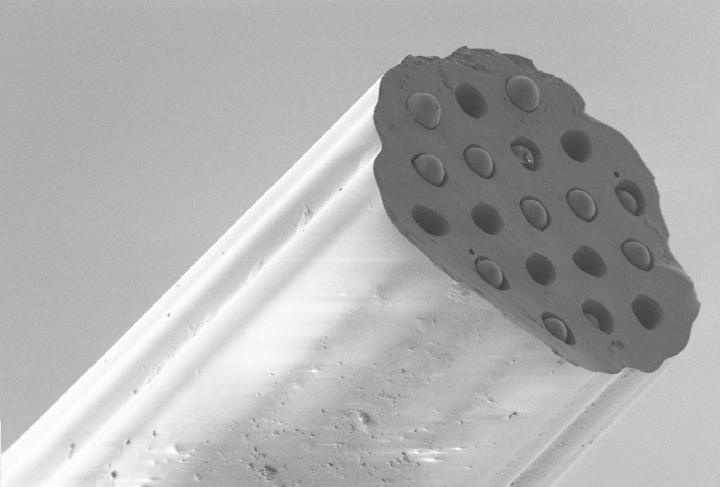
Credit: Michael Tanner, Herriot-Watt University and the University of Edinburgh.

A hair-sized probe that can measure key indicators of tissue damage deep in the lung has been developed by scientists.

The new technology could pave the way for accurate monitoring of tissue in areas where existing technologies cannot reach.

Experts say the probe can pick up tiny changes in tissue health and could improve how patients are assessed and treated, specifically those on ventilators in intensive care.

Lung diseases are one of the leading causes of death and disability in the world. Despite significant advances, little is known about how disease develops in patients suffering from pneumonia or lung injury.

A team of scientists developed the probe, which comprises an optical fibre about 0.2mm in diameter that holds 19 sensors.

Each sensor can measure different indicators in tissues, such as acidity and oxygen levels, which provide important information on the body’s reaction to disease processes.

Researchers have designed the technology to offer fast, accurate measurements and the flexibility to add more sensors.

Experts say the technology is widely applicable to other regions of the body and could be used to aid the understanding of inflammatory and bacterial diseases.

The research was supported by the UK’s Engineering and Physical Sciences Research Council (EPSRC) through support of the Proteus consortium, which includes the Universities of Edinburgh and Bath and Heriot-Watt University. It is published in Scientific Reports.

Dr Michael Tanner, Proteus Research Fellow at Heriot-Watt University and the University of Edinburgh, said: “This research is a great example of collaboration across disciplines to tackle healthcare challenges. These new methods, if taken to clinic, will lead to novel insights in disease biology. Our aim now is to expand the number of unique sensors on this miniaturised platform to provide even more information.”

###

Media Contact
Guy Atkinson
[email protected]

Related Journal Article

http://dx.doi.org/10.1038/s41598-019-44077-7

Tags: Internal MedicineMedicine/HealthPulmonary/Respiratory Medicine
Share14Tweet8Share2ShareShareShare2

Related Posts

Perilla Leaf Extract Extends Lifespan and Cuts Fat in Worms by Rewiring Insulin Signaling

September 26, 2026

Endotoxin on Trial: Massive Review Finds Experimental Inflammation Shots Remarkably Safe

September 26, 2026

New Mass Spectrometry Assay Tracks 42 Obesity Biomarkers in a Single Blood Test

September 26, 2026

Hidden Genetic Switch Links Cleft Lip Risk Gene to Neural Crest Cells

September 26, 2026
Please login to join discussion

POPULAR NEWS

  • Plant-Powered Nanoparticles Strip MRSA of Its Adhesive Weapons

    29 shares
    Share 12 Tweet 7
  • AI Turns Conflicting Opinions Into a Feature: New Model Weighs Disagreement to Make Group Decisions Trustworthy

    29 shares
    Share 12 Tweet 7
  • Radar AI Learns to Watch You Without Ever Seeing You

    29 shares
    Share 12 Tweet 7
  • Perilla Leaf Extract Extends Lifespan and Cuts Fat in Worms by Rewiring Insulin Signaling

    29 shares
    Share 12 Tweet 7

About

BIOENGINEER.ORG

We bring you the latest biotechnology news from best research centers and universities around the world. Check our website.

Follow us

Recent News

Plant-Powered Nanoparticles Strip MRSA of Its Adhesive Weapons

AI Turns Conflicting Opinions Into a Feature: New Model Weighs Disagreement to Make Group Decisions Trustworthy

Radar AI Learns to Watch You Without Ever Seeing You

Subscribe to Blog via Email

Enter your email address to subscribe to this blog and receive notifications of new posts by email.

Join 85 other subscribers
  • Contact Us

Bioengineer.org © Copyright 2023 All Rights Reserved.

Welcome Back!

Login to your account below

Forgotten Password?

Retrieve your password

Please enter your username or email address to reset your password.

Log In
No Result
View All Result
  • Homepages
    • Home Page 1
    • Home Page 2
  • News
  • National
  • Business
  • Health
  • Lifestyle
  • Science

Bioengineer.org © Copyright 2023 All Rights Reserved.