• HOME
  • NEWS
  • EXPLORE
    • CAREER
      • Companies
      • Jobs
    • EVENTS
    • iGEM
      • News
      • Team
    • PHOTOS
    • VIDEO
    • WIKI
  • BLOG
  • COMMUNITY
    • FACEBOOK
    • INSTAGRAM
    • TWITTER
Wednesday, July 8, 2026
BIOENGINEER.ORG
No Result
View All Result
  • Login
  • HOME
  • NEWS
  • EXPLORE
    • CAREER
      • Companies
      • Jobs
        • Lecturer
        • PhD Studentship
        • Postdoc
        • Research Assistant
    • EVENTS
    • iGEM
      • News
      • Team
    • PHOTOS
    • VIDEO
    • WIKI
  • BLOG
  • COMMUNITY
    • FACEBOOK
    • INSTAGRAM
    • TWITTER
  • HOME
  • NEWS
  • EXPLORE
    • CAREER
      • Companies
      • Jobs
        • Lecturer
        • PhD Studentship
        • Postdoc
        • Research Assistant
    • EVENTS
    • iGEM
      • News
      • Team
    • PHOTOS
    • VIDEO
    • WIKI
  • BLOG
  • COMMUNITY
    • FACEBOOK
    • INSTAGRAM
    • TWITTER
No Result
View All Result
Bioengineer.org
No Result
View All Result
Home NEWS Science News Biology

Tiny particle, big payoff

Bioengineer by Bioengineer
May 15, 2020
in Biology
Reading Time: 3 mins read
0
IMAGE
Share on FacebookShare on TwitterShare on LinkedinShare on RedditShare on Telegram

Innovative virus research may save wheat and other crops
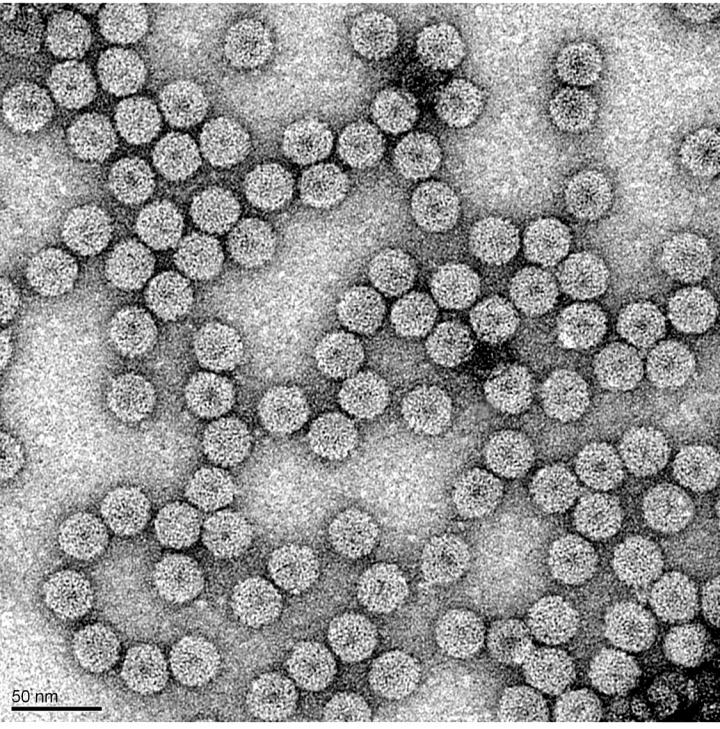
IMAGE

Credit: Ayala Rao/UCR

UC Riverside scientists have solved a 20-year-old genetics puzzle that could result in ways to protect wheat, barley, and other crops from a devastating infection.

Ayala Rao, professor of plant pathology and microbiology, has been studying Brome Mosaic virus for decades. Unlike some viruses, the genetic material of this virus is divided into three particles that until now were impossible to tell apart.

“Without a more definitive picture of the differences between these particles, we couldn’t fully understand how they work together to initiate an infection that destroys food crops,” Rao said. “Our approach to this problem has brought an important part of this picture into very clear focus.”

A paper describing the work Rao’s team did to differentiate these particles was recently published in the Proceedings of the National Academy of Sciences.

Inside each of the particles is a strand of RNA, the genetic material that controls the production of proteins. The proteins perform different tasks, some of which cause stunted growth, lesions, and ultimately death of infected host plants.

Two decades ago, scientists used the average of all three particles to create a basic description of their structure. In order to differentiate them, Rao first needed to separate them, and get them into their most pure form.

Using a genetic engineering technique, Rao’s team disabled the pathogenic aspects of the virus and infused the viral genes with a host plant.

“This bacterium inserts its genome into the plant’s cells, similar to the way HIV inserts itself into human cells,” Rao said. “We were then able to isolate the viral particles in the plants and determine their structure using electron microscopes and computer-based technology.”

Now that one of the particles is fully mapped, it’s clear the first two particles are more stable than the third.

“Once we alter the stability, we can manipulate how RNA gets released into the plants,” Rao said. “We can make the third particle more stable, so it doesn’t release RNA and the infection gets delayed.”

This work was made possible by a grant from the University of California Multicampus Research Program and Initiatives. Professors Wiliam Gelbart and Hong Zhou of UCLA, as well as graduate students Antara Chakravarthy of UCR and Christian Beren of UCLA, made significant contributions to this project.

Moving forward, Rao is hoping to bring the other two viral particles into sharper focus with the expertise of scientists at UCLA and UC San Diego.

Brome Mosaic virus primarily affects grasses such as wheat and barley, and occasionally affects soybeans as well. According to Rao, it is nearly identical to Cucumber Mosaic virus, which infects cucumbers as well as tomatoes and other crops that are important to California agriculture.

Not only could this research lead to the protection of multiple kinds of crops, it could advance the understanding of any virus.

“It is much easier to work with plant viruses because they’re easier and less expensive to grow and isolate,” Rao said. “But what we learn about the principles of replication are applicable to human and animal viruses too.”

###

Media Contact
Jules Bernstein
[email protected]

Original Source

https://news.ucr.edu/articles/2020/05/14/tiny-particle-big-payoff

Related Journal Article

http://dx.doi.org/10.1073/pnas.1915078117

Tags: Agricultural Production/EconomicsAgricultureBiochemistryBiologyCell BiologyGeneticsMicrobiologyPlant SciencesVirology
Share12Tweet8Share2ShareShareShare2

Related Posts

Four new indigenous cacao groups discovered in Peru

Four new indigenous cacao groups discovered in Peru

July 8, 2026
Evolution silences Hawaii’s crickets in record time

Evolution silences Hawaii’s crickets in record time

July 8, 2026

New imaging reveals nerves with stunning clarity

July 8, 2026

Here are a few rewritten headlines for a science magazine post, each with a slightly different tone: Intriguing & poetic: How do organs sculpt themselves? Sea stars hold the secret Direct & research-focused: Sea stars reveal the hidden rules of organ formation Metaphorical & inviting: Tiny architects beneath the waves: What sea stars teach us about building organs Short & punchy: Star-shaped clues to how our organs take shape Question-led: Could a sea star show us how organs form? Elegant & feature-style: The body’s blueprint, glimpsed in a sea star’s arm

July 6, 2026
Please login to join discussion

POPULAR NEWS

  • Detection of EDCs in Breast Milk and Infant Urine Up to Six Months Highlights Early Exposure Risks

    77 shares
    Share 31 Tweet 19
  • New Drug Candidate Developed at McMaster Shows Potential for Treating Brain Cancer

    58 shares
    Share 23 Tweet 15
  • KTU Researchers Explore Ultrasound’s Role in Enhancing Blood Flow Beyond Diagnostics

    53 shares
    Share 21 Tweet 13
  • 高齢者の骨粗鬆症治療の持続性比較

    51 shares
    Share 20 Tweet 13

About

We bring you the latest biotechnology news from best research centers and universities around the world. Check our website.

Follow us

Recent News

FOXM1 Inhibition Enhances Maturation of Human iPSC-Derived Liver Cells

Beavers boom in Pacific Northwest river estuaries

Breast cancer after childbirth may be more aggressive in young women

Subscribe to Blog via Email

Enter your email address to subscribe to this blog and receive notifications of new posts by email.

Join 83 other subscribers
  • Contact Us

Bioengineer.org © Copyright 2023 All Rights Reserved.

Welcome Back!

Login to your account below

Forgotten Password?

Retrieve your password

Please enter your username or email address to reset your password.

Log In
No Result
View All Result
  • Homepages
    • Home Page 1
    • Home Page 2
  • News
  • National
  • Business
  • Health
  • Lifestyle
  • Science

Bioengineer.org © Copyright 2023 All Rights Reserved.