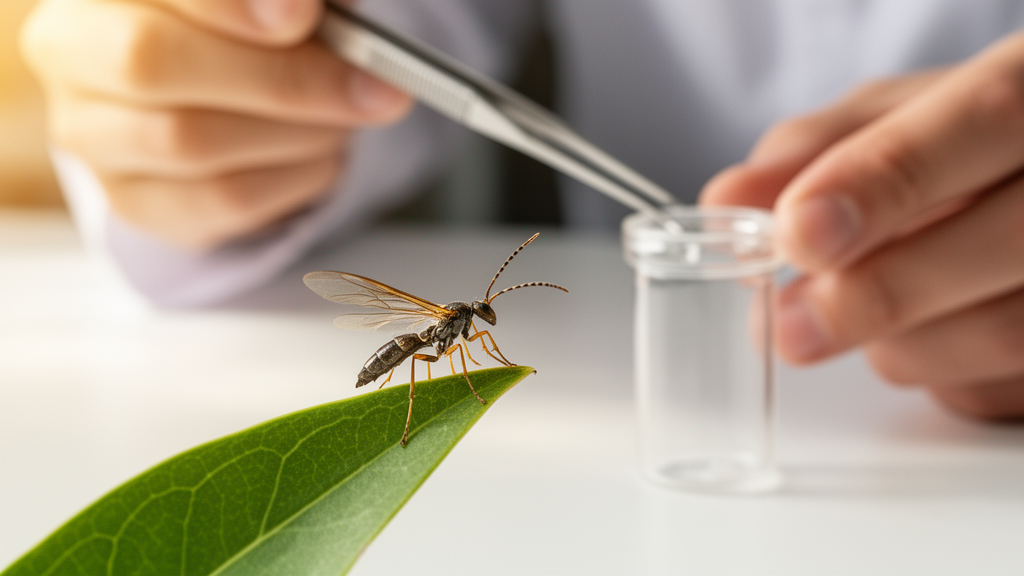
A quiet revolution has just taken place in the study of one of the most species-rich groups of parasitoid wasps on Earth. A new taxonomic review of the genus Tetrastichus in China documents seventeen species from the country, reports three of them as new national records, adds new provincial distribution data for fourteen others, and provides the first illustrated identification key covering every female Tetrastichus species known from China. The work, published in the Journal of Hymenoptera Research, also records a previously unknown host association for one species, reared from the larvae of a sawfly. Before this study, only 34 species of the genus were known from China, a strikingly low figure for a genus that currently contains 533 described valid species worldwide and ranks as the second largest genus in the subfamily Tetrastichinae.
Tetrastichus belongs to the family Eulophidae, a sprawling lineage of chalcidoid wasps whose members parasitize other insects. The genus name carries a convoluted history: it was first proposed by Walker in 1842, but that name was suppressed by the International Commission on Zoological Nomenclature in 1965, and the genus has since been attributed to Haliday in 1844, with Cirrospilus attalus Walker, 1839 designated as the type species. The European fauna was comprehensively revised by Graham in 1991, who treated 42 species and divided them into six species groups, a classification followed by later authorities. More recently, Hansson and Schmidt revised the European species using an integrative approach that combines DNA barcoding with morphological data, encompassing 93 species, of which 50 were newly described. Despite this rich regional tradition in Europe, the Chinese fauna remained poorly documented, with scattered distribution records and no unified identification key available.
Recognizing Tetrastichus in the field or under the microscope depends on a distinctive suite of morphological characters. The body is strongly sclerotized and occasionally collapses when dried. The malar sulcus, a groove on the face, is straight and not foveate below the eye. In females the antennal funicle and clava each have three segments, while males have a ventral plaque on the antennal scape and a four-segmented funicle. The mesosoma is convex dorsally, the pronotum is short, and the mid lobe of the mesoscutum usually carries one row of adnotaular setae. The scutellum bears distinct submedian and sublateral grooves. Most tellingly, the propodeum has a distinct median carina, with plicae developed at least posteriorly and usually extending anteriorly to connect with the paraspiracular carina, forming an inverted Y-shape; the spiracles are subcircular and usually exposed, and the propodeal surface often shows distinct reticulation and rugulosity. The forewing submarginal vein usually carries one dorsal seta, occasionally two, and the hindwing is obtuse.
Even with these characters, the genus is easy to confuse with relatives. Among the numerous genera in Tetrastichinae, Tetrastichus is regarded as a morphologically coherent group readily recognized by its uniquely sculptured propodeum, but that structure is not readily observable and often requires microscopic imaging. At first glance the wasps are frequently mistaken for several genera in the Tetrastichus group, including Quadrastichus, Oomyzus and Chaenotetrastichus, because of their strongly sclerotized bodies and the presence of a single seta on the forewing submarginal vein, and certain Quadrastichus species, such as Q. vacuna, even possess a paraspiracular carina. A reliable, fully illustrated key therefore fills a genuine practical need for anyone sorting chalcidoid wasps from Chinese material.
The biological diversity of the genus extends beyond morphology. Tetrastichus species primarily parasitize the eggs, larvae and pupae of insects in the orders Coleoptera, Lepidoptera, Hymenoptera and Diptera, with a particular focus on the beetle families Buprestidae, Cerambycidae, Chrysomelidae and Curculionidae. One Neotropical species, T. periplanetae, even parasitizes the American cockroach Periplaneta americana. This ecological breadth makes the genus a natural target for biodiversity surveys and for researchers interested in host-parasitoid relationships, yet the Chinese fauna had never been summarized in a single treatment.
The new study is built on substantial fieldwork. Specimens were collected by sweeping vegetation, yellow-pan trapping and host rearing from multiple provinces across China, covering the Northeast, North, East, South, Southwest and Northwest of the country. In the laboratory, specimens were dissected and mounted dorsally in Canada balsam following a standard method, or glued to triangular cards. Photographs were captured with a digital camera attached to a compound microscope, and card-mounted specimens were measured in absolute ethanol prior to mounting using an eyepiece reticle with a stereo microscope. Every specimen examined in the paper is deposited in the insect collections of Yancheng Teachers University in Jiangsu Province, and the terminology follows established morphological conventions for chalcidoid wasps.
Three species emerge as new records for China: T. brevicalcar, T. pilemostomae and T. temporalis. T. brevicalcar and T. temporalis were both collected in Tianjin through Malaise trapping at the Tianjin Academy of Agricultural Sciences between late August and mid-September 2021, while T. pilemostomae was swept at Xinyang Port Sluice in Yancheng, Jiangsu, in August 2023. All three were previously known from Europe: T. brevicalcar from Sweden, the United Kingdom and the Czech Republic; T. pilemostomae from England, Sweden and Romania; and T. temporalis from Sweden, the United Kingdom and France. The authors note that the newly recorded species exhibit only minor morphological variations compared with their original descriptions from outside China, and that such subtle phenotypic variation is common in widely distributed chalcidoid species; their morphological observations confirm the specimens’ conspecific status.
The new provincial records touch many of the species treated in the paper. T. aponiusi is newly documented from Liaoning, Shaanxi and Zhejiang; T. clavicornis from Yunnan; T. coelarchus from Qinghai; T. decrescens from Guangdong; T. heeringi from Yunnan; T. howardi from Hainan; T. ilithyia from Inner Mongolia; T. jinzhouicus from Jiangsu, Hainan and Yunnan; T. nigricoxae from Shandong; T. planipennisi from Shaanxi; T. schoenobii from Yunnan; T. taibaishanensis from Yunnan; and T. yangi from Yunnan. Each of these additions extends the known range of a species within China, and the authors argue that the new provincial records demonstrate that many Tetrastichus species have wider distributions than previously documented, with Malaise traps and yellow pan traps proving effective tools for detecting these small parasitoid wasps.
Among the host associations documented in the study, one stands out as entirely new: T. coelarchus was reared for the first time from the larvae of Arge pullata, a sawfly in the family Argidae. The specimens came from host rearing at a forest farm in Qinghai Province in May 2014. Other host records compiled in the species treatments draw on earlier literature: T. aponiusi has been reared from the bark beetle Scolytus dahuricus; T. planipennisi from the emerald ash borer Agrilus planipennis; T. decrescens from the beetle Henosepilachna vigintioctomaculata; T. nigricoxae and T. septentrionalis from the moth Hyphantria cunea; and T. howardi is described as one of the most polyphagous species in the genus, attacking eggs and larvae of Lepidoptera and pupae of Hymenoptera, a broad host range that likely contributes to its success as a biocontrol agent and its wide distribution across tropical and subtropical regions.
The illustrated key itself is organized around female specimens and runs through couplets based on forewing setation, gaster shape, antennal proportions, leg coloration, head structure and metallic luster. It separates species such as T. planipennisi, whose gaster is acuminate and twice as long as the combined head and mesosoma, from T. howardi and T. inferens, which share two dorsal setae on the submarginal vein but differ in the ratio of the marginal vein to the stigmal vein. The key is based on specimens examined in the study, supplemented with published morphological information from the literature for species the authors could not access for direct examination. The authors are candid about the limits of the work: males of some species were not collected, host associations for many taxa remain unknown, and a small subset of species were identified from published literature and original descriptions rather than from directly examined type material, so future revisions should confirm those identifications against types. They also attribute the uneven distribution of species records largely to sampling bias, noting that species with economic importance are more readily collected during pest surveys while many others remain undersampled, and they call for further targeted sampling and rearing studies to reveal the host biology and full distribution of Chinese Tetrastichus.
Subject of Research: Taxonomic review of the parasitoid wasp genus Tetrastichus in China, including new distribution records and an illustrated species identification key
Article Title: Taxonomic notes on the genus Tetrastichus Haliday ( Hymenoptera , Eulophidae ) from China
Article References: Li, W.-J., Shao, M.-Y., Xia, N., Zu, G.-H., & Li, C.-D. (2026). Taxonomic notes on the genus Tetrastichus Haliday (Hymenoptera, Eulophidae) from China. Journal of Hymenoptera Research, 99, 1149-1178. https://doi.org/10.3897/jhr.99.207788
Image Credits: AI Generated
Keywords: Tetrastichus, Eulophidae, parasitoid wasps, China, taxonomy, new species records, identification key, Tetrastichinae, host associations, biodiversity survey, Hymenoptera, chalcidoid wasps
News Source: Drew Townsend. (October 28, 2026). Tiny parasitoid wasps of China get their first complete identification key. Scienmag.