Beneath the surface of Otsego Lake, the storied body of water that gives rise to the 444-mile Susquehanna River, an unassuming cast of characters has been quietly keeping a diary. Zooplankton, the tiny free-floating animals that drift near the base of the aquatic food chain, respond within days or weeks to shifts in nutrients, invasive species, and water quality. Because of that sensitivity, three decades of monitoring data from the lake amount to something remarkable: a detailed, continuously updated record of how an entire freshwater ecosystem has changed over time. This summer, an undergraduate researcher at SUNY Cobleskill set out to read that record, one organism at a time, and to translate what she found into knowledge that scientists, lake managers, and the public can actually use.
Tiffany Miele, a second-year Environmental Management major from Hawthorne, New York, spent her internship peering through a microscope at creatures smaller than a grain of rice. Working under the mentorship of Dr. Mairi Meehan, Assistant Professor of Biology at SUNY Cobleskill, Miele took on the task of interpreting thirty years of zooplankton monitoring data from Otsego Lake in Cooperstown, with the goal of identifying and describing ecosystem change across that long arc of time. The project sits at the intersection of archival science, freshwater ecology, and education, and it forms part of a broader effort to expand undergraduate research opportunities at institutions that have historically had limited access to such funding.
The technical core of the work involved bringing archived samples face to face with freshly collected ones. Miele compared specimens preserved in 2012 with material collected in 2026, and the comparison revealed a striking shift in the lake’s dominant copepod groups. The 2012 samples showed greater abundance and diversity among cyclopoid copepods, a group of small crustaceans characterized by their rounded body form and short antennae. By 2026, the samples were dominated by calanoid copepods, a different subgroup with longer antennae and generally different feeding and swimming behavior. Miele and Dr. Meehan attribute this turnover to changing environmental conditions, including predation, competition, and the effects of climate change, all of which can reshape zooplankton community composition and abundance over time.
That kind of species turnover matters because copepods occupy a pivotal position in lake food webs. They graze on algae, they in turn feed fish larvae and other predators, and their community structure reflects the physical and chemical conditions of the water around them. A shift from cyclopoid to calanoid dominance can ripple through the ecosystem, altering energy flow from microscopic producers up to game fish, and it can signal underlying pressures such as warming water temperatures, changing nutrient loads, or the arrival and spread of invasive species. Long-term datasets like the one Miele mined are among the few tools ecologists have for distinguishing genuine directional change from the natural year-to-year noise of a lake’s biology.
In the laboratory, the work demanded patience and precision. Miele used a Sedgwick-Rafter counting cell, a shallow chamber that holds a fixed volume of water on a microscope slide, allowing researchers to count and measure organisms within a known quantity of sample. Working with a stereomicroscope, Image-Pro imaging software, and dichotomous keys, the paired identification guides that lead a user through a series of either-or choices to a species name, she identified and measured roughly 450 individual organisms. Each specimen had to be located, oriented, keyed out, and measured, a process that turns raw preserved material into quantifiable ecological data.
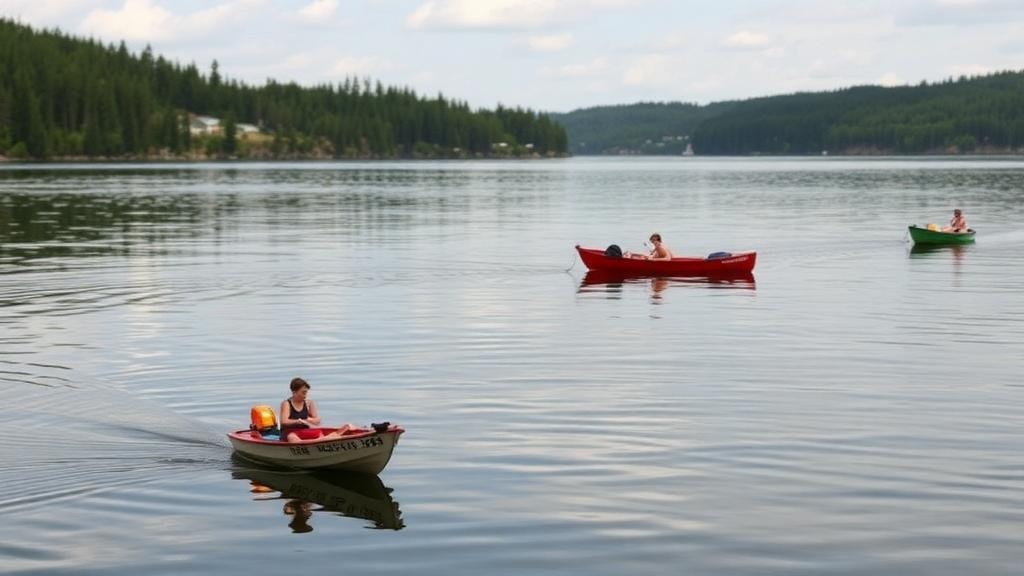
The fieldwork was equally hands-on. Miele deployed zooplankton nets, the fine-mesh conical nets that are towed through the water to concentrate drifting animals, and used flow meters to measure how much water passed through each net, a crucial step for converting counts into estimates of organism density. She collected and preserved samples and recorded water-quality readings, then organized and cleaned the resulting data and carried the project through analysis to scientific interpretation. Along the way she picked up an unexpected credential: she became a certified New York State boat operator, a practical necessity for a researcher who needs to reach sampling stations on the lake independently.
Dr. Meehan emphasized the breadth of skills her student developed during the project. She described Miele as heavily involved and eager to learn, noting that she had picked up nearly every tool and method the team uses to sample, identify, and analyze zooplankton, from imaging and identification work in the laboratory to net, flow-meter, and water-quality sampling in the field. The boat certification, in Dr. Meehan’s view, reflected both the independence Miele had developed as a researcher and the range of skills she was willing to take on in the name of gathering data. For her part, Miele called learning to drive a boat one of the most memorable parts of the whole experience, noting that she had never driven one before.
The project did not stop at the archive-to-analysis pipeline. An additional 24-hour diel vertical migration study built on Miele’s work and drew in other undergraduate students, who helped prepare and run round-the-clock sampling, collected complementary biological and water-quality measurements, and troubleshot problems in the field. Diel vertical migration, or DVM, is one of the most widespread movement patterns on Earth: zooplankton rise toward the surface under the cover of darkness to feed and sink into deeper, darker water by day, a behavior thought to balance the benefits of feeding against the risk of being eaten by visually hunting predators. Miele and Dr. Meehan ran their first DVM survey in July, tracking how zooplankton move up and down through the water column, and they hope to expand the effort into a year-round study to see how migration patterns change with the seasons.
Communicating the findings was treated as an essential part of the science rather than an afterthought. Miele developed and delivered a 12-minute research presentation to faculty, staff, and interns at the SUNY Oneonta Biological Field Station, covering the project’s background, methods, preliminary results, and ecological implications. She and Dr. Meehan then translated the completed findings into a scientific poster, titled Long-Term Zooplankton Species Turnover in Otsego Lake: Archival Evidence of Contemporary Ecological Pressures, which Miele presented to a public and stakeholder audience at the Otsego Lake Association Annual Meeting on August 8 at the Otsego Lake Sailing Club. The project’s results were also included in the Biological Field Station’s annual report, ensuring that the lake’s own stewards have access to what the zooplankton record reveals.
The research is embedded in a larger institutional story. It forms part of Dr. Meehan’s work as one of SUNY Cobleskill’s inaugural National Science Foundation EPIIC Fellows, conducted in partnership with the SUNY Oneonta Biological Field Station. The effort is funded through a $400,000 NSF grant program called Enabling Partnerships to Increase Innovation Capacity, with the College serving as lead institution for the A-SPARK team, short for Agriculture and Science Practice and Access for Research-Driven Knowledge. The three-year collaborative project runs through September 2028 and also includes Louisiana State University Eunice and Modesto Junior College in California, linking campuses across the country in a shared mission to build research capacity and open scientific careers to more students.
Miele’s scientific curiosity extends well beyond freshwater. As part of her coursework, she and fellow student Keaton Muller of Sparrowbush, New York, completed a literature review under Dr. Meehan’s mentorship examining the clownfish-anemone symbiosis, specifically the evolutionary and physiological mechanisms of mucus-based sting tolerance. The review tackles a long-standing puzzle in marine biology: how clownfish live unharmed among the stinging tentacles of sea anemones, which injure most other fish. Drawing on published studies, the students examined the biochemical makeup of clownfish mucus, how the trait may have evolved, and how clownfish differ from closely related damselfish that lack the protection. Their review points to distinct biochemical features, including lower levels of certain sugars that can trigger anemone stings and differences in lipid composition, while also identifying open questions about the evolutionary and biochemical processes behind the adaptation.
For Miele, the path to this research was itself a story of transformation. She arrived at college as an Animal Science major, but working on the clownfish project changed her direction entirely. She realized she wanted a career centered on ecology and the study of ecosystems, and when Dr. Meehan told her about the grant, she applied right away. Her advice to other students reflects what she learned in the field: it is okay not to know exactly what you are doing at first. She recalls being nervous when she started, worried she was not where she was supposed to be, but found that everything came together quickly. The people she met and the relationships she built, she says, made the experience one of the most memorable of her time in college. Meanwhile, the tiny drifters of Otsego Lake continue their slow-motion testimony, and with a planned year-round migration study on the horizon, the thirty-year record they embody is still being written.
Subject of Research: Long-term zooplankton community change and undergraduate research in Otsego Lake freshwater ecology
Article Title: Reading 30 years of Otsego Lake history, one zooplankton at a time
Article References: Reading 30 years of Otsego Lake history, one zooplankton at a time. (n.d.). Original publication
Image Credits: AI Generated
DOI: Not provided
Keywords: zooplankton, copepods, Otsego Lake, freshwater ecology, long-term monitoring, diel vertical migration, climate change, SUNY Cobleskill, NSF EPIIC grant, undergraduate research, SUNY Oneonta Biological Field Station, clownfish anemone symbiosis
News Source: Gavin Prescott. (October 12, 2026). Tiny Lake Drifters Reveal Three Decades of Hidden Change in Otsego Lake. Scienmag.