• HOME
  • NEWS
  • EXPLORE
    • CAREER
      • Companies
      • Jobs
    • EVENTS
    • iGEM
      • News
      • Team
    • PHOTOS
    • VIDEO
    • WIKI
  • BLOG
  • COMMUNITY
    • FACEBOOK
    • INSTAGRAM
    • TWITTER
Saturday, June 27, 2026
BIOENGINEER.ORG
No Result
View All Result
  • Login
  • HOME
  • NEWS
  • EXPLORE
    • CAREER
      • Companies
      • Jobs
        • Lecturer
        • PhD Studentship
        • Postdoc
        • Research Assistant
    • EVENTS
    • iGEM
      • News
      • Team
    • PHOTOS
    • VIDEO
    • WIKI
  • BLOG
  • COMMUNITY
    • FACEBOOK
    • INSTAGRAM
    • TWITTER
  • HOME
  • NEWS
  • EXPLORE
    • CAREER
      • Companies
      • Jobs
        • Lecturer
        • PhD Studentship
        • Postdoc
        • Research Assistant
    • EVENTS
    • iGEM
      • News
      • Team
    • PHOTOS
    • VIDEO
    • WIKI
  • BLOG
  • COMMUNITY
    • FACEBOOK
    • INSTAGRAM
    • TWITTER
No Result
View All Result
Bioengineer.org
No Result
View All Result
Home NEWS Science News Biology

Tiny Japanese dinosaur eggs help unscramble Cretaceous ecosystem

Bioengineer by Bioengineer
June 26, 2020
in Biology
Reading Time: 2 mins read
0
IMAGE
Share on FacebookShare on TwitterShare on LinkedinShare on RedditShare on Telegram

University of Tsukuba research reveals a nest of exceptionally small non-avian theropod egg fossils in Hyogo Prefecture, Japan, providing a window into Early Cretaceous biodiversity
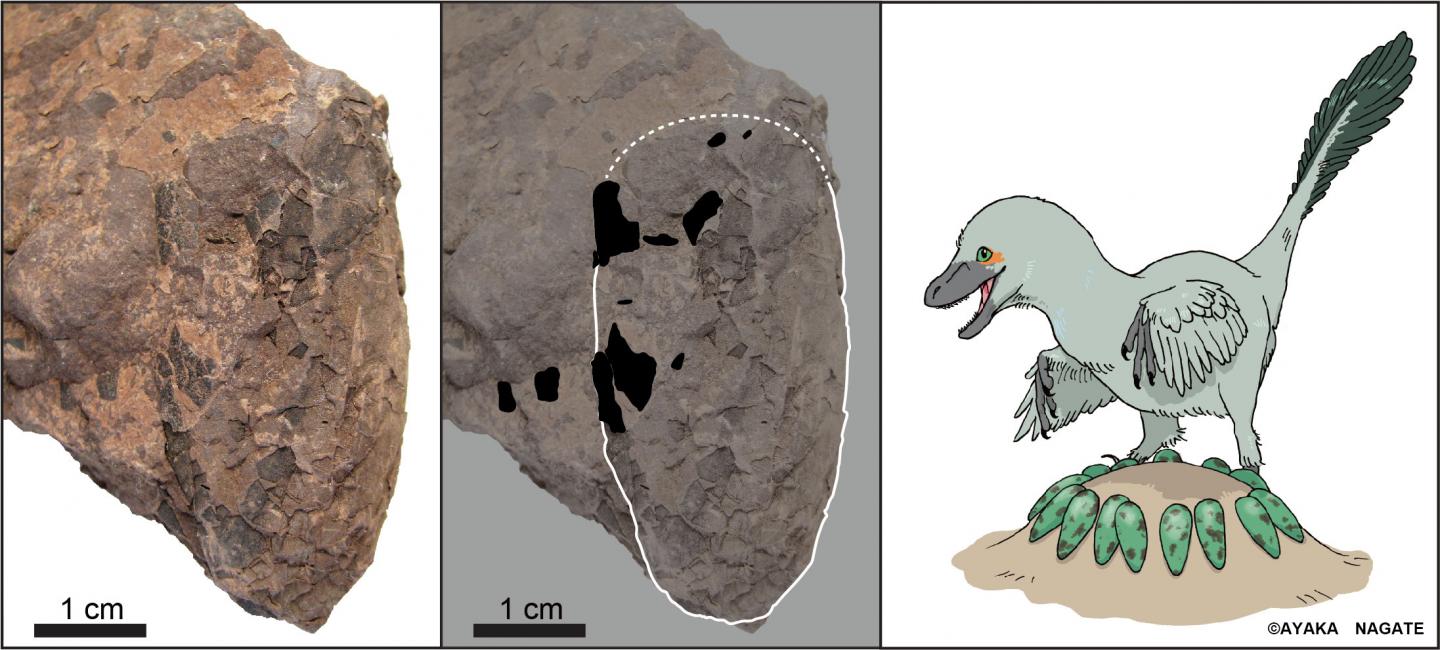
IMAGE

Credit: Photo by University of Tsukuba and Museum of Nature and Human Activities,Hyogo

Tsukuba, Japan – When most of us think of dinosaurs, we envision large, lumbering beasts, but these giants shared their ecosystems with much smaller dinosaurs, the smaller skeletons of which were generally less likely to be preserved. The fossilized egg shells of these small dinosaurs can shed light on this lost ecological diversity.

Led by the University of Tsukuba, researchers scoured an exceptional fossil egg site first discovered in 2015 in Hyogo Prefecture, southwestern Japan, and reported their findings in a new study published in Cretaceous Research.

The Kamitaki Egg Quarry, found in a red-brown mudstone layer of the Ohyamashimo Formation, deposited in an Early Cretaceous (about 110 million years old) river flood plain, was carefully and intensively excavated in the winter of 2019, and yielded over 1300 egg fossils. Most were isolated fragments, but there were a few partial and almost complete eggs.

According to lead author Professor Kohei Tanaka, “our taphonomic analysis indicated that the nest we found was in situ, not transported and redeposited, because most of the eggshell fragments were positioned concave-up, not concave-down like we see when egg shells are transported.”

Most of these fossil eggs belong to a new egg genus and species, called Himeoolithus murakamii, and are exceptionally small, with an estimated mass of 9.9 grams–about the size of a modern quail egg. However, biological classification analysis implies that the eggs belonged not to early birds, but to their cousins, the non-avian theropod dinosaurs (the group that includes well-known carnivores like Tyrannosaurus and Velociraptor). That puts Himeoolithus murakamii among the smallest non-avian theropod eggs reported to date. These tiny eggs were notably elongated in shape–unusual for similarly small eggs among Cretaceous birds, but typical among larger non-avian theropod eggs.

In addition to the abundant Himeoolithus murakamii egg shells, five more ootaxa (distinct types of egg fossils) were recognized in the Kamitaki locality. All of these ootaxa belonged to small non-avian theropods.

As Professor Tanaka explains, “the high diversity of these small theropod eggs makes this one of the most diverse Early Cretaceous egg localities known. Small theropod skeletal fossils are quite scarce in this area. Therefore, these fossil eggs provide a useful window into the hidden ecological diversity of dinosaurs in the Early Cretaceous of southwestern Japan, as well as into the nesting behavior of small non-avian theropods.”

###

Media Contact
Naoko Yamashina
[email protected]

Related Journal Article

http://dx.doi.org/10.1016/j.cretres.2020.104519

Tags: BiodiversityEarth ScienceEcology/EnvironmentEvolutionGeology/SoilPaleontology
Share13Tweet8Share2ShareShareShare2

Related Posts

Natural Hallucinogens: Evolution’s Ecological Tools, Not Mere Chemical Byproducts

June 25, 2026

This Famous Butterfly Revealed: Three Distinct Species Hidden in One

June 25, 2026

Scientists Attack Soybean Cyst Nematode by Starving Its Food Source

June 25, 2026

Decoding the Secret Code of a Crucial Immune Sensor

June 24, 2026
Please login to join discussion

POPULAR NEWS

  • Saying Goodbye to PGY-6: Pediatric Fellowship Realities

    103 shares
    Share 41 Tweet 26
  • Multi-Hospital Study Reveals Long Covid Burden Is Twice as High as Current Estimates

    92 shares
    Share 36 Tweet 23
  • Detection of EDCs in Breast Milk and Infant Urine Up to Six Months Highlights Early Exposure Risks

    77 shares
    Share 31 Tweet 19
  • New Drug Candidate Developed at McMaster Shows Potential for Treating Brain Cancer

    58 shares
    Share 23 Tweet 15

About

We bring you the latest biotechnology news from best research centers and universities around the world. Check our website.

Follow us

Recent News

Tracking Lanthanide-Labeled Microplastics in Plants

POSTECH Researchers Slash Cost of Reconstituted Cell-Free Systems by 95%

AI and Physics Collaborate to Design Advanced Hydrogen Storage Materials

Subscribe to Blog via Email

Success! An email was just sent to confirm your subscription. Please find the email now and click 'Confirm' to start subscribing.

Join 82 other subscribers
  • Contact Us

Bioengineer.org © Copyright 2023 All Rights Reserved.

Welcome Back!

Login to your account below

Forgotten Password?

Retrieve your password

Please enter your username or email address to reset your password.

Log In
No Result
View All Result
  • Homepages
    • Home Page 1
    • Home Page 2
  • News
  • National
  • Business
  • Health
  • Lifestyle
  • Science

Bioengineer.org © Copyright 2023 All Rights Reserved.