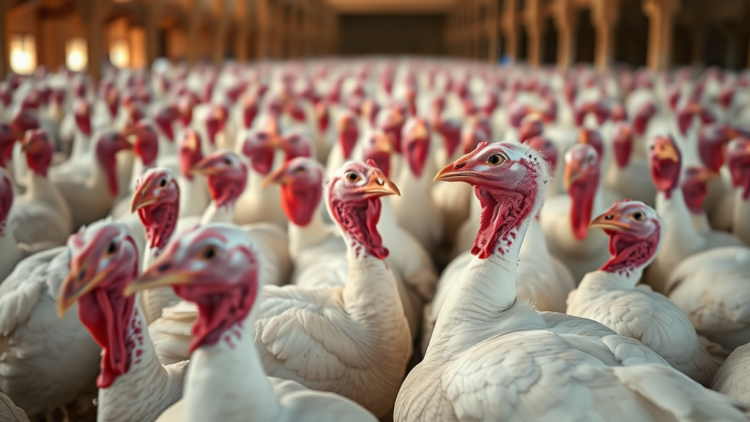
In the dim, crowded interior of a commercial turkey barn, one bird looks much like another. Thousands of large, white-feathered animals mill about under fixed overhead cameras, and to the human eye—and, crucially, to most computer vision systems—they are nearly indistinguishable. Yet knowing which turkey is which over time is exactly what modern precision livestock farming needs: sustained drops in a single animal’s activity can be an early warning of disease, stress, or worse. A new study published in Smart Agricultural Technology by Debayan Sen and Theo Lutz tackles this problem head-on, and its solution is refreshingly counterintuitive: instead of a bigger, more powerful artificial intelligence model, the researchers built a dramatically smaller one that is tailored specifically to turkeys.
The technical heart of the challenge lies in what is called re-identification. Object detection systems can draw boxes around every turkey in a single video frame, but behavior analysis demands something more: the ability to follow the same animal across frames, through occlusions and dense crowding, under a consistent identity. Multi-object tracking algorithms such as DeepSORT accomplish this by combining motion predictions with an appearance embedding—a numerical fingerprint, typically 128 numbers long, that captures what an individual looks like. The trouble is that the appearance model shipped by default with DeepSORT, a network called mars-small128 with roughly 2.8 million parameters, was trained on pedestrians. Humans are easy to tell apart by clothing, texture, and body structure; turkeys in a barn, uniform in color and shape, offer almost none of these cues. The result is that the generic model loses much of its discriminative power the moment it is pointed at poultry.
Sen and Lutz asked whether a compact, domain-specific embedding, trained on actual turkey data, could recover the discrimination that generic models lose while remaining light enough for on-farm deployment. Their answer is a Siamese convolutional neural network of just 714,000 parameters—about a quarter the size of the pedestrian baseline—that maps a cropped image of a turkey to a 128-dimensional vector on the unit hypersphere. The architecture was not designed in one stroke but arrived at through a careful, ablation-driven refinement process, in which each design decision had to justify itself through measurable gains in retrieval accuracy and training stability on held-out, unseen identities.
Three design elements survived that process. First, the network’s residual blocks use pre-activation ordering, a arrangement in which batch normalization and activation functions precede each convolution, keeping the skip connection free of non-linear transformations and improving gradient flow during training. Second, every residual block is augmented with squeeze-and-excitation channel attention, a small gating module that learns to emphasize the most informative feature channels—in this case, apparently, the subtle plumage coloration and body markings that do distinguish one turkey from another. Third, and most impactful, the channel count of the network’s deepest stage was doubled from 64 to 128, placing representational capacity where it matters most rather than in the final projection layer. An embedding head built around a batch-normalization neck, a technique borrowed from person re-identification that decouples metric and classification feature spaces, rounds out the design.
Training combined two complementary objectives: a batch-hard triplet loss, which pulls images of the same bird together in embedding space while pushing images of different birds apart by mining the hardest positive and negative pairs within each batch, and an auxiliary identity-classification loss with label smoothing, which regularizes the network on the modest training set of 74 turkey identities. The underlying dataset, extracted from overhead video of working commercial barns, comprised 106 unique turkey identities and 709 image crops, split so that the validation and test animals were never seen during training—a realistic open-set protocol, since any deployed system will inevitably encounter birds it has never learned from.
The results are striking. On an exhaustive pairwise evaluation of unseen test identities, the domain-specific embedding outperformed mars-small128 on every discrimination metric. The area under the receiver operating characteristic curve rose from 0.890 to 0.943, accuracy from 0.849 to 0.911, and recall by more than ten percent. Most telling was the separation between the similarity distributions of same-bird and different-bird pairs: the gap between their means grew by 73.5 percent, and a separability index improved by roughly half. Because false identity associations in tracking stem directly from overlap between these distributions, this cleaner separation is precisely the property that should translate into more stable identities downstream. Bootstrap confidence intervals confirmed that the gains were not an artifact of the small test pool. A t-SNE visualization of the embedding space showed tight, well-separated clusters for most individuals, with residual overlap confined to the genuinely most similar birds—an honest reflection of the problem’s intrinsic difficulty.
Just as important is what the small model does not cost. With 3.9 times fewer parameters and a footprint of 2.80 MiB versus 10.72 MiB, the custom network runs slightly faster per embedding than the baseline while using comparable GPU memory. Interpretability analyses using Grad-CAM showed that the network concentrates its attention on the bird’s body—the head–neck junction and upper back in standing birds, the breast and flank in resting ones—rather than on barn litter or background clutter, consistent with the squeeze-and-excitation design steering the model toward plumage and body-structure cues.
When the embedding was plugged into a DeepSORT tracking pipeline and tested on three commercial barn sequences, identity-related metrics improved consistently: mean IDF1, a strict measure of identity preservation, rose from 81.3 to 83.2 percent, and association accuracy improved, while detection accuracy remained unchanged—confirming the gain came from better association, not better detection. A controlled stress test that randomly dropped 10 to 30 percent of detections revealed a subtlety: the proposed embedding prefers a more permissive association threshold than the baseline, and once each model was evaluated at its own optimal setting, the domain-specific model won in five of six tested conditions. The authors are candid that the improvement in these particular sequences is moderate, largely because the footage contains few prolonged occlusions—the very regime where a strong appearance model matters most.
They are equally candid about the study’s limits. Identity fragmentation remains severe in absolute terms: even the improved tracker used about 90 track identities to cover roughly 57 real animals, meaning a farm relying on raw track counts would still over-count its flock. The authors identify this fragmentation, along with the need for larger-scale validation across more barns, flocks, and lighting conditions, as the primary remaining obstacle to reliable individual-level monitoring. Still, the central message stands and carries well beyond poultry: appearance representations learned for humans do not transfer to animals without loss, and the remedy is not a larger generic backbone but a smaller, domain-adapted one. For precision-livestock applications where compute and power are constrained, better identity discrimination and lower cost, it turns out, need not be in tension.
Subject of Research: A lightweight domain-specific appearance embedding for individual turkey re-identification in dense commercial barn environments using computer vision and multi-object tracking.
Article Title: A lightweight domain-specific appearance embedding for Turkey re-identification in dense barn environments
Article References: Sen, D., & Lutz, T. (2026). A lightweight domain-specific appearance embedding for Turkey re-identification in dense barn environments. Smart Agricultural Technology, 15, Article 102549. https://doi.org/10.1016/j.atech.2026.102549
Image Credits: AI Generated
DOI: 10.1016/j.atech.2026.102549
Keywords: turkey re-identification, precision livestock farming, computer vision, multi-object tracking, DeepSORT, Siamese network, appearance embedding, deep metric learning, triplet loss, squeeze-and-excitation attention, animal welfare monitoring, smart agriculture
Cite Scienmag News
APA MLA Chicago
Alan Morgan. (September 12, 2026). Tiny AI Model Learns to Tell Individual Turkeys Apart in Crowded Barns. Scienmag. https://scienmag.com/tiny-ai-model-learns-to-tell-individual-turkeys-apart-in-crowded-barns/
Alan Morgan. “Tiny AI Model Learns to Tell Individual Turkeys Apart in Crowded Barns.” Scienmag, 12 September 2026, https://scienmag.com/tiny-ai-model-learns-to-tell-individual-turkeys-apart-in-crowded-barns/. Accessed 12 September 2026.
Alan Morgan. “Tiny AI Model Learns to Tell Individual Turkeys Apart in Crowded Barns.” Scienmag. September 12, 2026. https://scienmag.com/tiny-ai-model-learns-to-tell-individual-turkeys-apart-in-crowded-barns/
Copy citation Download RIS
Tags: animal welfare monitoringappearance embeddingbehavior analysis of farm animalscomputer visioncomputer vision for poultry monitoringdeep learning for poultry healthdeep metric learningDeepSORTdense crowd tracking in livestock environmentsearly disease detection in turkeysinnovative approaches to animal identificationmulti-object trackingmulti-object tracking in agriculturePrecision Livestock FarmingSiamese networksmall AI models for animal trackingSmart Agriculturesqueeze-and-excitation attentiontailored AI solutions for farm managementtriplet lossturkey re-identificationturkey re-identification in crowded barnsvisual recognition of individual animals