


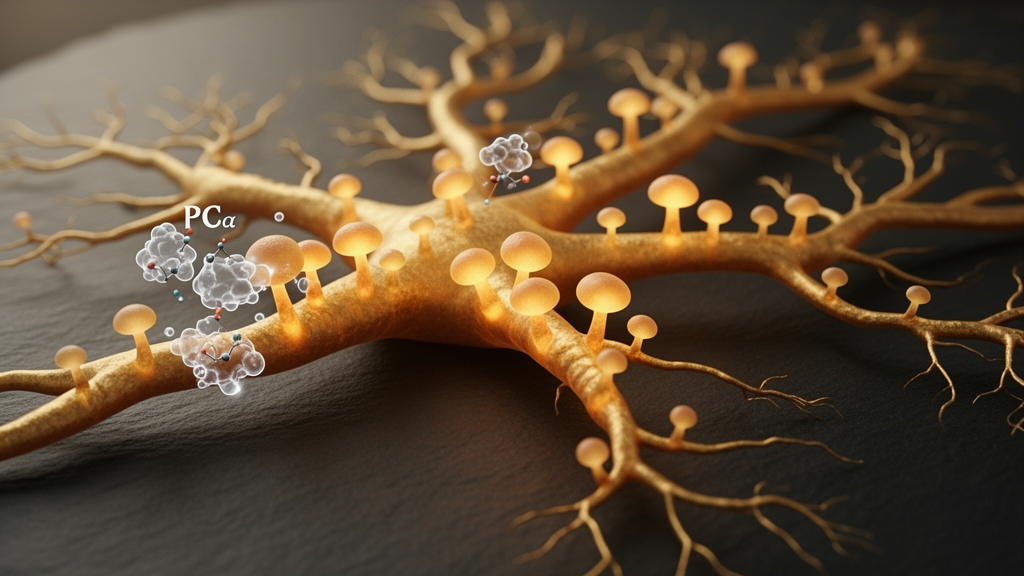
A study published in Cellular and Molecular Neurobiology on 1 October 2026 reports that a memory-enhancing protein acts through a precisely timed surge of protein kinase Cα (PKCα), a downstream effector of BDNF signaling, to drive structural rewiring of neurons in the perirhinal cortex of rats. The work, led by Irene Navarro-Lobato and Zafar U. Khan, was published as open-access original research and identifies PKCα as a required mediator of the synaptic remodeling that precedes measurable memory improvement.
The research builds on the team’s earlier finding that regulator of G-protein signaling 14 of 414 amino acids (RGS14414) can reverse memory deficits through a 14–3-3ζ–BDNF–dependent upregulation of BDNF signaling. In the new study, the authors show that the RGS14414-induced increase in BDNF leads to a time-controlled activation of PKCα.
The temporal sequence the researchers documented is central to their findings. When RGS14414 was expressed in the perirhinal cortex, PKCα levels remained elevated for approximately two weeks. During this early phase, no improvement in object recognition memory (ORM) was observed, indicating that the molecular rise alone was not sufficient to change behavior.
What did change during those first two weeks was neuronal structure. Notably, these structural gains persisted long after PKCα levels had returned to baseline, suggesting that a transient molecular signal can leave a durable anatomical imprint on cortical circuitry.
Only after this structural reorganization did behavior follow. Object recognition memory enhancement emerged during week three, a point at which the authors report that structural remodeling had already occurred and new synaptic connections had been established.
Causality was tested by removing PKCα from the equation. Knockdown of PKCα eliminated both the dendritic growth and the memory enhancement, demonstrating that the kinase is required for structural-plasticity–driven memory improvement. Without PKCα, the BDNF-linked cascade could not translate into either anatomical change or behavioral benefit.
The benefits extended beyond a single memory test and beyond young animals. The authors report that PKCα was essential not only for enhancing multiple types of memory in young adult rats but also for rescuing recognition, spatial, and temporal memory in aged animals. These memory types, the paper notes, represent core components of episodic memory that are primarily affected in patients with memory dysfunctions.
The authors frame these findings as identifying PKCα as a key mediator of time-controlled neuronal structural plasticity and as underscoring the central role of synaptic remodelling in memory enhancement. They also highlight PKCα-dependent synaptic remodelling as a promising therapeutic target for memory deficits and for other conditions associated with deficits in synaptic connectivity, including the memory impairment seen in normal aging and in Alzheimer’s disease and other neurological and neurodegenerative conditions, where most drug candidates and memory enhancers have struggled to reliably reverse deficits in humans.
Subject of Research: PKCα-mediated structural plasticity in perirhinal cortex neurons and its role in memory enhancement and rescue of memory deficits
Article Title: Time-Controlled Protein Kinase Cα-Mediated Structural Plasticity in Perirhinal Cortex Pyramidal Neurons Enhances Memory and Rescues Memory Deficits
Article References: Navarro-Lobato, I., Muñoz de León-López, C. A., Gaona-Romero, C., Carretero-Rey, M., Quiros-Ortega, M. E., Posadas, S., & Khan, Z. U. (2026). Time-Controlled Protein Kinase Cα-Mediated Structural Plasticity in Perirhinal Cortex Pyramidal Neurons Enhances Memory and Rescues Memory Deficits. Cellular and Molecular Neurobiology. https://doi.org/10.1007/s10571-026-01830-7
Image Credits: AI Generated
DOI: 10.1007/s10571-026-01830-7
Keywords: PKCα, RGS14414, BDNF, perirhinal cortex, dendritic spines, synaptic plasticity, object recognition memory, episodic memory, aging, memory deficits, neuroscience, rats
News Source: Cassandra Pierce. (October 30, 2026). Timing of PKCα-Driven Synaptic Remodeling Unlocks Memory Enhancement in Rats. Scienmag.



