


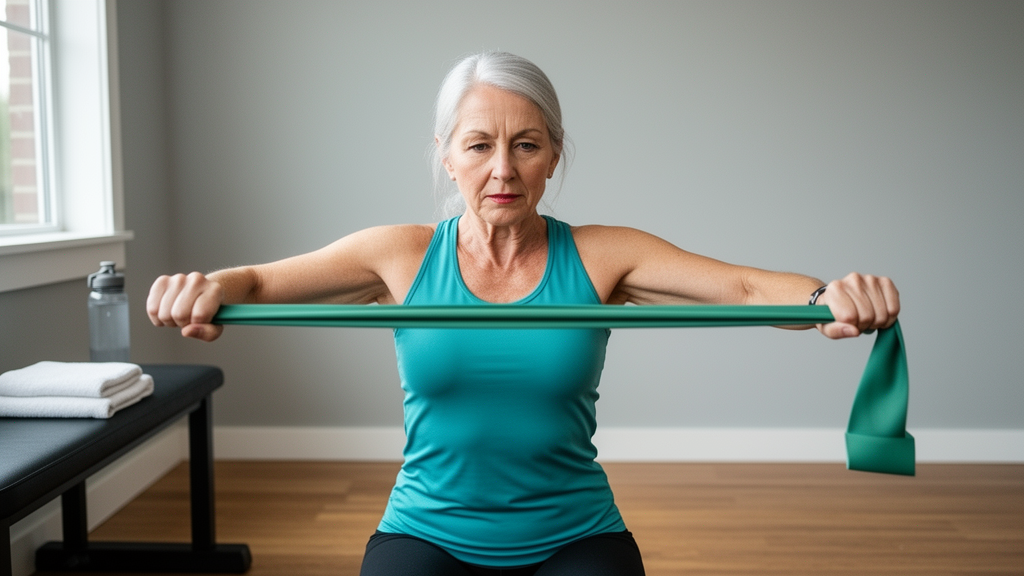
Twelve weeks of low-load elastic band resistance training improved functional fitness and several blood markers in women with an average age of 75, whether they trained twice or three times a week, but the thrice-weekly group gained markedly more handgrip strength and HDL cholesterol, according to a randomized controlled trial published in the European Review of Aging and Physical Activity. The study, conducted across three geriatric centers in Vojvodina, Serbia, is among the first to compare training frequencies specifically for low-load elastic band exercise in older women, a population for whom accessible, low-injury-risk strength training options carry particular practical value.
The trial enrolled 108 women who expressed interest after an educational lecture on strength training. After medical screening excluded nineteen women with orthopedic, neurologic, rheumatologic, or cardiovascular disorders, or who had participated in organized physical activity within the previous two years, 89 women were randomly allocated to two groups. Seven more dropped out for medical or personal reasons, leaving 82 participants, aged 75.1 years on average with a standard deviation of 8.6, who completed the full experiment. To be included in the analysis, participants had to attend at least 85 percent of sessions, and final attendance exceeded 90 percent in both arms. No injuries or illnesses were recorded during the intervention.
Participants were assigned either to a group training two sessions per week, called 2SW, or three sessions per week, called 3SW, for twelve weeks. Both groups performed identical workouts: two sets of twelve to fifteen repetitions at 40 to 50 percent of one-repetition maximum, using Thera-Band elastic bands, with sixty seconds of rest between sets and at least 48 hours between sessions. Each session comprised twelve chair-based exercises targeting hip, knee, shoulder, and trunk muscles, preceded by a ten-minute mobility warm-up and followed by static stretching. Intensity was monitored with the OMNI perceived exertion scale, and when ratings fell below 4, coaches increased resistance by shortening the hand grip or switching band colors to prevent stagnation as participants grew stronger.
The design was assessor-blinded: coaches knew each participant’s frequency because of the visible difference in schedules, but all outcome assessments, including blood sampling and functional testing, were carried out by personnel blinded to group assignment and unaffiliated with training supervision. Block randomization by site was performed by a researcher not involved in the study and unaware of its aims. The authors acknowledge that participants themselves could not be blinded, which may have influenced motivation on effort-dependent tests, although both groups received equally encouraging information about the intervention’s benefits.
Outcomes were measured before and after the intervention under standardized morning conditions. Metabolic biomarkers, including fasting glucose, triglycerides, total cholesterol, HDL, and LDL cholesterol, were analyzed in a certified laboratory using an automated analyzer, with LDL estimated by the Friedewald equation. Functional fitness was assessed with the six-item Senior Fitness Test battery: the 30-second Chair Stand, 30-second Arm Curl, Chair Sit-and-Reach, Back Scratch, 2.4-meter Up-and-Go, and 2-minute Step Test, supplemented by an isometric handgrip strength test. Test-retest reliability in a pilot sample of 20 individuals showed intraclass correlation coefficients between 0.87 and 0.92.
At baseline, the two groups were statistically similar. After twelve weeks, both groups improved significantly on the 30-second Chair Stand, 2-minute Step Test, 30-second Arm Curl, Chair Sit-and-Reach, Back Scratch, and handgrip strength, with large effect sizes across most measures. The 2.4-meter Up-and-Go test, a timed agility task, improved significantly only in the twice-weekly group, a counterintuitive result the authors attribute tentatively to accumulated neuromuscular fatigue in the higher-frequency group, since the test demands rapid, coordinated multidirectional movement that may be sensitive to residual fatigue.
The clearest between-group differences emerged in handgrip strength and HDL cholesterol. The thrice-weekly group increased handgrip strength by 28 percent versus 7 percent in the twice-weekly group, and raised HDL cholesterol by 9 percent versus 1 percent, with statistically significant group-by-time interactions for both outcomes. Reductions in total cholesterol and LDL cholesterol were comparable between groups and statistically significant in both. Fasting glucose and triglycerides showed no significant changes in either group. The authors note that their twice-weekly group started with numerically higher LDL, which may partly explain the significant decrease observed there despite chance baseline imbalance.
A crucial methodological caveat shapes how these results should be read. Because both groups performed the same volume per session, the thrice-weekly group completed 50 percent more total weekly sets, four versus six. The authors state explicitly that this confound restricts the ability to isolate the effects of frequency from volume; the greater strength and HDL gains may reflect either factor or their combination. Prior studies that matched total volume, such as work by Pina and colleagues comparing two sets three times weekly against three sets twice weekly, found no significant between-group differences in strength gains. The authors also point out that their twice-weekly protocol achieved substantial gains with roughly half the weekly volume of some earlier equi-volume trials, which they suggest may matter for frail older women who struggle to sustain frequent exercise routines.
The study has further limitations the authors themselves flag. There was no control group, so the true effect size of the intervention relative to no training cannot be determined, although prior research supports low-load elastic band training for these outcomes. Physical activity, sedentary behavior, and dietary intake were not monitored or standardized, leaving possible confounding of the metabolic results. Formal center-level analyses were not conducted due to sample size constraints, and no corrections for multiple comparisons were applied given the limited number of pre-planned comparisons. The isometric handgrip test also differed from the dynamic training movements, which the authors suggest may have reduced sensitivity to training-induced changes.
Within those constraints, the practical takeaway the authors offer is that two weekly sessions of low-load elastic band training already delivered meaningful improvements in functional fitness and lipid markers in these older women, while adding a third session appeared to amplify gains in grip strength and HDL cholesterol over twelve weeks. They emphasize that participation in strength training per se appears critical for functional capacity, whereas the magnitude of strength gains seems less directly tied to functional improvements. For exercise professionals designing programs around older adults’ time constraints, recovery ability, and adherence, the findings suggest both frequencies are viable, with the choice of a third session potentially justified when strength or cardio-metabolic outcomes are the priority. The authors call for future volume-matched protocols to clarify frequency-specific effects more definitively.
Subject of Research: Comparing two versus three weekly low-load elastic band resistance training sessions on functional fitness and metabolic biomarkers in older women
Article Title: Effects of two versus three weekly sessions of low-load elastic band resistance training on functional fitness and metabolic biomarkers in older adults: a randomized controlled trial
Article References: Jezdimirović Stojanović, T., Andrić, N., Zenić, N., Rincon Perez, A., & D.M. Stojanović, M. (2026). Effects of two versus three weekly sessions of low-load elastic band resistance training on functional fitness and metabolic biomarkers in older adults: a randomized controlled trial. European Review of Aging and Physical Activity, 23(1), Article 37. https://doi.org/10.1186/s11556-026-00427-9
Image Credits: AI Generated
DOI: 10.1186/s11556-026-00427-9
Keywords: resistance training, elastic bands, older adults, training frequency, handgrip strength, HDL cholesterol, functional fitness, randomized controlled trial, elderly women, metabolic biomarkers, Senior Fitness Test, low-load exercise
News Source: Beatrice Stafford. (October 30, 2026). Three Weekly Elastic Band Sessions Boost Strength and HDL More Than Two in Older Women. Scienmag.



