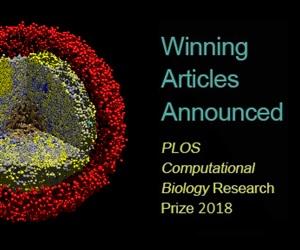
Credit: Ghaffarizadeh et al.,
The second annual PLOS Computational Biology Research Prize program has awarded top prizes to three exemplary studies published in 2017. The program launched last year to celebrate some of the journal's most outstanding research articles.
This year's winners stood out from an international pool of studies nominated by the public in three categories: Breakthrough Advance/Innovation, Exemplary Methods/Software, and Public Impact. A committee made up of editorial board members chose the final winner in each category.
Taking home the top Breakthrough Advance/Innovation prize is a study that addressed protein structure using ideas from the revolutionary computer science field known as deep learning. Study author Sheng Wang and colleagues at Toyota Technological Institute at Chicago, Illinois, developed a new deep learning method that improves predictions of how proteins fold and assemble into their final 3-D forms, which could help reveal new biological insights.
The top study in the Exemplary Methods/Software category presented a new, open source program called Unicycler, which assembles bacterial genomes from DNA sequencing data. Developed by Ryan Wick and colleagues at The University of Melbourne, Australia, Unicycler successfully combines accurate but short DNA sequences with longer but error-prone data, and it outperforms other hybrid approaches.
A new statistical analysis strategy for finding cancer-causing genetic mutations was the focus of the winning study in the Public Impact category. The novel approach focuses on "oncodomains," protein sub-components that are more likely to contain such mutations and are shared across many different proteins. Thomas Peterson, at the University of Maryland, and colleagues used their new method to identify thousands of rare mutations linked with cancer, which could help inform cancer drug development.
The three winning studies will join last year's winners in the online PLOS Computational Biology Research Prize collection, and the corresponding author(s) of each winning paper will receive a $2,000 USD award to help support their future work.
"Our Research Prize nominations highlighted the superb science performed by our community members," says PLOS Computational Biology Editor-in-Chief Jason Papin. "We are thrilled to announce our 2018 winners, and we already look forward to the next round of nominations in 2019."
###
In your coverage please use these URLs to provide access to the freely available articles in PLOS Computational Biology:
Accurate De Novo Prediction of Protein Contact Map by Ultra-Deep Learning Model
Citation: Wang S, Sun S, Li Z, Zhang R, Xu J (2017) Accurate De Novo Prediction of Protein Contact Map by Ultra-Deep Learning Model. PLOS Computational Biology 13(1): e1005324. https://doi.org/10.1371/journal.pcbi.1005324 http://journals.plos.org/ploscompbiol/article?id=10.1371/journal.pcbi.1005324
Unicycler: Resolving bacterial genome assemblies from short and long sequencing reads
Citation: Wick RR, Judd LM, Gorrie CL, Holt KE (2017) Unicycler: Resolving bacterial genome assemblies from short and long sequencing reads. PLOS Computational Biology 13(6): e1005595. https://doi.org/10.1371/journal.pcbi.1005595 http://journals.plos.org/ploscompbiol/article?id=10.1371/journal.pcbi.1005595
Oncodomains: A protein domain-centric framework for analyzing rare variants in tumor samples
Citation: Peterson TA, Gauran IIM, Park J, Park D, Kann MG (2017) Oncodomains: A protein domain-centric framework for analyzing rare variants in tumor samples. PLOS Computational Biology 13(4): e1005428. https://doi.org/10.1371/journal.pcbi.1005428 http://journals.plos.org/ploscompbiol/article?id=10.1371/journal.pcbi.1005428
Competing Interests: The authors of all three papers have confirmed that no competing interests exist.
Media Contact
Sheryl Baptista
[email protected]