A research group from Nagoya University in central Japan has discovered three new species of bioluminescent polycirrus worms from different parts of Japan. Usually found in shallow water, polycirrus are small worms, known for their bioluminescence. The researchers named one of their discoveries after a ghostly yokai, a creature in Japanese foklore; another after a lantern yokai; and the other after an influential Japanese marine biologist. They published their findings in the journal Royal Society Open Science.
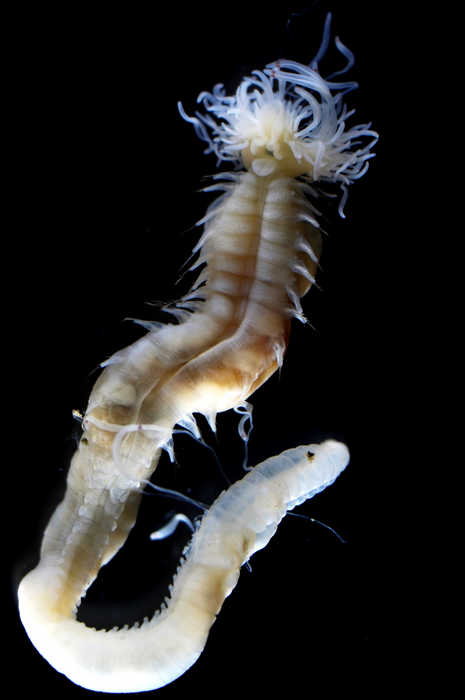
Credit: Naoto Jimi (Nagoya University)
A research group from Nagoya University in central Japan has discovered three new species of bioluminescent polycirrus worms from different parts of Japan. Usually found in shallow water, polycirrus are small worms, known for their bioluminescence. The researchers named one of their discoveries after a ghostly yokai, a creature in Japanese foklore; another after a lantern yokai; and the other after an influential Japanese marine biologist. They published their findings in the journal Royal Society Open Science.
Scientists have studied only a small fraction of the more than 7,000 species of luminescent organisms in the world. Research remains limited to certain species because of the existence of specimens that are difficult to classify into species. Without correct identification of the species, comparisons of different results are of limited use.
Naoto Jimi (he/him) and Special Assistant Professor Manabu Bessho-Uehara (he/him) at Nagoya University’s Graduate School of Science, led a research group with members from AIST, Olympus Corporation, and Japan Underwater Films Corporation, that organized Polycirrus according to their diversity. They discovered the three new species, all of which emit blue-violet light.
Jimi said that when they discovered these new species, they were amazed and felt a sense of duty to document and classify them. “Our previous research on the luminescence of the genus Polycirrus had established it as a valuable subject for bioluminescence studies,” he added. “However, we later discovered what we thought was a single species of Polycirrus was actually three different species.”
As the researchers found the worms in Japan, they gave them Japanese names. They named two of the three species Polycirrus onibi and Polycirrus aoandon as a reference to their bluish-violet luminescence. In Japanese folklore, onibi (demon fire) describes a will-o’-the-wisp type of yokai, shaped like a small, floating ball of light, that is believed to lead travellers in mountains and forests astray. Meanwhile, aoandon (blue lantern) is a ghost-like yokai that appears as a woman wearing a white kimono with horns and sharp teeth. It haunts lanterns found in Japanese homes by turning their light an unnatural blue color. The other worm was named Polycirrus ikeguchii in honor of Shinichiro Ikeguchi, the former director of the Notojima Aquarium.
“We used the names of Japanese yokai, such as onibi and aoandon, for the new species because the hazy violet-blue bioluminescence emitted by the Polycirrus species is strikingly similar to the descriptions of these creatures found in folklore,” said Jimi. “Polycirrus ikeguchii, on the other hand, was described from specimens collected in the Notojima region in Japan. As Shinichi Ikeguchi was the former director of Notojima Aquarium and helped to find the worm, it seemed appropriate to name it after him.”
The researchers hope to use their findings to deepen their understanding of the molecular nature of bioluminescence, which could lead to the development of new technologies. “The discovery that all three new species are luminescent has allowed us to link taxonomic and ecological findings and establish research that others can readily apply to the study of luminescent organisms,” said Jimi. “Understanding these luminescence mechanisms contributes to medical and life science research. Bioluminescence is a treasure trove of interesting and unusual chemistry. We intend to use our findings to deepen our understanding of the molecular nature of this phenomenon and apply this knowledge to the development of new life sciences technologies.”
Journal
Royal Society Open Science
DOI
10.1098/rsos.230039
Article Title
Investigating the Diversity of Bioluminescent Marine Worm Polycirrus (Annelida), with Description of Three New Species from the Western Pacific
Article Publication Date
29-Mar-2023