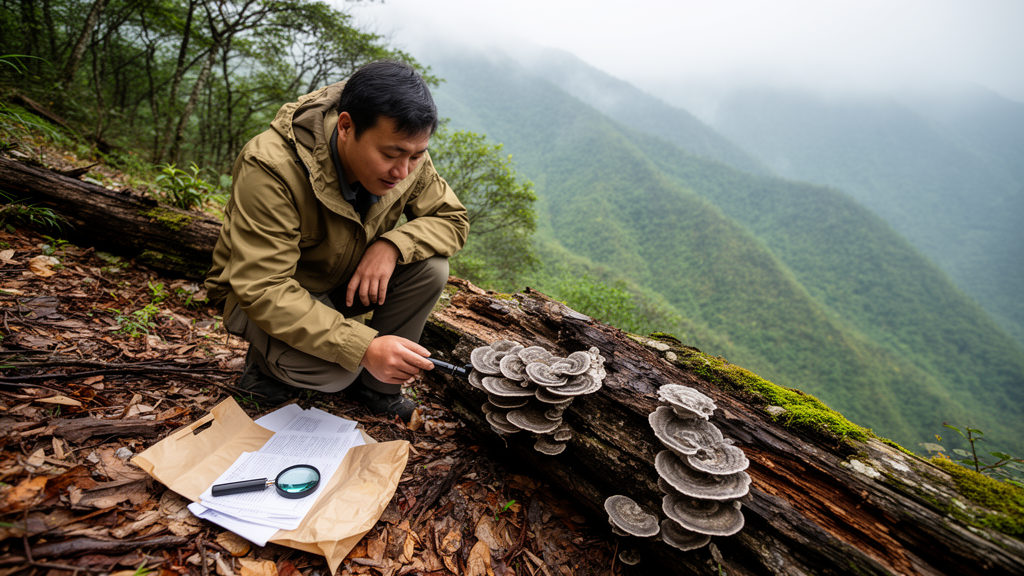
A taxonomic study of wood-inhabiting corticioid fungi collected in China’s Qinling Mountains identified three species new to science: Hymenochaete zhashuiensis, Hyphoderma brevicystidiatum and Steccherinum shangzhouense. The classifications were based on detailed morphological observations and phylogenetic analyses of combined internal transcribed spacer and nuclear large subunit ribosomal RNA gene sequences.
The researchers collected fresh specimens representing the three genera during macrofungal surveys in Zhashui County and Shangzhou District, both in Shaanxi Province. Basidiomata were photographed and described in the field, including their substrates and habitats. The specimens were dried and deposited in the herbarium of the Institute of Microbiology at Beijing Forestry University.
Microscopic examination included slide preparations in 5% potassium hydroxide, Cotton Blue and Melzer’s reagent. At least 30 basidiospores were measured from each specimen, with sterigmata excluded from basidial measurements and hilar appendages excluded from basidiospore measurements. Genomic DNA was extracted with a CTAB rapid plant genome DNA extraction kit, and the ITS and nLSU regions were amplified and sequenced. The resulting sequences were combined for separate phylogenetic analyses of Hymenochaete, Hyphoderma and Steccherinum.
Maximum-likelihood and Bayesian analyses placed the specimens in three independent lineages within their respective genera. Hymenochaete zhashuiensis, represented by specimen Cui 24846, was closely related to H. tasmanica and had 100% maximum-likelihood bootstrap support and a Bayesian posterior probability of 1.00. The two Hyphoderma specimens, Cui 24841 and Cui 24844, formed an independent clade with 98% maximum-likelihood bootstrap support and a Bayesian posterior probability of 0.99. Three Steccherinum specimens, Cui 24842, Cui 24843 and Cui 24845, formed a distinct lineage with 91% maximum-likelihood support and a Bayesian posterior probability of 0.99, close to S. fissurutum and S. fragrans.
Hymenochaete zhashuiensis has annual, resupinate to effused-reflexed basidiomata measuring 15–20 cm long, 8–12 cm wide and 0.5–3 mm thick. Its hymenial surface is reddish brown to rust-brown when fresh, and its hyphal system is monomitic, with simple-septate generative hyphae. Diagnostic features include abundant dark-brown, thick-walled hymenial setae measuring 66–89 × 7.8–11 µm, branched dendrohyphidia and ellipsoid to broadly ellipsoid basidiospores measuring 4–5.6 × 2.8–3.5 µm. The holotype was collected from a living angiosperm tree in Zhashui County at an elevation of 1,184.0 m.
Hyphoderma brevicystidiatum has white to cream, resupinate and membranaceous basidiomata that are 15–23 cm long, 2.5–4 cm wide and 0.3–1 mm thick. The species has a monomitic hyphal system with clamped generative hyphae and a smooth to slightly grandinioid hymenial surface. Its cylindrical to subcylindrical cystidia measure 24.2–30.5 × 4.2–7.4 µm and are mostly smooth, although some bear crystalline deposits. The basidiospores measure 6.2–10 × 2.7–4.2 µm. The holotype, Cui 24844, was found on a fallen Pinus branch in Shangzhou District at an elevation of 701.6 m; specimen Cui 24841 was collected from a fallen angiosperm branch in Zhashui County.
Steccherinum shangzhouense has annual, resupinate, membranaceous basidiomata that are 13–18 cm long, 1–2 cm wide and up to 120 µm thick. Its hymenial surface is white to cream when fresh, becomes pale gray to grayish upon drying and develops conspicuous cracks. The species has a monomitic hyphal system with simple-septate generative hyphae; cystidia and skeletocystidia were not observed. Its broadly ellipsoid to oblong ellipsoid basidiospores measure 5.2–7.9 × 2.5–5 µm. The holotype, Cui 24845, was collected from a fallen angiosperm branch in Shangzhou District at an elevation of 852 m, with two additional specimens from the district serving as paratypes.
The study was limited to the morphology, DNA data and phylogenetic comparisons available for the collected specimens and selected reference taxa. Its authors described the three species as distinct based on the combined evidence, while noting that research on corticioid-fungus diversity in the Qinling Mountains remains limited. The findings add three named taxa to the documented diversity of wood-inhabiting fungi in the region.
Subject of Research: Taxonomic identification of three new wood-inhabiting corticioid fungal species in China’s Qinling Mountains
Article Title: Three new wood-inhabiting corticioid fungi from the Qinling Mountains, China
Article References: Wan, L.-L., Zhang, L.-S., Dong, J.-H., Zeng, L., Liu, S., & Cui, B.-K. (2026). Three new wood-inhabiting corticioid fungi from the Qinling Mountains, China. MycoKeys, 138, 57-94. https://doi.org/10.3897/mycokeys.138.204396
Image Credits: AI Generated
DOI: 10.3897/mycokeys.138.204396
Keywords: mycology, taxonomy, corticioid fungi, wood-inhabiting fungi, Hymenochaete, Hyphoderma, Steccherinum, phylogenetics, Shaanxi Province, Qinling Mountains, Three, wood-inhabiting
News Source: Roger Howard. (October 20, 2026). Three new wood-inhabiting corticioid fungi from the Qinling Mountains, China. Scienmag.