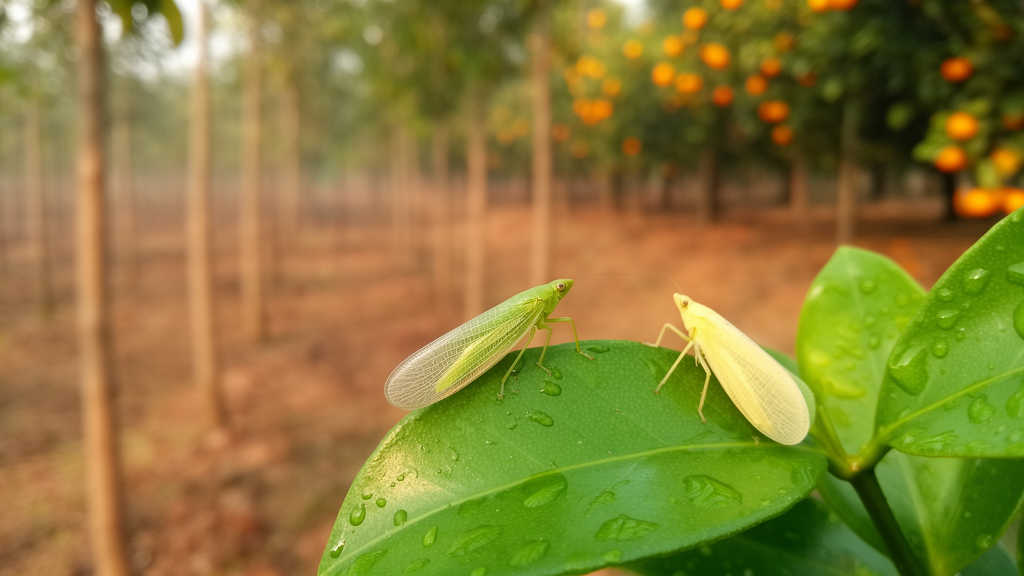
Deep in the rain forest patches of Petén, Guatemala, community members working a commercial teak plantation noticed something odd on their crop: small, strikingly patterned leafhoppers clustered in apparently high-density populations on the leaves. Concerned about potential pest damage, they reported the insects to researchers. The specimens that followed turned out to belong to a genus never before recorded in Central America — and they were not alone. A new taxonomic study has now described three species of the leafhopper genus Pentoffia that are entirely new to science, two from the Mexican state of Jalisco and one from Guatemala, while also delivering the first updated checklist and identification key for every known species of the genus across the Neotropics.
The findings, published in the Deutsche Entomologische Zeitschrift, matter far beyond the catalog of names. Leafhoppers are among the most successful plant-feeding insects on Earth, with the family Cicadellidae alone containing more than 23,000 described species occupying nearly every terrestrial habitat that supports vascular plants. Within this enormous lineage, the subfamily Evacanthinae represents a diverse yet comparatively understudied branch, currently comprising 651 described species placed in 83 valid genera. Members of this subfamily show a pronounced affinity for humid forest ecosystems, which makes the discovery of three new species from dense forest habitats in Mesoamerica particularly significant — a region whose leafhopper fauna remains poorly documented.
The new study also reshapes our understanding of where the genus Pentoffia lives. Until now, seven of the ten known species were recorded from humid South American forests in Ecuador, Colombia, and Peru, with a single species, P. nigra, known from Veracruz, Mexico. The discovery of P. petenensis in Guatemala and P. tlaxomulco and P. manantlanensis in Jalisco now establishes four species in Mexico and Guatemala, highlighting a strikingly disjunct distribution and revealing conspicuous gaps in sampling across Central America. The Guatemalan species also represents the first record of the genus feeding on teak, Tectona grandis, a commercially valuable tree in the mint family.
Each of the three new species carries a name rooted in its geography. Pentoffia petenensis, described by J. A. Pinedo-Escatel, honors the Departamento de Petén, where the holotype and paratypes were collected in the Municipio La Libertad. Pentoffia manantlanensis, described by Pinedo-Escatel and Blanco-Rodríguez, refers to the Biosphere Reserve Sierra de Manantlán in Jalisco, near which all available records of the type series were collected. Pentoffia tlaxomulco, also described by Pinedo-Escatel, takes its name from a combination of Nahuatl words — tlalli (land), xomúlli (corner), and co (place) — referring to the “Land in the corner,” the region around Tlajomulco de Zúñiga where the single known specimen was hand-collected within a semi-urban area by Benjamín Hernández-Márquez and donated in late 2024.
The collecting circumstances behind each species tell their own story. The Guatemalan specimens were manually collected from a teak plantation surrounded by discontinuous patches of rain forest, with local community members initially discovering the insects and reporting concerns about their potential pest status on the crop host. Mexican specimens from Sierra de Manantlán were collected using a sweep net in a lemon plantation near the city of Autlán de Navarro, while the Tlajomulco specimen was hand-collected within a semi-urban area. All specimens were preserved directly into 95% ethanol and subsequently stored at –20 °C, a protocol that keeps internal structures intact for later morphological analysis.
That analysis followed a meticulous laboratory routine. Abdomens were removed and cleared in 10% potassium hydroxide at room temperature overnight, then rinsed in distilled water and transferred through absolute ethanol with at least three changes. Cleared abdominal structures were transferred to glycerin and stored in microvials placed beneath the corresponding pinned specimens. Overall habitus images were captured at the Laboratorio Nacional de Biodiversidad of the Universidad Nacional Autónoma de México using a ZEISS multifocal photography system equipped with an AxioCam MRc5 camera. Terminology follows established standards for leafhopper morphology, wing venation follows the Anufriev and Emeljanov system, and leg chaetotaxy follows Rakitov. All studied material is housed in the Colección Nacional de Insectos in Mexico City.
What makes each species distinct comes down to a combination of external color pattern and internal genital architecture. Pentoffia petenensis males display black bodies with light orange and yellowish marks on the crown and a bold orange costal margin on the forewing, with a central T-shaped band running from the crown over the pronotum and scutellum. Females fade to whitish with a single black longitudinal T-band. The species is diagnosed by the size of the transverse black band of the crown, the overall light orange dorsal band, and atrial processes of the aedeagus bearing an asymmetric uniseriate tooth on the ventral margin. Males measure 6.09 millimeters in body length, females 7.85 millimeters.
Pentoffia manantlanensis males show black coloration with pale marks on the crown, pronotum, scutellum, and forewing, with a broad central T-shaped line and a single faint black stripe next to each eye. The species is distinguished by its dorsal color pattern, aedeagal atrial processes that cross near the base, and a truncate aedeagal apex in ventral view. It was collected from Citrus × limon, adding a second cultivated host association to the genus. Pentoffia tlaxomulco, known only from a single male, is darker overall than its congeners, with a broad T-band covering most of the crown surface and atrial processes notoriously larger and more slender than the connective. The female of this species remains unknown, as do its host plant and biology.
The study also provides an updated dichotomous key to all eleven known species of Pentoffia, an annotated species list with repositories, distributional notes, and a distribution map. The key relies on characters such as the number of longitudinal black stripes on the pronotum, forewing coloration, the arrangement of atrial processes, and the shape of the aedeagal shaft. The tribe Pentoffiini, to which the genus belongs, can be readily distinguished from other Evacanthinae tribes by the absence of ocelli — a strong defining diagnostic character at the tribal level — and currently comprises ten described species, now expanded to eleven with the three new additions replacing the previous count.
Phylogenetic analyses have recovered Pentoffiini as monophyletic, with Pentoffia placed as the sister taxon to Evanirvana, a genus containing two species from Brazil and Peru. The tribe was recovered as sister to the Oriental tribe Balbillini. Knowledge of the biology and host plant associations of Pentoffiini remains scarce, and most species are known from their type localities based on limited material, often represented solely by type series. The authors note that future studies integrating broader geographic sampling, comparative morphology, and molecular phylogenetics will be needed to resolve species boundaries, elucidate the evolutionary drivers of contrasting color patterns, and fill gaps in distribution across Central America — a region that remains poorly sampled for many leafhoppers.
Subject of Research: Taxonomic description of three new Pentoffia leafhopper species from Guatemala and Mexico
Article Title: On the Evacanthinae leafhopper genus Pentoffia Kramer ( Hemiptera , Cicadellidae ), with description of three species from Guatemala and Mexico, checklist, and key to all known Neotropical species
Article References: Pinedo-Escatel, J. A., Blanco-Rodríguez, E., & García-Ochaeta, J. F. (2026). On the Evacanthinae leafhopper genus Pentoffia Kramer (Hemiptera, Cicadellidae), with description of three species from Guatemala and Mexico, checklist, and key to all known Neotropical species. Deutsche Entomologische Zeitschrift, 73(1), 63-77. https://doi.org/10.3897/dez.73.166554
Image Credits: AI Generated
Keywords: Pentoffia, Evacanthinae, Cicadellidae, leafhoppers, new species, Guatemala, Mexico, taxonomy, leafhopper, genus, Kramer, Hemiptera
News Source: Gavin Prescott. (October 17, 2026). Three New Leafhopper Species Emerge From Teak Fields and Citrus Groves. Scienmag.