Infected wounds are among the most stubborn problems in modern medicine. When the skin barrier is breached, bacteria colonize the exposed tissue and can sustain a pro-inflammatory microenvironment that interferes with tissue remodeling, often converting acute injuries into chronic lesions. Studies have shown that more than 90 percent of chronic wounds are accompanied by bacterial infection, and without effective treatment the microbes can form persistent biofilms and trigger severe complications including bacteremia and septic shock. Conventional antibiotics and wound dressings struggle against drug-resistant bacteria and biofilm-associated infections, while long-term antibiotic use accelerates resistance, prolongs inflammation, and impairs healing. A research team in China now reports an antibiotic-free alternative: a sprayable hydrogel loaded with a light-activated crystalline photocatalyst that kills bacteria on demand and accelerates the repair of infected skin wounds.
The new material, described in Frontiers in Cellular and Infection Microbiology, is built around a viologen-functionalized metal-covalent organic framework, or Vio-MCOF, developed by researchers at Guangdong Pharmaceutical University, Jinan University, Guangdong Medical University, and Guangzhou Medical University. The work harnesses antibacterial photodynamic therapy, a modality in which a photosensitizer absorbs light and generates reactive oxygen species, or ROS, that damage bacterial membranes, proteins, and genetic material. Because the killing action is switched on only by illumination and relies on oxidative stress rather than a specific molecular target, aPDT offers excellent spatiotemporal control and a low risk of inducing bacterial resistance. The catch has always been the photosensitizer itself: many small-molecule agents used in wound therapy are photounstable, bind weakly to bacteria, and produce insufficient ROS to clear an infection.
The team’s solution was to covalently embed viologen units directly into the backbone of a metal-covalent organic framework during synthesis. Viologen is a cationic, redox-active unit with visible-light absorption and reversible electron-transfer properties. In the composite, the viologen fragments act as electron mediators that capture and shuttle photogenerated electrons, working cooperatively with copper-cluster active sites to suppress charge recombination, the wasteful process in which excited electrons fall back into holes before they can do useful chemistry. Suppressing that recombination allows more of the absorbed light energy to flow into ROS production. The permanent positive charge of the viologen units adds a second advantage: it generates electrostatic attraction to the negatively charged membranes of bacteria, pulling the catalyst into intimate contact with pathogens and shortening the distance that short-lived ROS must diffuse to deliver a lethal blow.
The choice of framework chemistry matters as much as the viologen. Metal-organic frameworks offer high surface areas and abundant metal active sites but are held together by weak coordination bonds that tend to collapse under physiological conditions. Covalent organic frameworks, by contrast, are stitched together with robust covalent linkages that survive in the body, but they lack efficient metal catalytic centers, which leads to rapid photogenerated electron-hole recombination and limited photodynamic activity. Metal-covalent organic frameworks merge the best of both worlds, combining stable covalent skeletons with accessible copper-cluster catalytic sites. Free viologen small molecules present their own problem: they are highly water soluble and structurally unstable, so they readily diffuse away from the wound site and leach into surrounding tissues, raising biosafety concerns. Covalent anchoring into the crystalline porous framework preserves the viologen’s photophysical and bacteria-binding properties while eliminating the leakage.
Synthesis proceeded through a solvothermal aldehyde-amine condensation using a Cu3 cluster as the metal node and either a diaminotetraphenyl linker, yielding DAQP-MCOF, or the viologen amine Vio-NH2, yielding Vio-MCOF. Powder X-ray diffraction confirmed ordered crystalline architectures for both materials, with characteristic low-angle diffraction peaks assignable to the (110), (220), (101), and (330) crystal planes. Fourier transform infrared spectroscopy showed the aldehyde C=O stretching peak of the free precursor at 1662 cm-1 markedly diminished in both frameworks, replaced by new Schiff-base C=N peaks at 1620 cm-1, evidence of successful framework assembly. X-ray photoelectron spectroscopy revealed that copper was present as a mixture of +1 and +2 oxidation states with satellite peaks characteristic of open-shell copper centers, and that this local coordination environment was well preserved after viologen incorporation. Scanning electron microscopy showed both materials self-assemble into spherical agglomerates stacked from primary nanosheets, a hierarchical morphology that provides large surface area for light capture, charge transport, and contact with bacterial cells.
Optical and electrochemical measurements then revealed why the viologen version outperforms its plain counterpart. Both frameworks absorb broadly across the 300 to 1500 nm range, indicating excellent light-harvesting capability, but Tauc plot analysis gave optical band gaps of 2.46 eV for DAQP-MCOF and only 1.72 eV for Vio-MCOF, the narrower gap reflecting improved utilization of simulated solar light. Mott-Schottky tests identified both materials as n-type semiconductors, with conduction band positions of -0.773 and -0.543 eV versus NHE and valence band positions of 1.687 and 1.177 eV respectively. Those band alignments satisfy the thermodynamic requirement for oxygen reduction to generate superoxide radicals, which may subsequently evolve into hydrogen peroxide. Transient photocurrent response tests delivered the most telling result: Vio-MCOF produced a much stronger photocurrent than DAQP-MCOF, indicating that the anchored viologen traps photogenerated electrons, suppresses electron-hole recombination, and opens efficient electron-transfer pathways through the copper clusters.
The antibacterial numbers are striking. In the dark, both MCOFs showed only mild, concentration-dependent bacteriostatic effects, though Vio-MCOF performed somewhat better against Staphylococcus aureus, likely because its more positive surface potential strengthens electrostatic adhesion to bacterial membranes. Under illumination from a 300 W xenon lamp with an AM1.5 filter, the picture changed dramatically. At 100 micrograms per milliliter, DAQP-MCOF achieved an antibacterial rate exceeding 84.2 percent against S. aureus, while Vio-MCOF exceeded 96.6 percent. At 200 micrograms per milliliter, Vio-MCOF nearly completely eradicated Escherichia coli, reaching an antibacterial rate of 99.9 percent, and achieved a bactericidal rate of over 99 percent against S. aureus after just 30 minutes of simulated solar light. The residual dark activity may arise partly from copper-ion release and the cationic surface charge, but the dominant killing mechanism is clearly light-triggered ROS generation.
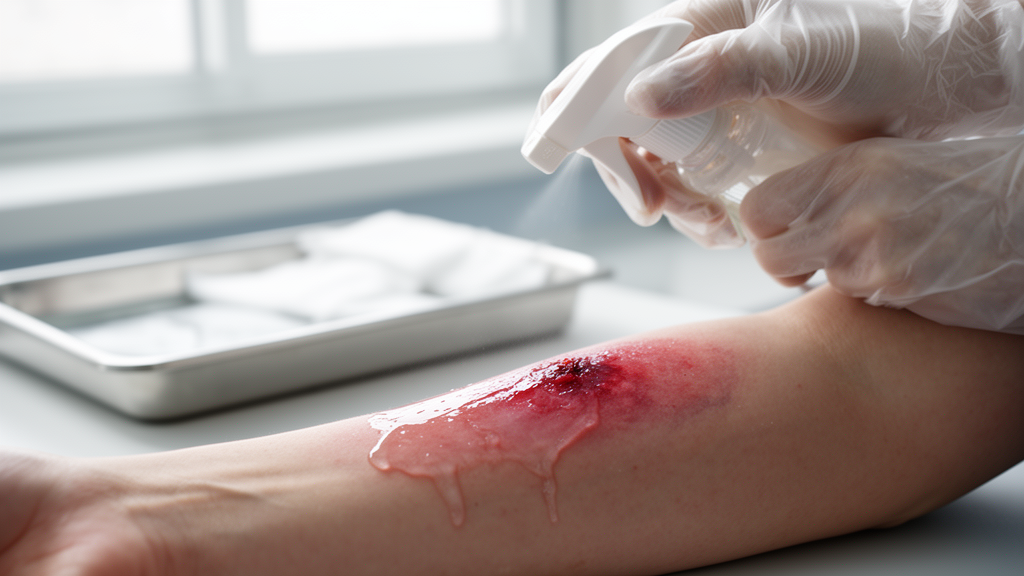
To turn the powder into a practical dressing, the researchers dispersed Vio-MCOF into a sprayable, ionically crosslinked sodium alginate hydrogel. Two precursor solutions are sprayed onto one another at the wound site: a 1.5 weight percent sodium alginate solution containing 2 milligrams per milliliter of MCOF, and a 3 weight percent calcium chloride solution. When the two streams meet, calcium ions crosslink the alginate carboxylate groups and a self-supporting hydrogel network forms within roughly five seconds, conforming to irregular wound surfaces that preformed dressings cannot easily cover. Electron microscopy of the freeze-dried gel showed a highly porous, three-dimensional interconnected network with the MCOF nanoparticles uniformly embedded in the polymer walls, without aggregation or phase separation. That porous architecture permits light penetration, exudate absorption, and gas exchange, while the alginate matrix immobilizes the catalyst and prevents material loss. In vitro testing confirmed the gel retained the photocatalyst’s potency: after light activation, Vio-MCOF-Gel achieved a 99.1 percent antibacterial rate against S. aureus, compared with 86.3 percent for the DAQP-MCOF gel, while a blank hydrogel showed essentially no intrinsic antibacterial activity.
Biosafety results were reassuring. The free Vio-MCOF powder inhibited proliferation of L929 mouse fibroblasts at relatively high concentrations of 50 and 100 micrograms per milliliter, but the hydrogel matrix effectively attenuated this cytotoxicity, apparently by restricting release and keeping the local concentration below the toxic threshold, and the composite gel caused no significant reduction in cell viability. Hemolysis assays showed all material groups fell below the 5 percent safety threshold, indicating good blood compatibility. In vivo, the team established full-thickness 10 mm wounds on the dorsal skin of C57BL/6 mice and inoculated them with S. aureus. Mice treated with the hydrogel plus 30 minutes of light irradiation showed significantly accelerated wound closure over 10 days, the lowest bacterial burden in wound tissue on day 3, reduced inflammatory cell infiltration, and markedly lower expression of the pro-inflammatory cytokines TNF-alpha and IL-6. Histology revealed orderly, densely deposited collagen fibers, and immunostaining showed upregulated CD31, a marker of new blood vessel formation, indicating that the treatment promoted angiogenesis alongside bacterial clearance.
The authors acknowledge limitations that temper the enthusiasm. The therapeutic evaluation covered only an acute S. aureus-infected full-thickness wound model, not the more challenging chronic settings such as diabetic or ischemic wounds where translational value would ultimately be proven. Direct ROS detection was not performed, and the effects of irradiation conditions and dosage on long-term antibacterial and antibiofilm performance remain to be examined in detail. The in vivo degradation behavior, metabolic products, and long-term biosafety of Vio-MCOF also require further investigation, and the team plans to optimize hydrogel formulations and light-treatment parameters to extend the system to chronic infected wounds. Even so, the study demonstrates a compelling design principle: covalently embedding an electron-mediating, positively charged unit into a hybrid framework that pairs covalent stability with metal catalysis can simultaneously solve the stability, adhesion, and ROS-yield problems that have limited photodynamic wound therapy. If the approach survives testing in chronic wound models, a light-activated spray-on dressing that heals infected wounds without a single molecule of antibiotic could become a genuinely disruptive addition to the clinic.
Subject of Research: Light-activated viologen-based metal-covalent organic framework sprayable hydrogel for accelerated healing of infected skin wounds
Article Title: Light-activated viologen-based metal-covalent organic framework sprayable hydrogel for accelerated healing of infected skin wounds
Article References: Feng, L.-J., Tong, J.-L., Xie, Q.-X., Wen, M.-N., Ma, X.-Z., Zang, Y., Zhong, J.-R., Yao, J., Li, X.-M., Zhao, B., & Tang, P. (2026). Light-activated viologen-based metal-covalent organic framework sprayable hydrogel for accelerated healing of infected skin wounds. Frontiers in Cellular and Infection Microbiology, 16, Article 1975470. https://doi.org/10.3389/fcimb.2026.1975470
Image Credits: AI Generated
DOI: 10.3389/fcimb.2026.1975470
Keywords: Light-activated, viologen-based, metal-covalent, organic, framework, sprayable, hydrogel, accelerated, healing, infected, skin, wounds
News Source: Drew Townsend. (October 17, 2026). Spray-on hydrogel kills wound bacteria with light-activated framework. Scienmag.