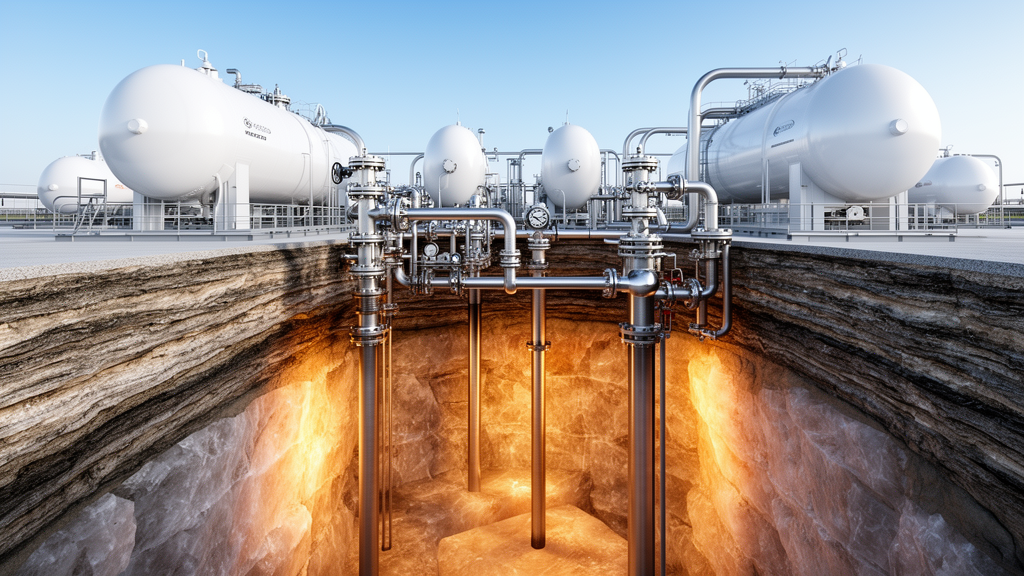
A comprehensive thermodynamic investigation has evaluated eleven equations of state against nearly two thousand experimental data points to determine how accurately standard engineering models predict the real-gas behaviour of pure hydrogen across surface and subsurface storage systems. Conducted by researchers Konstantinos Charalampous, Charalampos Konstantinou, and Panos Papanastasiou, the study reveals that no single thermodynamic equation delivers optimal performance across all operational environments. Instead, the accuracy of each mathematical formulation depends directly on the specific pressure and temperature window governing a given storage configuration. By assessing predictive deviations across pipeline infrastructure, specialized high-pressure tanks spanning Types I through V, deep geological salt caverns, and depleted hydrocarbon reservoirs, the authors demonstrated that selecting application-tailored equations significantly reduces systematic calculation errors. These findings establish clear engineering boundaries for predictive models widely used in commercial process engineering and reservoir simulation software, providing critical technical guidance for designing reliable storage systems required for the broader transition to renewable energy.
The expansion of green hydrogen as a versatile, low-carbon energy carrier is central to overcoming the intermittent power generation associated with solar and wind installations. Producing hydrogen via water electrolysis powered by surplus renewable electricity allows energy systems to balance supply with fluctuating demand over extended operating cycles. However, storing compressed gaseous hydrogen at scale introduces profound engineering complexities because its thermodynamic properties diverge substantially from classical fluids. Unlike heavier natural gas components historically modelled in oil and gas operations, pure hydrogen possesses an exceptionally low molecular weight of 2.016 grams per mole, a critical temperature of 33.2 Kelvin, and a critical pressure of 1.3 megapascals, along with an unusual Pitzer acentric factor of negative 0.218. At low temperatures and elevated densities, quantum mechanical behaviours and significant zero-point energies alter intermolecular repulsive and attractive forces in ways that standard equations of state struggle to reproduce without targeted mathematical modifications.
To rigorously evaluate how different models handle these physical anomalies, the research team assembled a comprehensive empirical database comprising 1979 individual experimental measurements of pure hydrogen volume, density, pressure, and temperature compiled across 16 published investigations. This extensive compilation spans an extraordinarily broad operating envelope, with pressures ranging from 0.1 to 2250 megapascals and temperatures extending from cryogenic conditions of 23 Kelvin up to 873 Kelvin. The underlying experimental data were obtained through several established laboratory techniques, predominantly the gas expansion pressure-volume-temperature apparatus consisting of dual rigid, piston-less high-pressure and low-pressure chambers. Other primary data sources utilized the Burnett method, which derives compressibility factors through controlled incremental expansions in sealed chambers of fixed volume, as well as the Michels method, which relies on direct volumetric measurements to enhance precision at elevated temperatures. The reported experimental measurement uncertainties across the compiled studies were exceptionally tight, typically falling between 0.07 and 0.5 percent in density and remaining at or below 0.2 percent overall across temperature measurement scales progressing historically from ITS-27 to ITS-90.
The investigation tested eleven distinct equations of state that represent the primary thermodynamic frameworks currently implemented in commercial reservoir simulators and industrial engineering software. These included three variants from the Redlich-Kwong family: the classical Redlich-Kwong-Soave formulation, the Mathias-Copeman modification which introduces compound-specific parameters into the attractive temperature term, and the Redlich-Kwong-Soave square-well formulation designed to capture supercritical interactions. From the Peng-Robinson family, the team assessed the standard Peng-Robinson equation alongside four specialized variants featuring diverse alpha functions: the Mathias-Copeman, Twu, Stryjek-Vera, and Gasem adaptations. Completing the eleven models were the two-parameter Nasrifar-Bolland equation, initially developed for natural gas systems with square-well potentials, the three-parameter Patel-Teja model that incorporates a flexible critical compressibility factor to improve liquid density calculations, and the Valderrama adaptation of Patel-Teja, known as PTV, which simplifies parameter estimation while maintaining high precision for light gases and gas hydrate calculations.
Evaluating these formulations across the entire experimental envelope demonstrated pronounced variations in global predictive capability when measured using root mean square error, mean absolute error, and their respective normalized forms. Across the full pressure spectrum, the Stryjek-Vera modification of the Peng-Robinson model achieved the highest absolute precision, exhibiting the lowest normalized root mean square error of 0.2026 and a normalized mean absolute error of 0.0777. The Valderrama Patel-Teja equation also performed exceptionally well for pressure estimation, achieving a normalized root mean square error of 0.7557 and a normalized mean absolute error of 0.1516. Conversely, the Nasrifar-Bolland equation exhibited substantial pressure inaccuracies across extreme ranges, yielding an elevated normalized root mean square error of 4.3238. When evaluating temperature predictions, the Mathias-Copeman Peng-Robinson variant proved to be the most accurate model overall, recording a normalized root mean square error of 0.2579 and a normalized mean absolute error of 0.0826, whereas the Stryjek-Vera Peng-Robinson formulation exhibited the largest temperature deviations with a normalized root mean square error of 0.7196.
A critical analytical finding from the research is the pronounced structural asymmetry observed when using the same thermodynamic equation to solve for pressure versus temperature. Cubic equations of state are explicit in pressure, calculating it directly as a polynomial function of temperature and molar volume, whereas determining temperature requires numerical inversion of the underlying formulation. Because pressure exhibits extreme sensitivity to slight variations in gas density and compressibility, minor temperature inaccuracies become substantially amplified when solving directly for pressure, an effect that is especially severe in hydrogen gas due to steep compressibility gradients. Furthermore, classical cubic equations were shown to lose predictive accuracy dramatically at temperatures below approximately 100 Kelvin and at pressures exceeding 250 megapascals. Because standard cubic equations rely on empirical classical potentials that omit quantum corrections, they fail to capture the quantum statistical behavior and zero-point energy present in cryogenic hydrogen regimes, underscoring the absolute necessity of utilizing quantum-corrected equations incorporating Wigner-Kirkwood expansions when designing extreme cryogenic applications.
Because global database rankings can be biased by regional data clustering, the researchers isolated operational pressure-temperature windows to establish tailored recommendations for surface pipeline infrastructure. For steel pipe storage operating under low-pressure conditions where hydrogen behaves relatively close to an ideal gas, the Valderrama Patel-Teja model emerged as the most appropriate thermodynamic equation overall, delivering the lowest error metrics for pressure estimation alongside the Mathias-Copeman Redlich-Kwong formulation, while the square-well and Valderrama models provided the best temperature estimations. For plastic pipe distribution systems, both the Mathias-Copeman Redlich-Kwong and Valderrama Patel-Teja equations demonstrated exceptional alignment along the one-to-one parity line for both pressure and temperature predictions. The authors noted that the modest compression levels characteristic of pipeline transportation restrict compressibility deviations, allowing the volume-translation parameters of the Valderrama model and the flexible alpha functions of the Mathias-Copeman model to achieve near-interchangeable, highly accurate volumetric predictions.
Surface storage vessels operating at higher pressure thresholds exhibited distinctly different thermodynamic requirements across standard engineering classifications. For vehicle storage tanks and metallic Type I storage cylinders, which typically operate between 250 and 700 bar at temperatures from 233 to 338 Kelvin, the Redlich-Kwong-Soave equation proved to be the most reliable formulation, closely followed by the Twu-modified Peng-Robinson model. For Type II composite hoop-wrapped cylinders operating between 700 and 875 bar, as well as lightweight carbon-fiber Type IV tanks operating across similar pressures, the Twu Peng-Robinson model delivered superior pressure calculations, with the Redlich-Kwong-Soave equation serving as a robust secondary alternative. In the highest-pressure regimes, encompassing Type III full composite tanks operating between 875 and 1100 bar and emerging liner-less Type V composite vessels exceeding 875 bar, the Twu Peng-Robinson equation provided the highest precision for pressure determinations, while the Nasrifar-Bolland, Twu, and Redlich-Kwong-Soave formulations provided superior temperature correlations, reflecting the dominant repulsive intermolecular forces encountered at ultrahigh gas densities.
For large-scale underground hydrogen storage designed to buffer seasonal energy disparities, the study examined the thermodynamic regimes of subsurface geological formations. Salt caverns, which operate at pressures between 10 and 30 megapascals and temperatures spanning 18 to 80 degrees Celsius, were best represented by the Redlich-Kwong-Soave equation when balancing both pressure and temperature accuracy, with the Mathias-Copeman Redlich-Kwong formulation offering strong pressure fidelity. In deeper depleted gas and oil reservoirs, where operating conditions reach higher pressures of 10 to 80 megapascals and temperatures between 40 and 140 degrees Celsius, the Redlich-Kwong-Soave and Twu Peng-Robinson formulations jointly provided the most accurate predictive capabilities. The authors emphasized that because geological formations occupy moderate-pressure and elevated-temperature envelopes, no single intermolecular force completely dominates gas behavior, allowing the balanced co-volume and attractive parameters of the Redlich-Kwong-Soave equation to track real-gas compressibility departures reliably without inducing mathematical over-correction.
To provide immediate, practical engineering utility without requiring iterative equation solving, the authors generated continuous empirical regression surfaces and implemented a machine learning random forest model trained on 1496 data points relevant to hydrogen storage. A global fifth-order polynomial surface correlating pseudoreduced temperature and pseudoreduced pressure achieved an exceptional coefficient of determination of 0.984 with a root mean square error of 0.3828. A more focused polynomial calibrated specifically for storage conditions up to 150 megapascals and 550 Kelvin achieved an R-squared value of 0.9481 and a root mean square error of 0.1202. The random forest regression model, built using 500 decision trees with an mtry value of 1, achieved an outstanding R-squared of 0.968, a root mean square error of 0.0957, and a mean absolute error of 0.0332 on independent testing data, corroborated by repeated five-fold cross-validation and out-of-bag validation. Variable importance analysis based on the Gini index revealed that pseudoreduced temperature accounts for 54 percent of the predictive importance compared to 46 percent for pressure, confirming that thermal sensitivity exerts the dominant influence on hydrogen deviation factors across practical storage operations.
Subject of Research: Evaluation of thermodynamic equations of state for surface and underground hydrogen storage
Article Title: Applicability of equations of state across a range of pressure and temperature conditions for surface and underground hydrogen storage
Article References: Charalampous, K., Konstantinou, C., & Papanastasiou, P. (2026). Applicability of equations of state across a range of pressure and temperature conditions for surface and underground hydrogen storage. Discover Energy, 6(1), Article 91. https://doi.org/10.1007/s43937-026-00177-w
Image Credits: AI Generated
DOI: 10.1007/s43937-026-00177-w
Keywords: hydrogen storage, equations of state, thermodynamics, gas deviation factor, underground hydrogen storage, salt caverns, depleted reservoirs, compressibility factor, random forest model, pressure volume temperature, Applicability, equations
News Source: Denise Maddox. (November 12, 2026). Thermodynamic Equations Evaluated Across Pressures for Surface and Underground Hydrogen Storage. Scienmag.