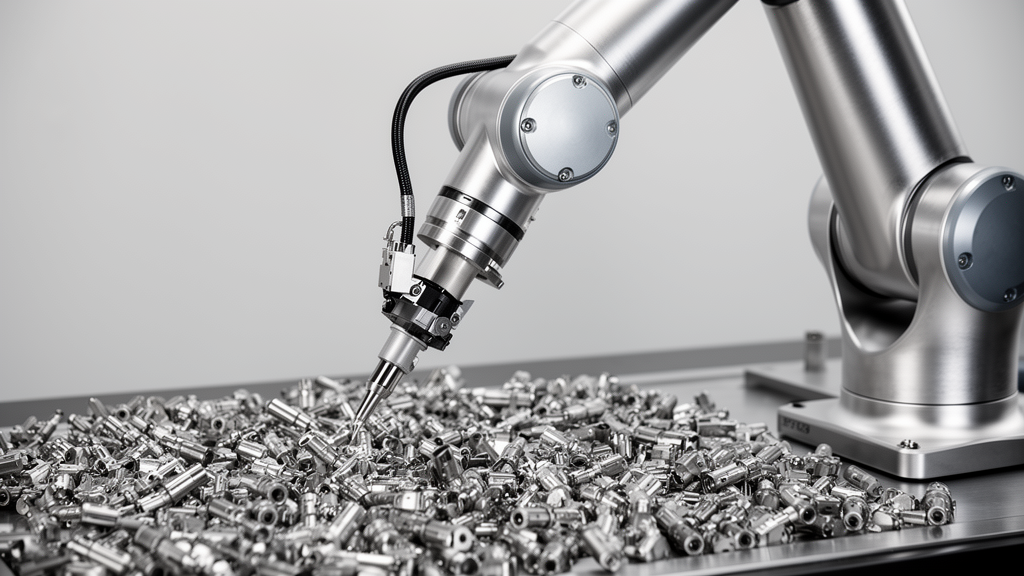
A novel motion control framework for redundant robot manipulators, termed Obstacle Avoidance Manipulability Optimization (OAMO), has been developed to enable real-time end-effector tracking while simultaneously ensuring singularity avoidance and whole-arm obstacle clearance in cluttered workspaces. Redundant manipulators possess more degrees of freedom than are strictly required for a task, creating a challenge in simultaneously optimizing end-effector precision and internal arm configuration. Conventional reactive controllers or task-priority frameworks often handle these requirements in separate stages, which can lead to degraded tracking performance or task failure when whole-arm collision avoidance constraints are introduced. The OAMO approach solves this by consolidating end-effector trajectory tracking, manipulability enhancement, and link-level obstacle avoidance into a single quadratic program (QP) formulated in joint-velocity space. By addressing these competing objectives within a unified optimization loop, the scheme maintains high kinematic dexterity and keeps the entire manipulator structure safe from contact with environmental obstacles.
The technical foundation of the OAMO scheme rests on a robust method for managing manipulability, which is traditionally defined as a non-convex measure that can be computationally burdensome. Near kinematic singularities, the gradient of this manipulability measure typically becomes ill-conditioned, amplifying numerical noise and resulting in unstable control commands. To circumvent this, the researchers applied a first-order Taylor expansion to the manipulability measure, incorporating Tikhonov damping. This damping mechanism replaces the numerically volatile inverse gradient near singularities with a well-conditioned surrogate. The constant term in the expansion is omitted, as it does not influence the minimizer, while the damping ensures that the manipulability-gradient remains bounded even as the configuration nears singular states. As the damping factor approaches zero, the exact gradient limit is recovered, allowing the controller to maintain numerical stability without sacrificing kinematic dexterity.
Within the quadratic program, the control objective is further constrained by hardware-specific limits, including joint-velocity and joint-acceleration box constraints. The avoidance of static obstacles is incorporated through distance-activated half-space constraints that act on each link of the manipulator. By using a closest-point query interface, the system determines the distance between the robot links and obstacles, applying these constraints only when a safe distance threshold is breached. This ensures that the robot maintains a healthy clearance from its surroundings without introducing unnecessary motion constraints when far from objects. The resulting convex optimization problem is solved using a projection neural dynamics recursion, which has been analytically proven to converge globally to the Karush–Kuhn–Tucker (KKT) optimum at every sampling instant.
To validate the OAMO framework, the research team conducted a series of simulation experiments using a 6-degree-of-freedom UR5e redundant manipulator. The studies included three specific scenarios: fixed-position reconfiguration, closed-contour tracking, and navigating an obstacle-laden spiral trajectory. In the first experiment, the manipulator was tasked with maintaining a stationary end-effector position while reconfiguring its internal joints to increase manipulability. In both obstacle-free and obstacle-laden conditions, the arm successfully escaped singular initial configurations. When an obstacle was introduced, the system prioritized whole-arm avoidance, demonstrating that the OAMO formulation treats avoidance as a hard constraint that effectively coexists with the manipulability-ascent objective, maintaining the tracking error within the millimeter range throughout the process.
In the second case study, the manipulator was programmed to track a complex closed-contour spline generated from image data. This test evaluated the robot’s ability to maintain tracking accuracy while navigating curved paths in environments with multiple spherical obstacles. The results showed that the OAMO-controlled manipulator consistently adjusted its configuration to avoid collisions while keeping the end-effector overlapping with the reference path. During segments where constraints were heavily active, such as in tight detour windows around obstacles, the joint velocities remained well-behaved and within prescribed box constraints. The internal configuration reached terminal manipulability values higher than those recorded in obstacle-free versions of the same trajectory, suggesting that avoidance-induced reconfigurations can occasionally provide more room for the manipulability objective to act.
A critical benchmark for the OAMO scheme was Experiment 3, which compared its performance against established baseline methods, including the reactive NEO controller and a task-priority null-space approach. In the obstacle-laden spiral trajectory scenario, the OAMO method achieved a mean tracking error of approximately 0.113 meters, significantly outperforming the best baseline, a NEO variant that resulted in a mean tracking error of 0.490 meters. Several variants of the null-space and NEO methods failed to complete the task entirely, suffering from singular configurations or constraint conflicts that led to task failure. The OAMO scheme maintained a terminal tracking error at the millimeter scale, proving that it can successfully achieve sub-millimeter precision at the trajectory’s end while maintaining whole-arm safety throughout the entire path.
Performance efficiency was another key focus of the study, with the per-step solver time recorded in the millisecond range. This computational speed is essential for online motion control, as it allows the controller to function within high-frequency servo loops. While some task-priority methods showed lower per-step execution times, they often sacrificed whole-arm obstacle avoidance or failed to maintain tracking performance in complex scenarios. OAMO offers a superior balance by delivering low tracking errors and robust obstacle clearance without exceeding the computational limits of standard real-time robotic hardware, as demonstrated by the use of an Intel Xeon-based workstation.
Despite these findings, the study highlights several limitations that define the current scope of the OAMO approach. The controller is formulated strictly at the kinematic velocity level and does not explicitly integrate dynamic models, friction, contact forces, or actuator delays. Furthermore, the reliance on a first-order Taylor approximation means that the manipulability improvement is managed through local updates rather than global path optimization. While the UR5e simulation provides a strong proof of concept, the performance on physical robotic platforms, particularly under conditions of uncertainty or dynamic obstacles, remains to be explored in future work. The current study is restricted to spherical obstacle models and static environments, and extension to complex, general-purpose collision geometries is necessary for real-world applications.
The potential for scaling the OAMO framework to higher-degree-of-freedom manipulators is a subject of ongoing consideration. The formulation is not inherently limited to 6-DOF systems; the underlying matrices and vectors can be adapted to any finite number of joints, provided the task dimension remains constant. For larger systems, the primary computational cost lies in constructing the quadratic and obstacle-related matrices, which scales with the number of active link–obstacle pairs. Future developments could utilize sparse Jacobian structures, parallel gradient evaluation, or incremental SVD updates to mitigate computational overhead. These advancements would enable the OAMO scheme to maintain its millisecond-scale performance even as robot architectures grow more complex.
Ultimately, this research provides a integrated solution to one of the most persistent problems in redundant robotics. By embedding manipulability optimization and whole-arm avoidance into a single, solver-friendly QP structure, the authors have bridged the gap between tracking precision and configuration quality. The convergence proof for the projection neural dynamics solver ensures that the system reliably reaches an optimal KKT state, a feature that distinguishes it from more heuristic-based reactive approaches. The documented effectiveness of OAMO in maintaining low tracking errors in confined, cluttered spaces marks a significant step forward for redundant motion planning, establishing a new framework that prioritizes both safety and operational flexibility in robotic control systems.
The tuning of the multi-objective cost function reveals practical operational balances between competing robotic demands. For straightforward motions, the framework assigns objective weights of 10.0 to trajectory tracking, 1.0 to manipulability maximization, 0.01 to velocity smoothing, and 0.0001 to regularization. In contrast, following complex curves with a high manipulability weight causes noticeable joint oscillations because the configuration-space ascent actively competes with the shifting trajectory vector. To suppress these fluctuations, the authors scale the manipulability weight down to between 0.2 and 0.5 during curved tracking, maintaining smoothness and path fidelity while retaining obstacle avoidance.
Operating rates and numerical solver settings are similarly tailored to keep the local linearization valid throughout execution. The control loop executes at sampling intervals of 10 milliseconds for the fixed-position and spiral trials and 20 milliseconds for closed-contour tests. Because the Taylor expansion evaluates locally at each sampling instant, larger intervals would induce excessive joint motion per step, undermining both manipulability estimates and linearized avoidance boundaries. To counteract trajectory drift inherent in open-loop numerical integration, the equivalent velocity target integrates a proportional position-feedback gain that drives exponential error decay. At each step, the recurrent neural dynamics routine runs with a stopping tolerance of 10−4, capped at 100 iterations for stationary reconfiguration and 50 iterations for moving trajectories.
Geometric collision evaluation and algebraic convergence properties complete the underlying control architecture. To generate the half-space avoidance constraints, the framework relies on a deterministic closest-point query returning link-to-obstacle distances and outward unit surface normals. Although the reported evaluations apply analytic queries to spherical obstacles, the same interface directly supports capsule primitives and external collision libraries such as the Flexible Collision Library. Analytically, the recurrent solver formulation pairs the primal velocity vector with dual Lagrange multipliers. The system Jacobian contains skew-symmetric off-diagonal blocks, establishing monotonicity over the closed convex constraint set and guaranteeing that continuous trajectories converge globally to the Karush–Kuhn–Tucker optimum.
Subject of Research: Real-time manipulability and obstacle avoidance optimization for redundant robot manipulators using projection neural dynamics.
Article Title: Real-time manipulability optimization with whole-arm obstacle avoidance for redundant manipulators via projection neural dynamics
Article References: Wu, T., Bezerra, R., & Yamazaki, K. (2026). Real-time manipulability optimization with whole-arm obstacle avoidance for redundant manipulators via projection neural dynamics. Frontiers in Robotics and AI, 13, 1915338. https://doi.org/10.3389/frobt.2026.1915338
Image Credits: AI Generated
DOI: 10.3389/frobt.2026.1915338
Keywords: robotics, redundant manipulators, manipulability optimization, quadratic programming, obstacle avoidance, kinematic singularities, neural dynamics, real-time control, whole-arm avoidance, trajectory tracking, UR5e, Tikhonov damping, KKT optimality, motion planning, redundancy resolution, robotic control systems, convex optimization, kinematic dexterity, joint-velocity constraints
News Source: Denise Maddox. (November 16, 2026). New Control Scheme Stabilizes Robot Manipulators for Real-Time Cluttered Workspace Navigation. Scienmag.