• HOME
  • NEWS
  • EXPLORE
    • CAREER
      • Companies
      • Jobs
    • EVENTS
    • iGEM
      • News
      • Team
    • PHOTOS
    • VIDEO
    • WIKI
  • BLOG
  • COMMUNITY
    • FACEBOOK
    • INSTAGRAM
    • TWITTER
Friday, May 15, 2026
BIOENGINEER.ORG
No Result
View All Result
  • Login
  • HOME
  • NEWS
  • EXPLORE
    • CAREER
      • Companies
      • Jobs
        • Lecturer
        • PhD Studentship
        • Postdoc
        • Research Assistant
    • EVENTS
    • iGEM
      • News
      • Team
    • PHOTOS
    • VIDEO
    • WIKI
  • BLOG
  • COMMUNITY
    • FACEBOOK
    • INSTAGRAM
    • TWITTER
  • HOME
  • NEWS
  • EXPLORE
    • CAREER
      • Companies
      • Jobs
        • Lecturer
        • PhD Studentship
        • Postdoc
        • Research Assistant
    • EVENTS
    • iGEM
      • News
      • Team
    • PHOTOS
    • VIDEO
    • WIKI
  • BLOG
  • COMMUNITY
    • FACEBOOK
    • INSTAGRAM
    • TWITTER
No Result
View All Result
Bioengineer.org
No Result
View All Result
Home NEWS Science News Chemistry

Thermo-chemical power generation integrated with forced convection cooling

Bioengineer by Bioengineer
November 27, 2019
in Chemistry
Reading Time: 2 mins read
0
IMAGE
Share on FacebookShare on TwitterShare on LinkedinShare on RedditShare on Telegram

IMAGE

Credit: Tokyo Tech

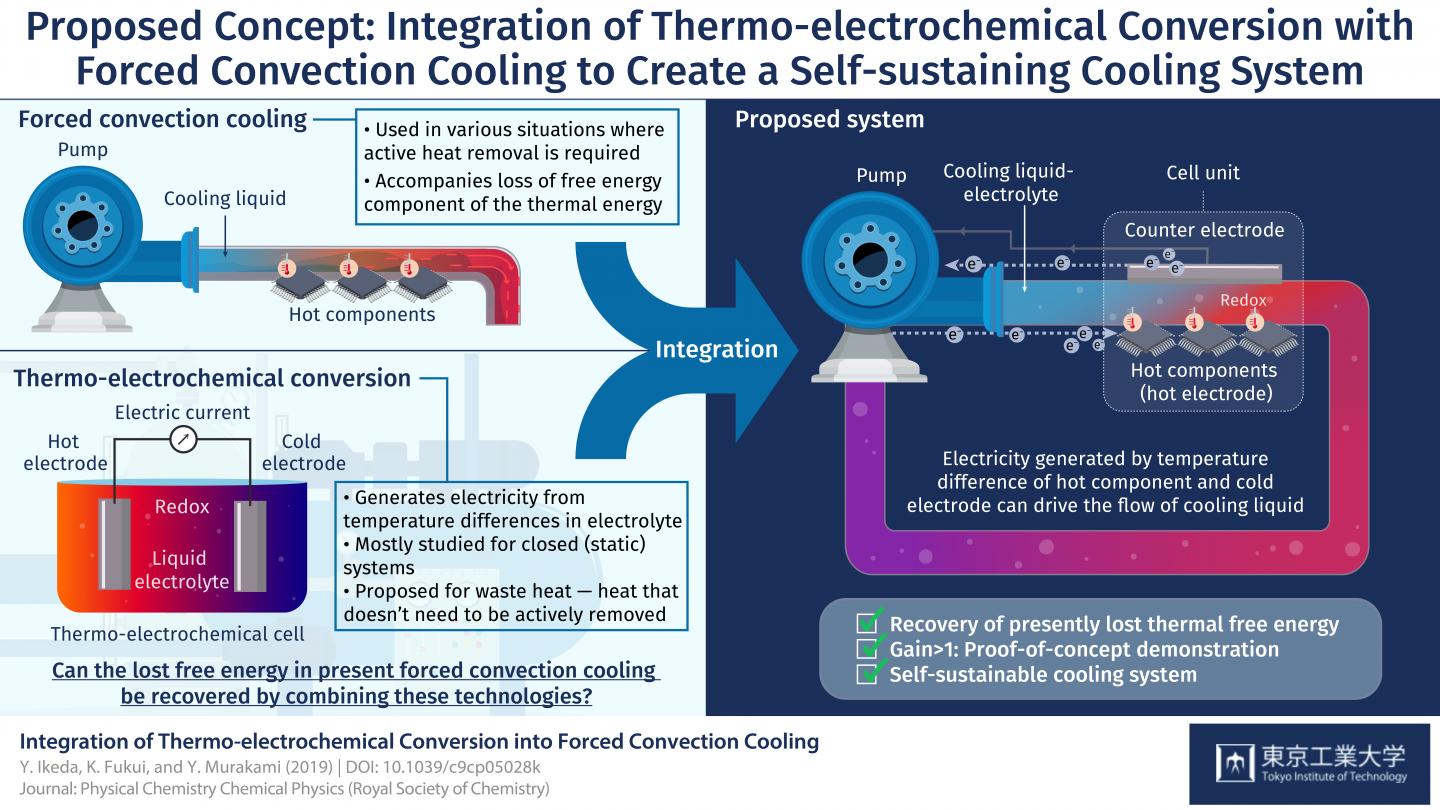
Active cooling is crucial in most modern technologies, ranging from microprocessors in data centers to turbines and engines. Forced convection cooling, which circulates a coolant fluid over the surface of a hot object, is effective for meeting such cooling requirements but demands a pumping power to send the coolant through the heat generating section. However, active cooling ? fast removal of a large quantity of thermal energy in the heat source under a large temperature difference ? promptly destroys the free-energy component of the thermal energy, which is an energy portion that can be converted to an electric work. This issue concomitant with forced convection cooling has remained unaddressed despite the widespread use of forced convection cooling in the current world.

One specific method for converting wasted heat ? the heat that doesn’t need to be actively removed ? into electrical energy through liquid chemical reactions has been studied for several decades. This method, called thermo-electrochemical conversion, involves the submergence of two electrodes held at different temperatures in a liquid electrolyte encased in a closed vessel, where a reversible reduction-oxidation (“redox”) reaction occurs. This reaction generates an electric current through an external circuit. Research on thermo-electrochemical conversion has been mostly carried out for static fluids.

In this study, a team of researchers from Tokyo Institute of Technology integrated thermo-electrochemical conversion with forced convection cooling to partly recover the aforementioned free-energy portion, presently lost during forced-convection cooling, in the form of electric power. In the cell developed by these researchers, the electrolyte liquid is flown as a coolant between two parallel electrodes, one of which is a heat-releasing object to be cooled. The redox reaction occurring in the cell generates electricity; this electricity can be used to drive the coolant flow through the cell. This work delves into uncharted territory, as the concept and feasibility of self-sustaining liquid-cooling system have not been previously demonstrated.

The researchers carried out detailed studies to elucidate how the cooling and power generation works in this type of forced-flow thermo-electrochemical system. These novel findings are expected to provide a basic strategy for scaled-up future applications. “Although the prototype cell developed in this study was small and thus the power generation performance was limited, this technology has much scope for improvement through optimizing the geometry of the liquid channel, electrode material, and the redox chemicals,” remarks Prof. Yoichi Murakami, the principle investigator of this project.

Through further studies, this concept proposed by the researchers can hopefully find its application in near future, providing a new technological platform for forced convection cooling. “Through this approach, we can partially recover the free energy portion of the thermal energy currently lost during forced convection cooling, and this acquired electric power can be used for pumping the coolant in forced convection cooling,” concludes Prof. Murakami.

###

Media Contact
Kazuhide Hasegawa
[email protected]
81-357-342-975

Original Source

https://www.titech.ac.jp/english/news/2019/045723.html

Related Journal Article

http://dx.doi.org/10.1039/c9cp05028k

Tags: Energy/Fuel (non-petroleum)Industrial Engineering/ChemistryTechnology/Engineering/Computer Science
Share12Tweet8Share2ShareShareShare2

Related Posts

Personalized beverages offer vital nutrients for space missions, new study reveals — Chemistry

Personalized beverages offer vital nutrients for space missions, new study reveals

May 15, 2026
Synthetic Cell Microreactor with Dual Dynamic DNA Pores — Chemistry

Synthetic Cell Microreactor with Dual Dynamic DNA Pores

May 15, 2026

Hanyang University Researchers Pinpoint 2.5 Nanometers as Minimum Coating Thickness for Durable Solid-State EV Batteries

May 15, 2026

Smart Hydrogels Revolutionize Information Security with Photo-Patterning and Multi-Stimuli Responsive Structural Colors

May 15, 2026
Please login to join discussion

POPULAR NEWS

  • Research Indicates Potential Connection Between Prenatal Medication Exposure and Elevated Autism Risk

    843 shares
    Share 337 Tweet 211
  • New Study Reveals Plants Can Detect the Sound of Rain

    729 shares
    Share 291 Tweet 182
  • Salmonella Haem Blocks Macrophages, Boosts Infection

    62 shares
    Share 25 Tweet 16
  • Breastmilk Balances E. coli and Beneficial Bacteria in Infant Gut Microbiomes

    58 shares
    Share 23 Tweet 15

About

We bring you the latest biotechnology news from best research centers and universities around the world. Check our website.

Follow us

Recent News

Personalized beverages offer vital nutrients for space missions, new study reveals

Innovative Ultrasonic Framework Enhances Real-Time Measurement of Oil Film Thickness in Rolling Bearings

HESpotEx: Deep Learning Predicts Gene Expression from Histology

Subscribe to Blog via Email

Enter your email address to subscribe to this blog and receive notifications of new posts by email.

Join 82 other subscribers
  • Contact Us

Bioengineer.org © Copyright 2023 All Rights Reserved.

Welcome Back!

Login to your account below

Forgotten Password?

Retrieve your password

Please enter your username or email address to reset your password.

Log In
No Result
View All Result
  • Homepages
    • Home Page 1
    • Home Page 2
  • News
  • National
  • Business
  • Health
  • Lifestyle
  • Science

Bioengineer.org © Copyright 2023 All Rights Reserved.