The heady math that describes how bubbles form in a glass of Champagne has inspired a framework for engineering living cells.
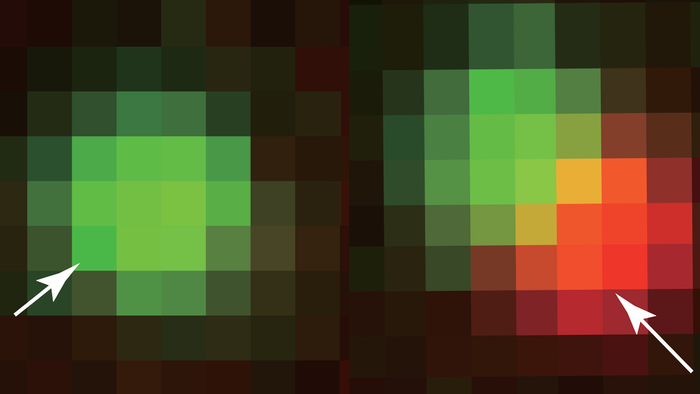
Credit: Image courtesy of the researchers
The heady math that describes how bubbles form in a glass of Champagne has inspired a framework for engineering living cells.
A study published Sep. 22 in Nature details how an established physics theory governing bubble and droplet formation led to a new understanding of the principles organizing the contents of living cells. The work marks a seismic shift in researchers’ ability both to understand and control the complex soft materials within our cells.
“This approach is common in materials science, but we’ve adapted it to do something unprecedented in cells,” said principal investigator Clifford Brangwynne, the June K. Wu ’92 Professor in Engineering and director of the Princeton Bioengineering Initiative.
The current work follows Brangwynne’s discovery more than a decade ago that cellular proteins organize into liquid structures inside the cell. That insight gave rise to a new field of study examining how parts of cells form much like oil drops coalescing in water. Scientists have puzzled ever since over the exact details of how those structures assemble. But it’s a hard thing to measure the squishy dynamics of individual molecules inside a cell, where mysterious, overlapping processes roil chaotically as minute structures form and dissolve a thousand times per second.
Postdoctoral researcher Shunsuke Shimobayashi had studied soft matter physics at the Kyoto University and wondered whether his background working on organic compounds called lipids might illuminate anything interesting about the problem. If protein molecules condense out of their surroundings the way oil separates from water, maybe the math that described the first steps in that process, called nucleation, would prove useful in proteins as well.
Shimobayashi turned to classical nucleation theory, a pillar of materials science. Its equations had powered some of the most profound technological transformations of the 20th century, from the climate models that first revealed global warming to the fertilizers that helped lift billions of people out of starvation.
He was also keenly aware of a critical distinction: those equations describe simple, inanimate systems, but the inside of a cell is in turmoil. “It’s a much more complex material environment for biomolecules,” Shimobayashi said. But he pushed ahead, collaborating with theorists Pierre Ronceray and Mikko Haataja, professor of mechanical and aerospace engineering. The researchers stripped the theory down to its two most important parameters, adapting it to try to understand how the process might work in cells. Then to test the theory, Shimobayashi turned to an advanced protein tool developed in Brangwynne’s lab in 2018 that provided an ideal, simplified system that mimics how the process occurs naturally in cells. Putting them together, the results came as something of a shock.
When Shimobayashi tried to induce the droplets to seed instantaneously, the system failed. But when he seeded the droplets more slowly, they nucleated at precisely defined locations, in a way that lined up perfectly with his adapted theory. He had predicted how, where and when the protein droplets formed with what Brangwynne called “remarkable accuracy.”
The team next turned back to the messy complexity of native cell structures. When they accounted for all the processes that act on protein concentrations, they found that the theory worked just as well. They had quantified the molecule-by-molecule assembly of proteins into the complex liquid structures that regulate life’s most basic routines. Not only do these structures look and act like oil in water, Shimobayashi said, they also form droplets in the same basic nucleation patterns, clustering around minute variations in their environment at rates that can be predicted with the same quantitative precision as other kinds of materials.
With that predictive power comes an accelerated engineering capacity, according to Brangwynne. He believes quantifying biomolecular processes and developing predictive models in the mold of physics will lead to a world in which we no longer watch passively as our loved ones succumb to diseases like Alzheimer’s.
“We first have to understand how it works, with quantitative mathematical frameworks that are the bedrock of society’s engineering marvels. And then we can take the next steps, to manipulate biological systems with greater control,” Brangwynne said. “We need to be able to turn the knobs.”
In addition to Brangwynne and Shimobayashi, the study’s authors include Pierre Ronceray, formerly a postdoctoral researcher at Princeton; David W. Sanders, a postdoctoral researcher in Brangwynne’s lab; and Mikko Haataja, professor of mechanical and aerospace engineering. The work was supported in part by the Howard Hughes Medical Institute, the National Institutes of Health and the Princeton Center for Complex Materials.
Journal
Nature
DOI
10.1038/s41586-021-03905-5
Method of Research
Experimental study
Subject of Research
Cells
Article Title
Nucleation landscape of biomolecular condensates
Article Publication Date
22-Sep-2021