Researchers from Tokyo Medical and Dental University (TMDU) demonstrate how a polymeric nanoparticle gene delivery system can promote bone formation
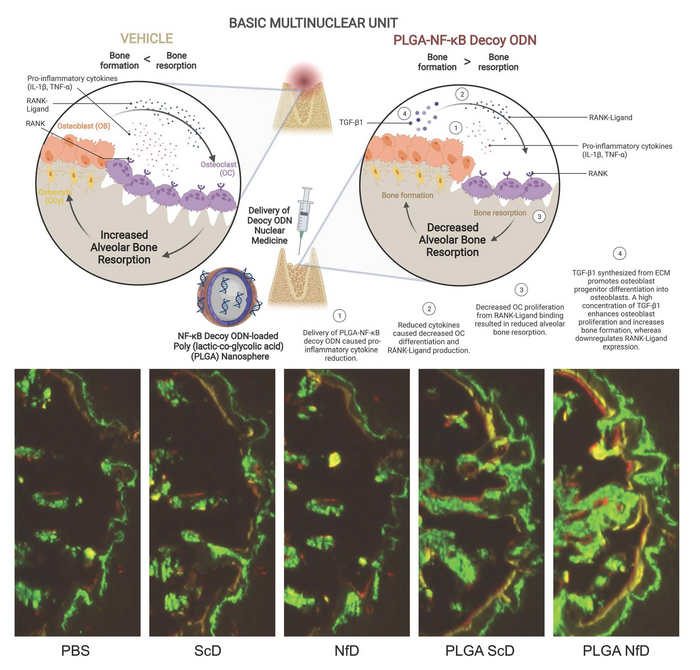
Credit: Department of Orthodontic Science, TMDU
Researchers from Tokyo Medical and Dental University (TMDU) demonstrate how a polymeric nanoparticle gene delivery system can promote bone formation
Tokyo, Japan – Does a “magic bullet” exist in regenerative medicine? Researchers have long wished to design a cutting-edge gene therapy that regenerates tissues damaged by disease or trauma. That wish may come true now that a research team has developed a polymeric gene delivery therapy that promotes new bone formation after traumatic inflammation.
In a study published this month in the International Journal of Molecular Sciences, researchers from Tokyo Medical and Dental University (TMDU) have revealed that a gene delivery therapy can effectively suppress inflammation to enhance tissue healing after tooth extraction.
Tooth extraction is a common surgical procedure in dental medicine. When a tooth is removed, sores are formed on the socket, which triggers a physiological healing process involving the reconstruction of damaged soft and hard tissues. One phase of wound healing, known as hemostasis, begins by stopping the bleeding from blood clots, which stimulates an inflammatory phase. This can help prevent further bleeding, but complications can arise if prolonged. After tooth extraction, excessive inflammation can cause residual ridge resorption (reduction of the residual bone in the jaw), which can induce a negative and aggravating impact on dental surgery.
Bone remodeling, which occurs throughout life, is mediated by a signaling pathway that involves the protein complex NF-κB (nuclear factor-kappa B). It controls the production of genes that regulates inflammation and bone healing. “Inhibitors of NF-κB are widely recognized in the treatment of bone resorption; however, the application of an NF-κB decoy oligodeoxynucleotide (ODN) is poorly investigated,” explains lead author Takashi Ono.
In this study, tooth extraction was conducted using molar extraction surgery. A gene/drug delivery system was developed utilizing an efficient copolymer vector – a type of poly(Lactic-co-glycolic Acid) – to deliver NF-κB decoy ODNs (double-stranded DNA fragments) to the extraction socket of rats and their therapeutic effects were investigated. It was found that the local administration of NF-κB decoy ODNs using a copolymer vector effectively inhibited bone resorption and promoted bone formation at the extraction socket. Additionally, gene delivery therapy prevented excessive inflammation. “This is the first in-vivo study revealing the efficacy of NF-κB decoy ODNs administered by a copolymer vector to promote bone healing after tooth extraction,” says Ono.
The findings of this study may lead to innovative gene therapy to prevent residual ridge resorption after surgical tooth extraction.
###
This article, “NF-κB Decoy ODN-Loaded Poly(Lactic-co-glycolic Acid) Nanospheres Inhibit Alveolar Ridge Resorption,” was published in the International Journal of Molecular Sciences at DOI: 10.3390/ijms24043699
Journal
International Journal of Molecular Sciences
DOI
10.3390/ijms24043699
Article Title
NF-κB Decoy ODN-Loaded Poly(Lactic-co-glycolic Acid) Nanospheres Inhibit Alveolar Ridge Resorption