• HOME
  • NEWS
  • EXPLORE
    • CAREER
      • Companies
      • Jobs
    • EVENTS
    • iGEM
      • News
      • Team
    • PHOTOS
    • VIDEO
    • WIKI
  • BLOG
  • COMMUNITY
    • FACEBOOK
    • INSTAGRAM
    • TWITTER
Saturday, May 16, 2026
BIOENGINEER.ORG
No Result
View All Result
  • Login
  • HOME
  • NEWS
  • EXPLORE
    • CAREER
      • Companies
      • Jobs
        • Lecturer
        • PhD Studentship
        • Postdoc
        • Research Assistant
    • EVENTS
    • iGEM
      • News
      • Team
    • PHOTOS
    • VIDEO
    • WIKI
  • BLOG
  • COMMUNITY
    • FACEBOOK
    • INSTAGRAM
    • TWITTER
  • HOME
  • NEWS
  • EXPLORE
    • CAREER
      • Companies
      • Jobs
        • Lecturer
        • PhD Studentship
        • Postdoc
        • Research Assistant
    • EVENTS
    • iGEM
      • News
      • Team
    • PHOTOS
    • VIDEO
    • WIKI
  • BLOG
  • COMMUNITY
    • FACEBOOK
    • INSTAGRAM
    • TWITTER
No Result
View All Result
Bioengineer.org
No Result
View All Result
Home NEWS Science News Biology

The tug-of-war at the heart of cellular symmetry

Bioengineer by Bioengineer
June 25, 2020
in Biology
Reading Time: 3 mins read
0
IMAGE
Share on FacebookShare on TwitterShare on LinkedinShare on RedditShare on Telegram

May the forces be within your cells
IMAGE

Credit: Kyoto University/Makito Miyazaki

Japan — Symmetry and asymmetry are fundamental properties of nature. Seen from above, butterflies have left-right symmetry, while male fiddler crabs show dramatic asymmetry. This is also the case for the fundamental units of life: cells. They control the symmetry of their internal structures to regulate all biological functions.

Publishing in Nature Communications, a team led by Kyoto University’s Hakubi Center for Advanced Research has announced the development of an artificial cell that brings to light the dynamics that govern each cell’s internal symmetry.

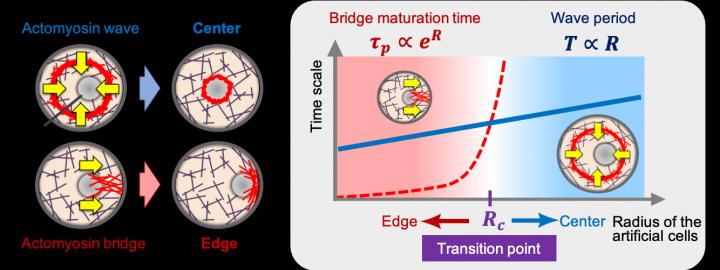
The team found that the actomyosin network — a complex consisting primarily of the protein actin that creates the filamentary meshwork, and the force-generating molecular motor myosin — self-organizes into two distinct structures that push-and-pull intracellular components as if in a tug-of-war.

Previous studies have shown that the structural mass of a cell — the actin cytoskeleton — is involved in symmetrical positioning. It has been hypothesized that this network steers and positions intracellular components. However, the mechanisms of how the proteins find the ‘center’ of the cell, or how they induce symmetry breaking, have remained elusive.

“Living cells are traditionally used to study these processes,” explains Makito Miyazaki who led the study. “But a cell is so complex that it can obfuscate the underlying regulatory system.”

To overcome this difficulty, the team settled on a bottom-up approach, developing a simplified, artificial cell by confining the actin cytoskeleton in a tiny droplet of liquid. This enabled them to control the sizes and concentrations of any proteins of interest.

By then changing the cell size, the team discovered two coexisting actomyosin networks with opposing functions: a ring-like centripetal actomyosin that pushes toward the center, and radially-formed bulk actomyosin bridges that pull to the edges.

Molecular perturbation experiments and theoretical modeling further revealed that the balance between these two networks is what determines positioning symmetry.

“How cells organize their internal structures is an important question, which we must answer in order to understand how our bodies are constructed from single fertilized cells,” concludes Miyazaki.

By simplifying the cell system, the team believes that it has developed a universally-applicable model that could lead to further revelations regarding life’s most fundamental functions.

###

The paper “Tug-of-war between actomyosin-driven antagonistic forces determines the positioning symmetry in cell-sized confinement” appeared 15 June 2020 in the journal Nature Communications, with doi: 10.1038/s41467-020-16677-9

About Kyoto University

Kyoto University is one of Japan and Asia’s premier research institutions, founded in 1897 and responsible for producing numerous Nobel laureates and winners of other prestigious international prizes. A broad curriculum across the arts and sciences at both undergraduate and graduate levels is complemented by numerous research centers, as well as facilities and offices around Japan and the world. For more information please see: http://www.kyoto-u.ac.jp/en

Media Contact
Raymond Kunikane Terhune
[email protected]

Related Journal Article

http://dx.doi.org/10.1038/s41467-020-16677-9

Tags: BiochemistryBiologyBiomechanics/BiophysicsCell BiologyDevelopmental/Reproductive BiologyMolecular Biology
Share12Tweet8Share2ShareShareShare2

Related Posts

Single mother must adapt swiftly — the survival of her colony depends on it — Biology

Single mother must adapt swiftly — the survival of her colony depends on it

May 15, 2026
Why Are Nearly Everyone Right-Handed? It Might Be Linked to How We Learned to Walk — Biology

Why Are Nearly Everyone Right-Handed? It Might Be Linked to How We Learned to Walk

May 15, 2026

Excessive Neuronal Activity Initiates Severe Autoimmune Brain Disorder

May 15, 2026

Precision Anti-Aging Strategies Focus on Eliminating Harmful Senescent Cells While Preserving Beneficial Ones

May 15, 2026
Please login to join discussion

POPULAR NEWS

  • Research Indicates Potential Connection Between Prenatal Medication Exposure and Elevated Autism Risk

    844 shares
    Share 338 Tweet 211
  • New Study Reveals Plants Can Detect the Sound of Rain

    730 shares
    Share 291 Tweet 182
  • Salmonella Haem Blocks Macrophages, Boosts Infection

    62 shares
    Share 25 Tweet 16
  • Breastmilk Balances E. coli and Beneficial Bacteria in Infant Gut Microbiomes

    58 shares
    Share 23 Tweet 15

About

We bring you the latest biotechnology news from best research centers and universities around the world. Check our website.

Follow us

Recent News

Metabolic Stress Worsens Parkinson’s via Mitochondrial Ferroptosis

Four New Hydroxyl Fatty Acids from Bacillus sp.

Validating B-IPQ Short Form for Older Colombians

Subscribe to Blog via Email

Enter your email address to subscribe to this blog and receive notifications of new posts by email.

Join 82 other subscribers
  • Contact Us

Bioengineer.org © Copyright 2023 All Rights Reserved.

Welcome Back!

Login to your account below

Forgotten Password?

Retrieve your password

Please enter your username or email address to reset your password.

Log In
No Result
View All Result
  • Homepages
    • Home Page 1
    • Home Page 2
  • News
  • National
  • Business
  • Health
  • Lifestyle
  • Science

Bioengineer.org © Copyright 2023 All Rights Reserved.