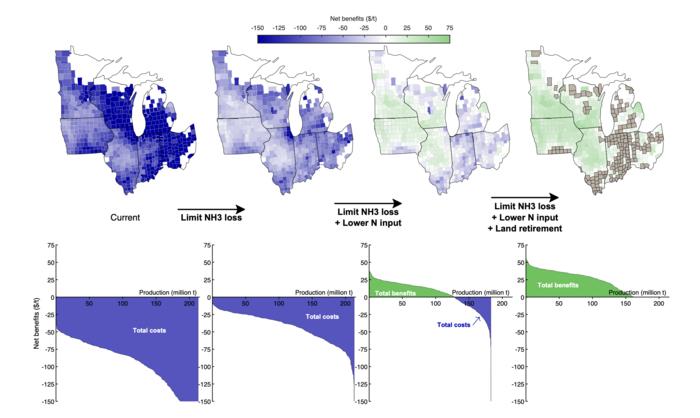
A model examines farmers’ profits and the health and environmental costs of growing corn in the US Midwest, where about 20% of the world’s corn is grown. Corn farming involves applying fertilizer or manure to provide the crop with nitrogen, a vital nutrient. But around half of the nitrogen added to fields never makes it into the crop, and instead enters the environment, either through the air or the water. Andrew L. Goodkind and colleagues set out to model the costs and benefits of corn farming, both under current nitrogen management and alternative approaches. In particular, the authors were interested in capturing the costs associated with air pollution, which have not been as well studied as the costs associated with water pollution. The authors find that the health and environmental costs of current management practices are $25.6 billion per year, far exceeding farmer profits, which averaged $4.3 billion per year from 2013–2022. Emissions in the form of ammonia are responsible for 65% of the costs of nitrogen use. Ammonia forms fine particulate matter that, when inhaled, is associated with a myriad of health conditions. The team then considered several management alternatives, including injecting fertilizer into the ground to reduce air emissions, or reducing fertilizer application rates. Implementing both changes makes corn profits higher than health and environmental costs for the Midwest as a whole, turning net losses into net gains. For some counties, however, costs still outweigh benefits, even after management changes. For these areas, located largely in Indiana, southern Illinois, Ohio, and Michigan, retiring land from corn production may be the best option, according to the authors.
Credit: Goodkind et al.
A model examines farmers’ profits and the health and environmental costs of growing corn in the US Midwest, where about 20% of the world’s corn is grown. Corn farming involves applying fertilizer or manure to provide the crop with nitrogen, a vital nutrient. But around half of the nitrogen added to fields never makes it into the crop, and instead enters the environment, either through the air or the water. Andrew L. Goodkind and colleagues set out to model the costs and benefits of corn farming, both under current nitrogen management and alternative approaches. In particular, the authors were interested in capturing the costs associated with air pollution, which have not been as well studied as the costs associated with water pollution. The authors find that the health and environmental costs of current management practices are $25.6 billion per year, far exceeding farmer profits, which averaged $4.3 billion per year from 2013–2022. Emissions in the form of ammonia are responsible for 65% of the costs of nitrogen use. Ammonia forms fine particulate matter that, when inhaled, is associated with a myriad of health conditions. The team then considered several management alternatives, including injecting fertilizer into the ground to reduce air emissions, or reducing fertilizer application rates. Implementing both changes makes corn profits higher than health and environmental costs for the Midwest as a whole, turning net losses into net gains. For some counties, however, costs still outweigh benefits, even after management changes. For these areas, located largely in Indiana, southern Illinois, Ohio, and Michigan, retiring land from corn production may be the best option, according to the authors.
Journal
PNAS Nexus
Article Title
Managing nitrogen in maize production for societal gain
Article Publication Date
24-Oct-2023