Credit: Kobe University
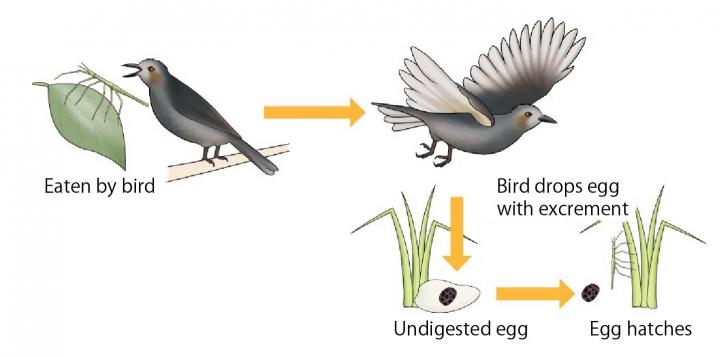
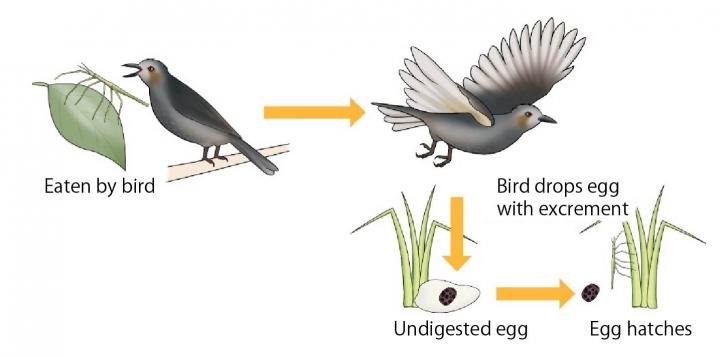
It's commonly assumed that when insects are eaten by birds, they and their unborn young have no chance of survival. However, a team of Japanese researchers hypothesized that the eggs within insect bodies can pass through birds undigested. They tested this hypothesis with stick insects, known for their hard eggs, and found that some eggs are excreted unharmed and successfully hatch. Stick insects cannot travel very far by themselves, so being eaten by birds could even contribute to expanding their habitat.
The research team was led by Associate Professor Kenji Suetsugu (Kobe University Graduate School of Science), Associate Professor Katsuro Ito (Kochi University), and Associate Professor Takeshi Yokoyama (Tokyo University of Agriculture and Technology). The findings were published in the online edition of Ecology on May 28.
Plants cannot move around, so they have developed various ways to distribute their seeds. The most common is seed dispersal by animals, who eat the fruits and excrete the seeds whole. For many birds, insects are also one of their main food sources. If insect eggs can pass through birds unharmed, we could say that insects, just like plants, are using the birds as a means of long-distance transport.
To achieve this, several conditions must be met: the eggs must be strong enough to pass through digestive tracts unharmed, the insect young born from these eggs must be able to fend for themselves, and the eggs must be viable without fertilization. Stick insects fulfil these conditions. The insect eggs are only fertilized just before the eggs are laid, using sperm stored within the seminal vesicle. However, females of many stick insect species are parthenogenic, enabling them to produce viable eggs without fertilization. In addition, like plant seeds, stick insect eggs have a very hard shell. They lay these eggs by scattering them on the surface of the ground, and after hatching the young locate suitable plants for food by themselves.
The research team fed eggs from three species of stick insects to brown-eared bulbul (one of the main bird predators for stick insects). For all three species, between 5 and 20% of the eggs were excreted unharmed. They also confirmed that for one species, eggs retrieved from the bird's excrement successfully hatched. Despite being eaten by birds, the unborn insects survived. Adult stick insects are frequently eaten by birds, and the stomachs of adult female stick insects are always filled with eggs, so this route is a potential way to widen stick insect distribution.
Many plants have evolved eye-catching, nutritious fruit as a strategy to appeal to animals, while stick insects are plain and hard to spot. But even though they do not actively seek to be eaten, for insects with low mobility like stick insects, consumption by birds is one way to expand their habitat. Many relatives of stick insects have dispersed across islands unconnected to the mainland. The ability of animals with low mobility to successfully travel long distances is a topic that puzzled Darwin.
"Our next step is analyzing the genetic structure of stick insects" comments team leader Professor Suetsugu. "Based on this we'd like to investigate whether similar genetic structure of stick insects can be found along birds' migration flight paths, and whether there are genetic similarities between stick insects and plants that rely on birds for seed distribution". These investigations will reveal that the dispersal of stick insect eggs by birds could affect the distribution and gene flow of stick insects.
###
Media Contact
Eleanor Wyllie
[email protected]
@KobeU_Global
http://www.kobe-u.ac.jp/en/
Related Journal Article
http://dx.doi.org/10.1002/ecy.2230