Professor Dong-Woo Cho from the Department of Mechanical Engineering along with Jae Yun Kim, a PhD candidate, from the School of Interdisciplinary Bioscience and Bioengineering and Tugce Sen, a PhD student, from Department of Mechanical Engineering at POSTECH, teamed up with Professor Jae Yeon Lee from Daegu Haany University’s Department of Companion Animal Health. Together, they crafted a material aimed at swiftly staunching kidney bleeding and facilitating wound recovery. Their research featured in the online edition of Biomaterials, an international journal in the field of biomaterials.
Credit: POSTECH
Professor Dong-Woo Cho from the Department of Mechanical Engineering along with Jae Yun Kim, a PhD candidate, from the School of Interdisciplinary Bioscience and Bioengineering and Tugce Sen, a PhD student, from Department of Mechanical Engineering at POSTECH, teamed up with Professor Jae Yeon Lee from Daegu Haany University’s Department of Companion Animal Health. Together, they crafted a material aimed at swiftly staunching kidney bleeding and facilitating wound recovery. Their research featured in the online edition of Biomaterials, an international journal in the field of biomaterials.
The kidneys play a crucial role in bodily functions including waste removal and blood pressure regulation. Despite being dubbed the silent organ due to its lack of overt symptoms, early detection of kidney tumors allows for their removal via partial nephrectomy. However, surgical complications such as excessive bleeding, infection, and tissue damage pose significant risks. Patients undergoing such procedures are prone to developing chronic ailments such as diminished kidney function and hypertension, complicating both treatment and recovery processes.
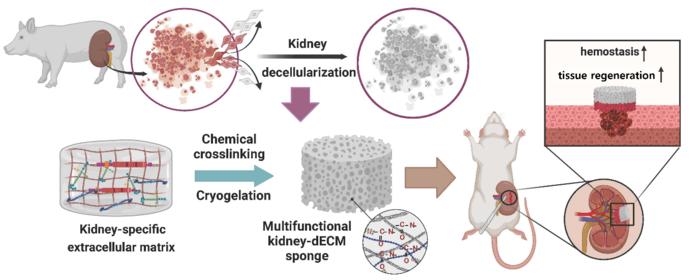
In this research endeavor, the team used kidney-derived decellularized extracellular matrix (dECM) to develop a hemostatic solution tailored for kidney applications. The inherent presence of proteins and factors in dECM, mirroring those found in the body, facilitates the recreation of the kidney’s distinctive microenvironment, thus boasting a notable level of biocompatibility. These attributes have propelled its widespread adoption in tissue engineering where it finds utility in the fabrication of artificial organs and the restoration of diverse tissue types.
Initially, the team scrutinized the composition of kidney-derived dECM to ascertain the presence of hemostatic elements within its structure. Subsequently, they mixed the kidney-derived dECM with a chemical cross-linker, successfully forming a porous sponge material termed “cryogel.”
The team’s gel exhibited a highly porous architecture, boasting an expansive surface area that efficiently absorbed blood. Animal studies revealed a significant reduction of tissue damage and necrosis by up to threefold four weeks post-partial nephrectomy when compared to both a control group and traditional gelatin sponges. Additionally, the team observed that the concentration of cross-linking agents in the renal gel affected crucial properties such as biodegradation rate and hemocompatibility.
Professor Dong-Woo Cho from POSTECH remarked, “This study underscores once more the clinical significance of dECM-based medical sponge materials.” Professor Jae Yeon Lee of Daegu Haany University expressed optimism by stating, “We’re excited about the potential to substantially decrease the number of patients progressing to end-stage renal failure.”
The research was conducted with support from the Mid-Career Researcher Program and the Nano-materials Source Technology Development Project of the Ministry of Science and ICT.
Journal
Biomaterials
DOI
10.1016/j.biomaterials.2024.122524
Article Title
Degradation-controlled tissue extracellular sponge for rapid hemostasis and wound repair after kidney injury
Article Publication Date
20-Mar-2024