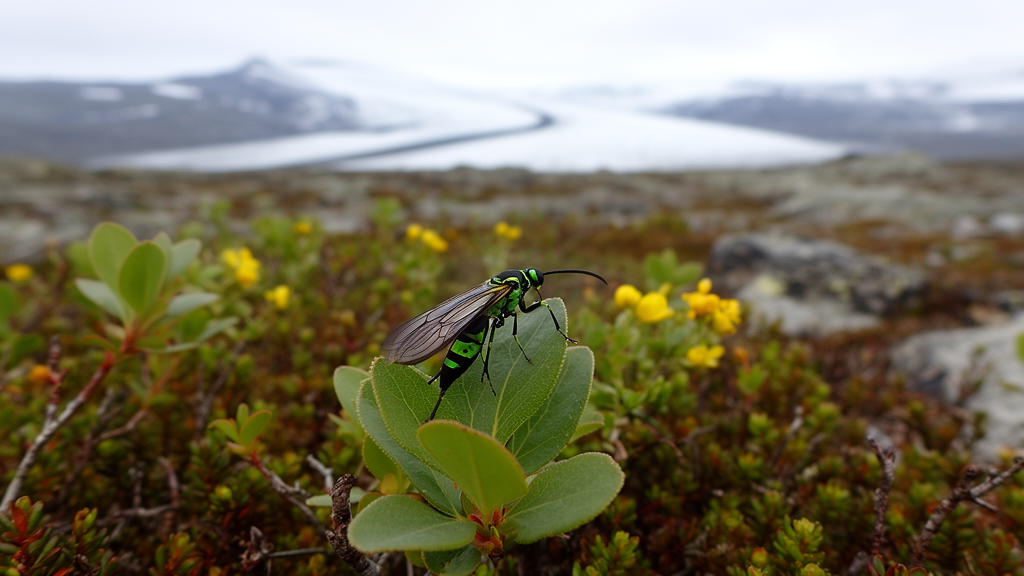
A targeted faunistic and genetic study of sawflies in southern and south-western Greenland found six species during fieldwork from mid-June to early July 2025. The investigation documented the first reported Greenland record of Euura vaga, identified a human-mediated introduction of Pristiphora laricis and assessed genetic evidence that may help explain the origins of the country’s sawfly fauna. This was a field inventory rather than a comprehensive census of Greenland.
Researchers collected around Narsarsuaq and Qassiarsuk in South Greenland from 13–24 June 2025, then worked around Nuuk and Kapisillit in southern South-West Greenland from 25 June–3 July. Most specimens were obtained by sweeping vegetation with entomological nets, while selected plants known to host sawflies elsewhere were inspected for larvae, galls and leaf mines. Adults were pinned, and some specimens or detached legs were preserved in ethanol for genetic analysis.
The collections contained adults of all six species, while three were also represented by larvae. Two larvae were found in the field and one was reared from an egg. The authors considered it unlikely that many early-season species had been overlooked because extensive sweeping produced only one swept larva, but they cautioned that one or two later-emerging species could have been missed.
The six-species total therefore describes the sampled localities and period rather than the definitive diversity of Greenland. Among the collected species were Ametastegia pallipes, Euura amentorum, E. excisa, E. obducta and E. vaga, as well as Pristiphora laricis. E. vaga had not previously been recorded in Greenland.
Field observations also documented host and habitat associations: larvae of E. excisa were found on Bistorta vivipara in moist habitats, including stream banks; adults of E. amentorum were swept from flowering willows, including Salix glauca; and an E. obducta female laid eggs on Poa nemoralis rather than the Calamagrostis canadensis also offered to it. P. laricis was abundant throughout the roughly 150-hectare Arboretum Groenlandicum at Narsarsuaq, including on vegetation other than its larch hosts. For the genetic analysis, the authors sequenced fragments of the mitochondrial COI gene and up to seven nuclear genes with an Oxford Nanopore MinION.
They calculated nucleotide distances, obtained some values from the BOLD Identification Engine, and constructed neighbour-joining trees using the TN93 substitution model. Newly generated sequences were submitted to GenBank under accessions PX854216–PX854231 and PX875218–PX875325. The genetic comparisons suggested different possible origins for members of the Greenland fauna.
A. pallipes, E. amentorum, E. excisa, E. obducta, E. vaga and P. laricis appeared more likely to have European origins on the available data, although the native or introduced status of several species remained uncertain. The establishment of P. laricis was interpreted as an obvious human-mediated introduction because the sawfly feeds on larch, a plant genus deliberately introduced to Greenland only during the past century. The study also revised the taxonomy of Greenlandic sawflies.
Nematus borealis was synonymised with E. obscuripes, although confirmation through examination of genitalia and genetics remained necessary because the extracted genitalia had been lost. A Greenland specimen was identified as E. punctifrons, and an older record under the name Pachynematus parvilabris was considered probably referable to that species. A historical record of Cladius grandis was not accepted because the original specimen could no longer be found and the reported association with willow conflicted with the species’ known host biology.
One unusual mitochondrial result was a COI sequence from a Greenlandic E. excisa that was identical across 1,078 base pairs to a sequence from an Estonian E. declinata. Nuclear genes nevertheless supported E. declinata and E. excisa as separate species. The authors therefore considered mitochondrial introgression more plausible than incomplete lineage sorting, while noting that hybridisation and backcrossing could explain the pattern if the species had once occurred together.
Overall, the observed genetic patterns were consistent with human transport having played a substantial role in shaping Greenland’s sawfly fauna, but the evidence did not establish exact introduction dates or routes. Comparison was limited by scarce North American nuclear-gene sequences, incomplete seasonal coverage and unresolved taxonomic questions. The study did not support large natural movements across water bodies as a ready explanation, and further genetic material would be required to distinguish confidently among the remaining possibilities.
Subject of Research: Field and genetic assessment of Greenland’s sawfly fauna and its possible biogeographic origins
Article Title: The sawflies ( Hymenoptera , Tenthredinidae ) of Greenland
Article References: Prous, M., Lønnve, O. J., Olsen, K. M., & Liston, A. (2026). The sawflies (Hymenoptera, Tenthredinidae) of Greenland. Deutsche Entomologische Zeitschrift, 73(1), 79-94. https://doi.org/10.3897/dez.73.181906
Image Credits: AI Generated
Keywords: Greenland, sawflies, Tenthredinidae, faunistic survey, population genetics, Euura, human-mediated introduction, COI barcoding, biogeography, Arctic insects, Hymenoptera, scientific research
News Source: Margaret Porter. (October 20, 2026). The sawflies ( Hymenoptera , Tenthredinidae ) of Greenland. Scienmag.