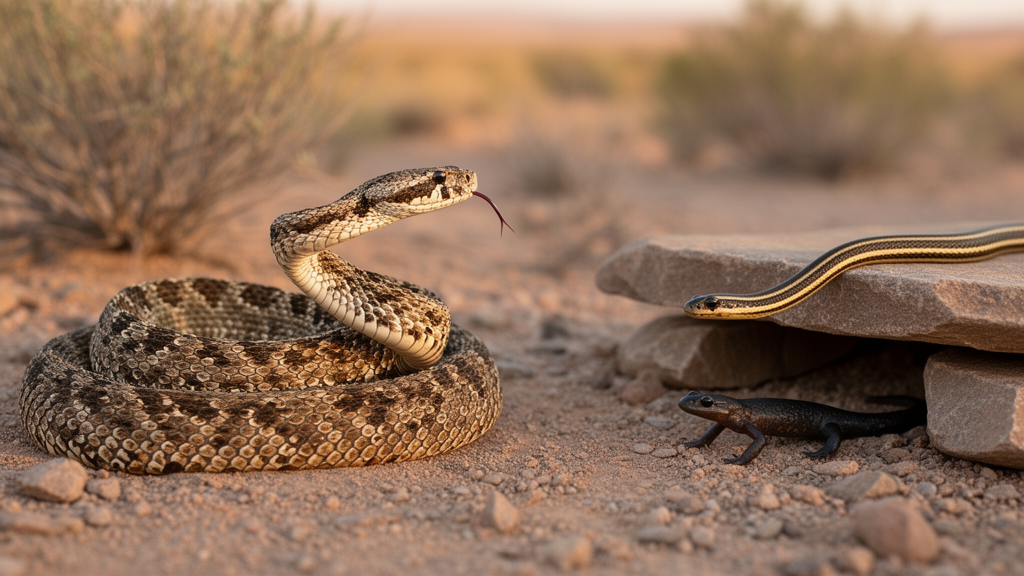
Researchers recorded two cases of the Mexican garter snake, Thamnophis scaliger, successfully preying on the endangered Altamirano’s salamander, Ambystoma altamirani, at Raíces in Mexico’s Nevado de Toluca Volcano. A third observation showed a Mexican dusky rattlesnake, Crotalus triseriatus, partially submerged in a stream and unsuccessfully attempting to capture the same salamander species at Corral de Piedra. These field observations document predator–prey interactions involving native snakes and an endemic amphibian restricted to high-altitude streams and lakes in central Mexico.
The study was an observational field report based on targeted surveys for A. altamirani conducted from 2016 through 2024 at the two Nevado de Toluca sites. The salamander is classified as endangered on the International Union for Conservation of Nature Red List and as threatened under Mexican law. It inhabits cool, high-altitude environments in central Mexico and occupies a predatory role within the aquatic habitats where it occurs, although the study did not measure its abundance, diet or population trend.
During each sampling session, teams of two or three researchers walked slowly along streams to visually detect A. altamirani and record any predation or attempted-predation events. Fieldwork was conducted in daylight between 10:00 a.m. and 2:00 p.m., a period selected from earlier field observations as favorable for detecting the salamanders and their predators. Investigators recorded the species involved, location, environmental setting and behavior during each encounter.
The first successful predation event was observed on May 5, 2020, at approximately noon in the cool, clear waters of Raíces, a site at 3,431 meters above sea level. A T. scaliger captured an A. altamirani by the head while the salamander was in the water. The snake applied pressure to subdue and drown its prey and consumed the salamander over approximately 30 minutes. This observation adds to previously published reports that Mexican garter snakes can consume A. altamirani.
A second T. scaliger predation event was recorded on May 12, 2024, at about 1:00 p.m., again at Raíces. The snake patrolled the water’s edge before lunging into shallow water and capturing a small A. altamirani near the base of its tail. After the salamander struggled briefly, the snake maintained its grip and dragged the animal from the water onto adjacent grassland. On land, it swallowed the salamander tail first and completed ingestion in approximately one hour. The snake then retreated into nearby vegetation to digest the meal.
The attempted predation by C. triseriatus was observed on November 20, 2016, at approximately 11:00 a.m. in a stream at Corral de Piedra. The site is a grassland region surrounded by Abies–Pinus forest at 2,865 meters above sea level. The rattlesnake was partly submerged, with half of its body above the riverbank, while targeting A. altamirani in the water. The attempt did not succeed. The observation records the Mexican dusky rattlesnake entering an aquatic setting while pursuing a salamander, rather than establishing how frequently this behavior occurs.
Both snake species are native to Mexico’s montane environments and have varied diets that include amphibians. T. scaliger is semiaquatic and feeds on amphibians, reptiles, small fish and invertebrates, while C. triseriatus is a highland snake endemic to the Trans-Mexican Volcanic Belt whose diet includes snakes, lizards, arthropods and amphibians. Prior studies have also documented predation among other Thamnophis and Ambystoma species, including T. elegans preying on A. macrodactylum and T. sirtalis consuming A. tigrinum and A. maculatum.
The three observations do not quantify the frequency of predation or establish the effects of these encounters on the size or trend of the A. altamirani population. Survey coverage was limited to two sites, and the observations were made during daylight hours under conditions selected to improve visibility. Consequently, the report cannot estimate how often the snakes encounter or consume the salamanders across the species’ broader range. It also does not distinguish the contribution of predation from other pressures, including habitat loss, pollution and introduced species.
The findings add behavioral details to the limited record of native snake predation on A. altamirani. The observations show one garter snake subduing a salamander in water, another carrying prey from a stream onto land, and a rattlesnake pursuing a salamander from the water while partly submerged. The authors note that A. altamirani faces an additional ecological pressure in a montane habitat where its populations are already constrained by environmental and anthropogenic threats. They call for further research to determine the frequency and population-level consequences of these interactions, as well as studies of the feeding behavior of native snakes in areas inhabited by threatened amphibians.
Subject of Research: Field observations of native snake predation on the endangered Altamirano’s salamander in central Mexico
Article Title: Predation of Ambystoma altamirani ( Caudata , Ambystomatidae ) by Thamnophis scaliger ( Squamata , Colubridae ) and Crotalus triseriatus ( Squamata , Viperidae ) in Nevado de Toluca Volcano, Central Mexico
Article References: Sunny, A., Heredia-Bobadilla, R. L., Domínguez-Vega, H., Sandoval-Serés, E., Gómez-Ortiz, Y., & Caballero-Viñas, C. (2025). Predation of Ambystoma altamirani (Caudata, Ambystomatidae) by Thamnophis scaliger (Squamata, Colubridae) and Crotalus triseriatus (Squamata, Viperidae) in Nevado de Toluca Volcano, Central Mexico. Neotropical Biology and Conservation, 20(1), 47-57. https://doi.org/10.3897/neotropical.20.e145580
Image Credits: AI Generated
DOI: 10.3897/neotropical.20.e145580
Keywords: Ambystoma altamirani, Thamnophis scaliger, Crotalus triseriatus, predation, field observations, montane streams, Nevado de Toluca, endangered amphibian, central Mexico, Ambystoma, altamirani, Caudata
News Source: Margaret Porter. (October 20, 2026). Field observations document Mexican garter snake predation and an unsuccessful rattlesnake attempt on endangered Altamirano’s salamander. Scienmag.