• HOME
  • NEWS
  • EXPLORE
    • CAREER
      • Companies
      • Jobs
    • EVENTS
    • iGEM
      • News
      • Team
    • PHOTOS
    • VIDEO
    • WIKI
  • BLOG
  • COMMUNITY
    • FACEBOOK
    • INSTAGRAM
    • TWITTER
Friday, May 15, 2026
BIOENGINEER.ORG
No Result
View All Result
  • Login
  • HOME
  • NEWS
  • EXPLORE
    • CAREER
      • Companies
      • Jobs
        • Lecturer
        • PhD Studentship
        • Postdoc
        • Research Assistant
    • EVENTS
    • iGEM
      • News
      • Team
    • PHOTOS
    • VIDEO
    • WIKI
  • BLOG
  • COMMUNITY
    • FACEBOOK
    • INSTAGRAM
    • TWITTER
  • HOME
  • NEWS
  • EXPLORE
    • CAREER
      • Companies
      • Jobs
        • Lecturer
        • PhD Studentship
        • Postdoc
        • Research Assistant
    • EVENTS
    • iGEM
      • News
      • Team
    • PHOTOS
    • VIDEO
    • WIKI
  • BLOG
  • COMMUNITY
    • FACEBOOK
    • INSTAGRAM
    • TWITTER
No Result
View All Result
Bioengineer.org
No Result
View All Result
Home NEWS Science News Biology

The return of Cthulhu — the small sea critter

Bioengineer by Bioengineer
April 10, 2019
in Biology
Reading Time: 2 mins read
0
IMAGE
Share on FacebookShare on TwitterShare on LinkedinShare on RedditShare on Telegram

IMAGE

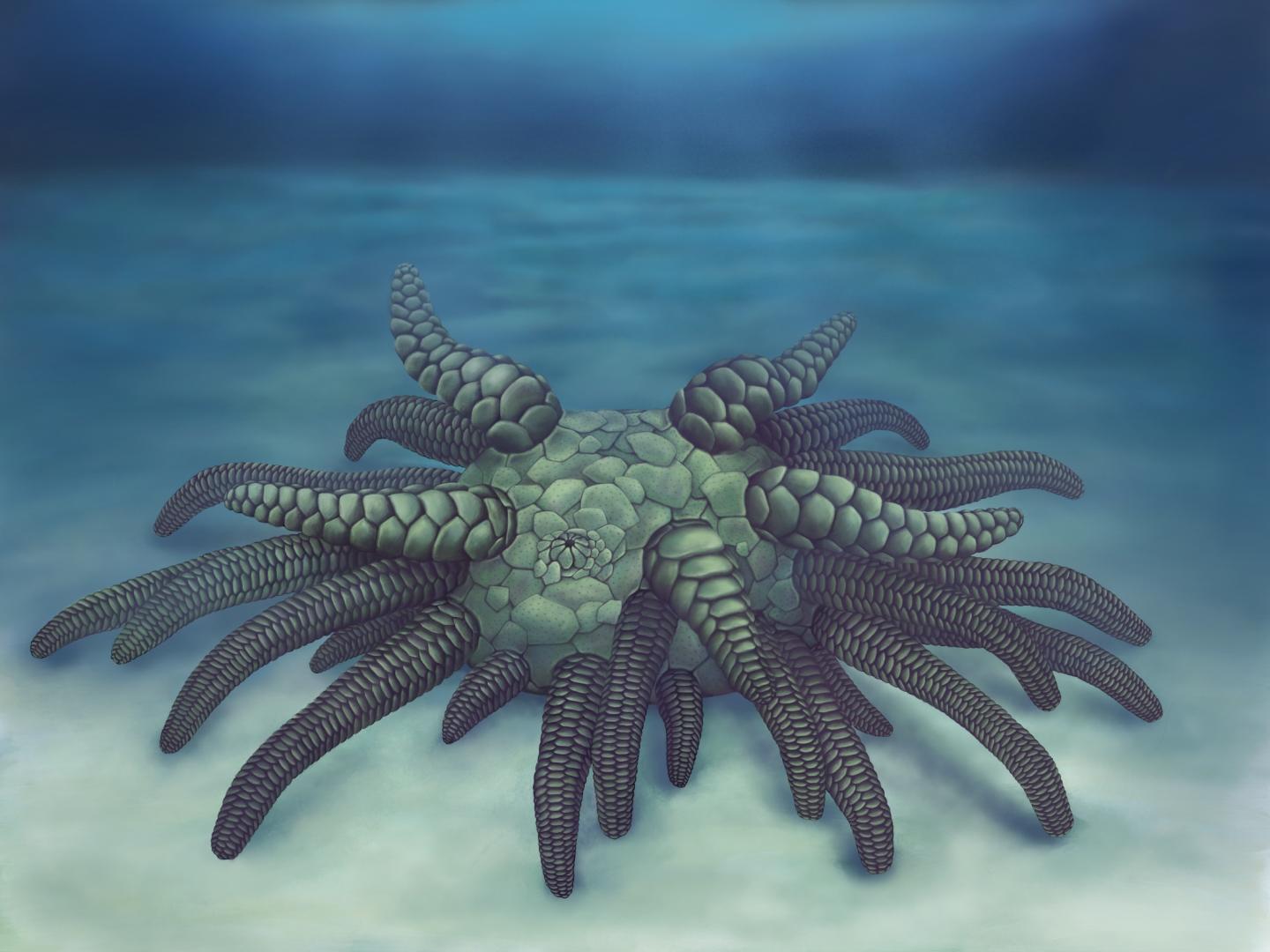
Credit: Elissa Martin/Yale Peabody Museum of Natural History

New Haven, Conn. – Cthulhu is calling from the ancient depths — and this time, researchers are only too happy to speak its name.

Researchers at Yale, Oxford, the University of Leicester, Imperial College London, and University College London have identified a 430 million-year-old fossil as a new species related to living sea cucumbers. They named the creature Sollasina cthulhu, after H.P. Lovecraft’s tentacled monster, Cthulhu.

A study announcing the discovery appears April 10 in the journal Proceedings of the Royal Society B.

The new cthulhu, Sollasina, had 45 tentacle-like tube feet, which it used to crawl along the ocean floor and capture food. The creature was small, about the size of a large spider. It was found in the Herefordshire Lagerstätte in the United Kingdom, a site that has proven to be a trove of fossilized ancient sea animals.

“In this paper, we report a new echinoderm — the group that includes sea urchins, sea cucumbers, and sea stars — with soft-tissue preservation,” said Yale paleontologist Derek Briggs, a co-author of the study. “This new species belongs to an extinct group called the ophiocistioids. With the aid of high-resolution physical-optical tomography, we describe the species in 3D, revealing internal elements of the water vascular system that were previously unknown in this group and, indeed, in nearly all fossil echinoderms.”

The 3D reconstruction process involves grinding a fossil away, layer by layer, and taking photographs at each stage. This results in hundreds of slice images, which are digitally reconstructed into a “virtual fossil.”

That’s how the researchers were able to discern Sollasina’s internal water vascular system and determine it is more closely related to sea cucumbers rather than to sea urchins.

“The water vascular system operates the tentacle-like structures that they used for locomotion and food capture,” Briggs said. “The tube feet of living echinoderms are naked, but in the ophiocistioids they were plated. Our analysis strongly suggests that ophiocistioids diverged from the line leading to modern sea cucumbers.”

The researchers said Sollasina’s existence demonstrates that the sea cucumber skeleton was modified gradually during the assembly of its body plan.

###

The lead author of the study is Imran Rahman, deputy head of research at the Oxford University Museum of Natural History. Other authors are Jeffrey Thompson of University College London, David Siveter of the University of Leicester, Derek Siveter of Oxford, and Mark Sutton of Imperial College London.

The Yale Peabody Museum of Natural History Invertebrate Paleontology Division, the Oxford University Museum of Natural History, the John Fell Oxford University Press Research Fund, the Natural Environment Research Council, and the Leverhulme Trust supported the research.

Media Contact
Jim Shelton
[email protected]

Tags: BiologyEvolutionPaleontology
Share12Tweet8Share2ShareShareShare2

Related Posts

61 Newly Discovered Beetle Species Highlight How Much We Still Have to Learn About Biodiversity — Biology

61 Newly Discovered Beetle Species Highlight How Much We Still Have to Learn About Biodiversity

May 15, 2026
Supercomputer Simulations Uncover How Bacterial Enzyme Pumps Sodium Ions, Opening Doors to Novel Antibiotics — Biology

Supercomputer Simulations Uncover How Bacterial Enzyme Pumps Sodium Ions, Opening Doors to Novel Antibiotics

May 15, 2026

New Astrobiology Special Collection Highlights Emerging Evidence Supporting Land-Based Origins of Life

May 14, 2026

Revolutionizing Textiles: Engineered Protein Fibers Pave the Way for Sustainable, Recyclable Fabrics

May 14, 2026
Please login to join discussion

POPULAR NEWS

  • Research Indicates Potential Connection Between Prenatal Medication Exposure and Elevated Autism Risk

    843 shares
    Share 337 Tweet 211
  • New Study Reveals Plants Can Detect the Sound of Rain

    729 shares
    Share 291 Tweet 182
  • Salmonella Haem Blocks Macrophages, Boosts Infection

    62 shares
    Share 25 Tweet 16
  • Breastmilk Balances E. coli and Beneficial Bacteria in Infant Gut Microbiomes

    58 shares
    Share 23 Tweet 15

About

We bring you the latest biotechnology news from best research centers and universities around the world. Check our website.

Follow us

Recent News

Hanyang University Researchers Pinpoint 2.5 Nanometers as Minimum Coating Thickness for Durable Solid-State EV Batteries

Axonic Spine Synapses Trigger Action Potentials, Direct Signals

New Study Uncovers Why Breast Cancer Becomes More Lethal with Age

Subscribe to Blog via Email

Enter your email address to subscribe to this blog and receive notifications of new posts by email.

Join 82 other subscribers
  • Contact Us

Bioengineer.org © Copyright 2023 All Rights Reserved.

Welcome Back!

Login to your account below

Forgotten Password?

Retrieve your password

Please enter your username or email address to reset your password.

Log In
No Result
View All Result
  • Homepages
    • Home Page 1
    • Home Page 2
  • News
  • National
  • Business
  • Health
  • Lifestyle
  • Science

Bioengineer.org © Copyright 2023 All Rights Reserved.