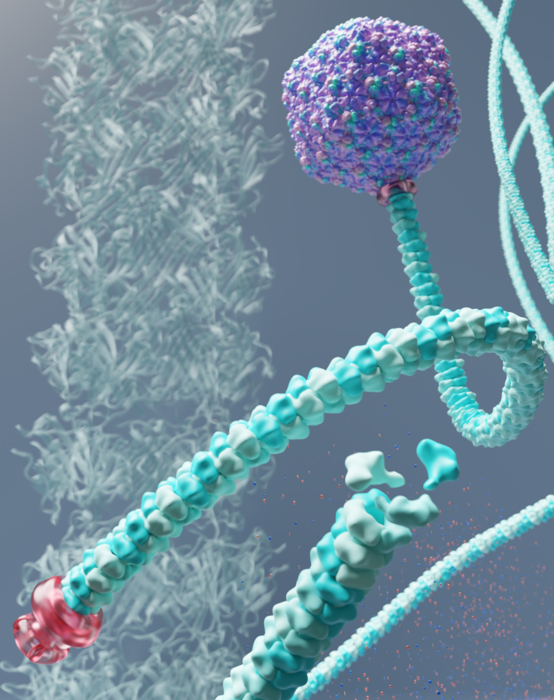
A recent study in the Journal of Biological Chemistry has revealed the secret behind an evolutionary marvel: a bacteriophage with an extremely long tail. This extraordinary tail is part of a bacteriophage that lives in inhospitable hot springs and preys on some of the toughest bacteria on the planet.
Credit: Leonora Martinez-Nunez
A recent study in the Journal of Biological Chemistry has revealed the secret behind an evolutionary marvel: a bacteriophage with an extremely long tail. This extraordinary tail is part of a bacteriophage that lives in inhospitable hot springs and preys on some of the toughest bacteria on the planet.
Bacteriophages are a group of viruses that infect and replicate in bacteria and are the most common and diverse things on Earth.
“Bacteriophages, or phages for short, are everywhere that bacteria are, including the dirt and water around you and in your own body’s microbial ecosystem as well,” said Emily Agnello, a graduate student at the University of Massachusetts Chan Medical School and the lead author on the study.
Unlike many of the viruses that infect humans and animals that contain only one compartment, phages consist of a tail attached to a spiky, prismlike protein shell that contains their DNA.
Phage tails, like hairstyles, vary in length and style; some are long and bouncy while others are short and stiff. While most phages have short, microscopic tails, the “Rapunzel bacteriophage” P74-26 has a tail 10 times longer than most and is nearly 1 micrometer long, about the width of some spider’s silk. The “Rapunzel” moniker is derived from the fairy tale in which a girl with extremely long hair was locked in a tower by an evil witch.
Brian Kelch, an associate professor of biochemistry and molecular biotechnology at UMass Chan who supervised the work, described P74-26 as having a “monster of a tail.”
Phage tails are important for puncturing bacteria, which are coated in a dense, viscous substance. P74-26’s long tail allows it to invade and infect the toughest bacteria. Not only does P74-26 have an extremely long tail, but it is also the most stable phage, allowing it to exist in and infect bacteria that live in hot springs that can reach over 170° F. Researchers have been studying P74-26 to find out why and how it can exist in such extreme environments.
To work with a phage that thrives in such high temperatures, Agnello had to adjust the conditions of her experiments to coax the phage tail to assemble itself in a test tube. Kelch said Agnello created a system with which she could induce rapid tail self-assembly.
“Each phage tail is made up of many small building blocks that come together to form a long tube. Our research finds that these building blocks can change shape, or conformation, as they come together,” Agnello said. “This shape-changing behavior is important in allowing the building blocks to fit together and form the correct structure of the tail tube.”
The researchers used high-power imaging techniques as well as computer simulations and found that the building blocks of the tail lean on each other to stabilize themselves.
“We used a technique called cryo-electron microscopy, which is a huge microscope that allows us to take thousands of images and short movies at a very high magnification,” Agnello explained. “By taking lots of pictures of the phage’s tail tubes and stacking them together, we were able to figure out exactly how the building blocks fit together.”
They found P74-26 uses a “ball and socket” mechanism to sturdy itself. In addition, the tail is formed from vertically stacking rings of molecules that make a hollow canal.
“I like to think about these phage building blocks as kind of like Legos,” Kelch said. “The Lego has studs on one side and the holes or sockets on the other.”
He added: “Imagine a Lego where the sockets start off closed. But as you start to build with the Legos, the sockets begin to open up to allow the studs on other Legos to build a larger assembly. This movement is an important way that these phage building blocks self-regulate their assembly.”
Kelch pointed out that, compared with most phages, P74-26 uses half the number of building blocks to form stacking rings that make up the tail.
“We think what has happened is that some ancient virus fused its building blocks into one protein. Imagine two small Lego bricks are fused into one large brick with no seams. This long tail is built with larger, sturdier building blocks,” Kelch explained. “We think that could be stabilizing the tail at high temperatures.”
The researchers now plan to use genetic manipulation to alter the length of the phage tail and see how that changes its behavior.
Phages occupy almost every corner of the globe and are important to a variety of industries like healthcare, environmental conservation and food safety. In fact, long-tailed phages like P74-26 have been used in preliminary clinical trials to treat certain bacterial infections.
“Bacteriophages are gaining ever-growing interest as an alternative to antibiotics for treating bacterial infections,” Agnello said. “By studying phage assembly, we can better understand how these viruses interact with bacteria, which could lead to the development of more effective phage-based therapies. … I believe that studying unique, interesting things can lead to findings and applications that we can’t even yet imagine.”
Journal
Journal of Biological Chemistry
DOI
10.1016/j.jbc.2023.103021
Method of Research
Experimental study
Article Title
Conformational dynamics control assembly of an extremely long bacteriophage tail tube
Article Publication Date
13-Feb-2023