Reverse osmosis (RO) has attracted wide attention for its extensive applicability in brackish water and seawater desalination. Thin-film composite (TFC) polyamide (PA) RO membranes consisting of a dense separating layer and a porous support layer have been the leading products of this field. However, relatively low permeability-selectivity of PA RO membrane and membrane fouling of TFC RO membrane limit the widespread applicability of TFC PA RO membranes.
Credit: Xinxia Tian , Hui Yu , Jun Yang , Xiaotai Zhang, Man Zhao , Yang Yang , Wei Sun, Yangyang Wei , Yin Zhang, Jian Wang , Zhun Ma
Reverse osmosis (RO) has attracted wide attention for its extensive applicability in brackish water and seawater desalination. Thin-film composite (TFC) polyamide (PA) RO membranes consisting of a dense separating layer and a porous support layer have been the leading products of this field. However, relatively low permeability-selectivity of PA RO membrane and membrane fouling of TFC RO membrane limit the widespread applicability of TFC PA RO membranes.
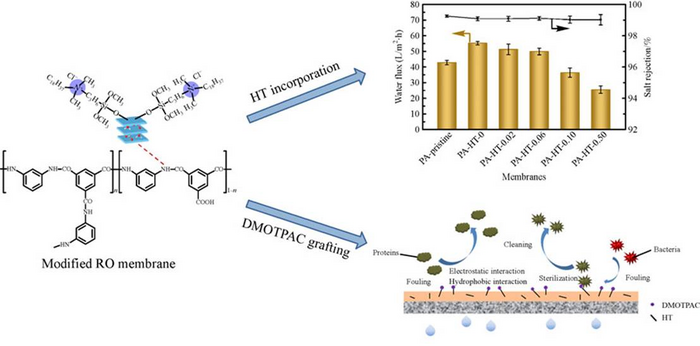
The synthesis of nanocomposite membranes has been demonstrated to be an excellent technology to combine the advantages of polymers and inorganic nanomaterials. The native performance of RO membrane could be improved by fine-tuning the composition and structure. For example, hydrotalcite (HT) was dispersed in an aqueous solution and incorporated into PA matrix in the interfacial polymerization step to construct transport channels for water. The obtained membrane exhibited high perm-selectivity with increased water flux without sacrificing salt rejection. In addition, membrane modification (including nanoparticle incorporation, surface coating and grafting) has been proved to be an efficient approach to prevent biofouling. Among them, grafting anti-biofouling agents on nanoparticles embed in the PA matrix could excellent strategy to endow RO membranes with anti-biofouling properties without damaging the PA matrix. HT nanoparticles contain abundant hydroxyls, which can react with siloxy of silane coupling agents, allowing for ant-biofouling grafting. Consequently, novel TFC RO membranes with high perm-selectivity and anti-biofouling property can be obtained by employing HT nanoparticles as dopants in the PA layers and grafting silane coupling agents containing anti-biofouling functional groups on the membrane surface.
Inspired by the properties of HT nanoparticles and silane coupling agents containing quaternary ammonium, Prof. Jian Wang from the the Institute of Seawater Desalination and Multipurpose Utilization, Prof. Zhun Ma from the Shangdong University of Science and Technology, Dr. Xinxia Tian from the the Institute of Seawater Desalination and Multipurpose Utilization and their team members have worked jointly and developed novel RO membranes with prolonged and stable high performance by improving the original perm-selectivity and anti-biofouling property simultaneously. Their work greatly improves the performance of TFC PA RO membranes, which provides valuable technical guidance for desalination in the future. This study entitled “Preparation of reverse osmosis membrane with high permselectivity and anti-biofouling properties for desalination” is published online in Frontiers of Environmental Science & Engineering in 2022.
In this study, the Mg-Al-CO3 HT nanoparticles were incorporated in PA layers during interfacial polymerization by dispersing in organic solutions. HT incorporation was performed with a dual role, enhancing water flux and acting as grafting sites. The HT incorporation increased the water flux without sacrificing the salt rejection, compensating for the loss caused by the following grafting reaction. The exposed surface of HT acted as grafting sites for anti-biofouling agent dimethyloctadecyl[3-(trimethoxysilyl)propyl] ammonium chloride (DMOT-PAC). The combination of HT incorporation and DMOTPAC grafting endowed RO membranes with high perm-selectivity and anti-biofouling properties. The water flux of PA-HT-0.06 was 49.8 L/m2•h, which was 16.4% higher than that of the pristine membrane. The salt rejection of PA-HT-0.06 was 99.1%, which was comparable to that of the pristine membrane. As to the fouling of negatively charged lysozyme, the water flux recovery of the modified membrane was higher than that of the pristine membrane (e.g., 86.8% of PA-HT-0.06 compared to 78.2% of PA-pristine). The sterilization rate of PA-HT-0.06 for E. coli and B. subtilis were 97.3% and 98.7%.
This study is the first to report the formation of covalent bonds between DMOTPAC and HT nanoparticles embedded in PA matrix to obtain RO membranes with both high perm-selectivity and anti-biofouling properties. The integration nanoparticles incorporation and functional group grafting pledges the development of RO membranes with high permselectivity and anti-biofouling properties.
DOI
10.1007/s11783-021-1497-0
Method of Research
Experimental study
Subject of Research
Not applicable
Article Title
Preparation of reverse osmosis membrane with high permselectivity and anti-biofouling properties for desalination
Article Publication Date
15-Jul-2022