• HOME
  • NEWS
  • EXPLORE
    • CAREER
      • Companies
      • Jobs
    • EVENTS
    • iGEM
      • News
      • Team
    • PHOTOS
    • VIDEO
    • WIKI
  • BLOG
  • COMMUNITY
    • FACEBOOK
    • INSTAGRAM
    • TWITTER
Tuesday, July 7, 2026
BIOENGINEER.ORG
No Result
View All Result
  • Login
  • HOME
  • NEWS
  • EXPLORE
    • CAREER
      • Companies
      • Jobs
        • Lecturer
        • PhD Studentship
        • Postdoc
        • Research Assistant
    • EVENTS
    • iGEM
      • News
      • Team
    • PHOTOS
    • VIDEO
    • WIKI
  • BLOG
  • COMMUNITY
    • FACEBOOK
    • INSTAGRAM
    • TWITTER
  • HOME
  • NEWS
  • EXPLORE
    • CAREER
      • Companies
      • Jobs
        • Lecturer
        • PhD Studentship
        • Postdoc
        • Research Assistant
    • EVENTS
    • iGEM
      • News
      • Team
    • PHOTOS
    • VIDEO
    • WIKI
  • BLOG
  • COMMUNITY
    • FACEBOOK
    • INSTAGRAM
    • TWITTER
No Result
View All Result
Bioengineer.org
No Result
View All Result
Home NEWS Science News Biology

The new yellow sea snake assumes an unusual ambush posture

Bioengineer by Bioengineer
July 31, 2017
in Biology
Reading Time: 2 mins read
0
Share on FacebookShare on TwitterShare on LinkedinShare on RedditShare on Telegram
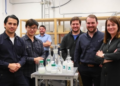
IMAGE

Credit: Brooke L. Bessesen

Carrying its petite frame and all-yellow skin, the recently scrutinized sea snake populations from Golfo Dulce, Costa Rica, already seem different enough to be characterized as a new subspecies. However, their most extraordinary trait is only exposed at night when the serpents opportunistically feed on small fish by hanging upside down from the water surface, assuming a peculiar sinusoidal ambush posture.

The new yellow sea snake subspecies (Hydrophis platurus xanthos) is described by Brooke Bessesen, Phoenix Zoo, USA, and Dr. Gary Galbreath, Northwestern University and The Field Museum of Natural History, USA, in the open access journal ZooKeys.

Unlike its related species, the yellow-bellied sea snake (Hydrophis platurus), the yellow sea snake subspecies lives in a significantly more hostile environment – the waters in the gulf are warmer, often turbulent, and the dissolved oxygen in them occasionally drops to extremely low levels. The two snakes' territories are separated by some 22 kilometers.

Likely as a result, the new reptile has evolved to hunt at night, while its lighter coloration plays role in thermoregulation.

Given the list of well-defined distinct traits, the new subspecies could eventually turn out to be a new species instead. As for the moment, however, the authors remain cautious until additional data are available.

More importantly, the scientists call for conservation measures to be applied to the new serpent's habitat. With its very restricted geographic range of about 320 km2 located in a currently unprotected area, the yellow sea snake is at a serious risk of extinction. Collectors have already been reported to remove specimens from the sea. Additionally, the reptiles are already living at the upper edge of the species' temperature tolerance, which makes them particularly susceptible to climate change.

"Hopefully this globally unique population can continue to offer both scientists and conservation-conscious tourists a worthy subject of observation and study," say the authors.

###

Original source:

Bessesen BL, Galbreath GJ (2017) A new subspecies of sea snake, Hydrophis platurus xanthos, from Golfo Dulce, Costa Rica. ZooKeys 686: 109-123. https://doi.org/10.3897/zookeys.686.12682

Media Contact

Brooke L. Bessesen
[email protected]
@Pensoft

http://www.pensoft.net

Related Journal Article

http://dx.doi.org/10.3897/zookeys.686.12682
Share12Tweet8Share2ShareShareShare2

Related Posts

Here are a few rewritten headlines for a science magazine post, each with a slightly different tone: Intriguing & poetic: How do organs sculpt themselves? Sea stars hold the secret Direct & research-focused: Sea stars reveal the hidden rules of organ formation Metaphorical & inviting: Tiny architects beneath the waves: What sea stars teach us about building organs Short & punchy: Star-shaped clues to how our organs take shape Question-led: Could a sea star show us how organs form? Elegant & feature-style: The body’s blueprint, glimpsed in a sea star’s arm

July 6, 2026
Bacteria evolve faster with unconventional gene copies — Biology

Bacteria evolve faster with unconventional gene copies

July 6, 2026

Neighbours rewire soil feedback via root microbiome shifts

July 6, 2026

Evolution-Inspired Biosensors Revolutionize Lipid Tracking in Real Time

July 2, 2026
Please login to join discussion

POPULAR NEWS

  • Detection of EDCs in Breast Milk and Infant Urine Up to Six Months Highlights Early Exposure Risks

    77 shares
    Share 31 Tweet 19
  • New Drug Candidate Developed at McMaster Shows Potential for Treating Brain Cancer

    58 shares
    Share 23 Tweet 15
  • Saying Goodbye to PGY-6: Pediatric Fellowship Realities

    103 shares
    Share 41 Tweet 26
  • KTU Researchers Explore Ultrasound’s Role in Enhancing Blood Flow Beyond Diagnostics

    53 shares
    Share 21 Tweet 13

About

We bring you the latest biotechnology news from best research centers and universities around the world. Check our website.

Follow us

Recent News

Flame retardant BDE-209 targets molecularly linked to ulcerative colitis

Ultra-high frequency particle impacts mimic rockbursts to shatter hard rock

Kidney transplant outcomes in older adults studied by German researchers

Subscribe to Blog via Email

Enter your email address to subscribe to this blog and receive notifications of new posts by email.

Join 83 other subscribers
  • Contact Us

Bioengineer.org © Copyright 2023 All Rights Reserved.

Welcome Back!

Login to your account below

Forgotten Password?

Retrieve your password

Please enter your username or email address to reset your password.

Log In
No Result
View All Result
  • Homepages
    • Home Page 1
    • Home Page 2
  • News
  • National
  • Business
  • Health
  • Lifestyle
  • Science

Bioengineer.org © Copyright 2023 All Rights Reserved.