• HOME
  • NEWS
  • EXPLORE
    • CAREER
      • Companies
      • Jobs
    • EVENTS
    • iGEM
      • News
      • Team
    • PHOTOS
    • VIDEO
    • WIKI
  • BLOG
  • COMMUNITY
    • FACEBOOK
    • INSTAGRAM
    • TWITTER
Sunday, May 10, 2026
BIOENGINEER.ORG
No Result
View All Result
  • Login
  • HOME
  • NEWS
  • EXPLORE
    • CAREER
      • Companies
      • Jobs
        • Lecturer
        • PhD Studentship
        • Postdoc
        • Research Assistant
    • EVENTS
    • iGEM
      • News
      • Team
    • PHOTOS
    • VIDEO
    • WIKI
  • BLOG
  • COMMUNITY
    • FACEBOOK
    • INSTAGRAM
    • TWITTER
  • HOME
  • NEWS
  • EXPLORE
    • CAREER
      • Companies
      • Jobs
        • Lecturer
        • PhD Studentship
        • Postdoc
        • Research Assistant
    • EVENTS
    • iGEM
      • News
      • Team
    • PHOTOS
    • VIDEO
    • WIKI
  • BLOG
  • COMMUNITY
    • FACEBOOK
    • INSTAGRAM
    • TWITTER
No Result
View All Result
Bioengineer.org
No Result
View All Result
Home NEWS Science News Chemistry

The most spectacular celestial vision you’ll never see

Bioengineer by Bioengineer
November 5, 2019
in Chemistry
Reading Time: 3 mins read
0
IMAGE
Share on FacebookShare on TwitterShare on LinkedinShare on RedditShare on Telegram

Views of giant planet in wild orbit would be unparalleled
IMAGE

Credit: Teo Mocnik / UCR


Contrary to previous thought, a gigantic planet in wild orbit does not preclude the presence of an Earth-like planet in the same solar system – or life on that planet.

What’s more, the view from that Earth-like planet as its giant neighbor moves past would be unlike anything it is possible to view in our own night skies on Earth, according to new research led by Stephen Kane, associate professor of planetary astrophysics at UC Riverside.

The research was carried out on planets in a planetary system called HR 5183, which is about 103 light years away in the constellation of Virgo. It was there that an eccentric giant planet was discovered earlier this year.

Normally, planets orbit their stars on a trajectory that is more or less circular. Astronomers believe large planets in stable, circular orbits around our sun, like Jupiter, shield us from space objects that would otherwise slam into Earth.

Sometimes, planets pass too close to each other and knock one another off course. This can result in a planet with an elliptical or “eccentric” orbit. Conventional wisdom says that a giant planet in eccentric orbit is like a wrecking ball for its planetary neighbors, making them unstable, upsetting weather systems, and reducing or eliminating the likelihood of life existing on them.

Questioning this assumption, Kane and Caltech astronomer Sarah Blunt tested the stability of an Earth-like planet in the HR 5183 solar system. Their modeling work is documented in a paper newly published in the Astronomical Journal.

Kane and Blunt calculated the giant planet’s gravitational pull on an Earth analog as they both orbited their star. “In these simulations, the giant planet often had a catastrophic effect on the Earth twin, in many cases throwing it out of the solar system entirely,” Kane said.

“But in certain parts of the planetary system, the gravitational effect of the giant planet is remarkably small enough to allow the Earth-like planet to remain in a stable orbit.”

The team found that the smaller, terrestrial planet has the best chance of remaining stable within an area of the solar system called the habitable zone — which is the territory around a star that is warm enough to allow for liquid-water oceans on a planet.

These findings not only increase the number of places where life might exist in the solar system described in this study — they increase the number of places in the universe that could potentially host life as we know it.

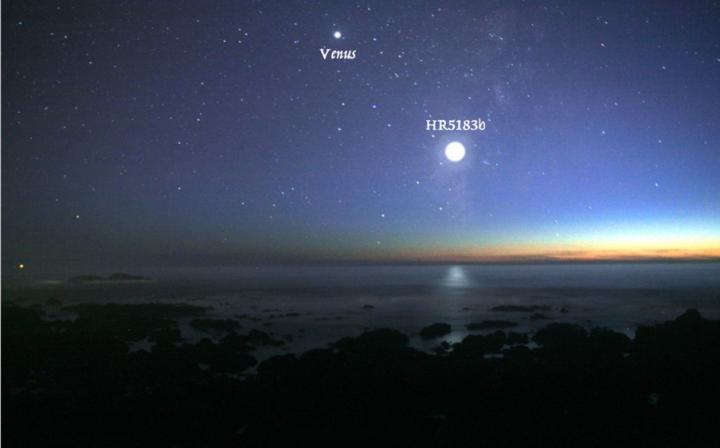
This is also an exciting development for people who simply love stargazing. HR 5813b, the eccentric giant in Kane’s most recent study, takes nearly 75 years to orbit its star. But the moment this giant finally swings past its smaller neighbor would be a breathtaking, once-in-a-lifetime event.

“When the giant is at its closest approach to the Earth-like planet, it would be fifteen times brighter than Venus — one of the brightest objects visible with the naked eye,” said Kane. “It would dominate the night sky.”

Going forward, Kane and his colleagues will continue studying planetary systems like HR 5183. They’re currently using data from NASA’s Transiting Exoplanet Survey Satellite and the Keck Observatories in Hawaii to discover new planets, and examine the diversity of conditions under which potentially habitable planets could exist and thrive.

###

Media Contact
Jules Bernstein
[email protected]
951-827-4580

Original Source

https://news.ucr.edu/articles/2019/11/04/most-spectacular-celestial-vision-youll-never-see

Related Journal Article

http://dx.doi.org/10.3847/1538-3881/ab4c3e

Tags: AstronomyAstrophysicsExperiments in SpaceGeophysics/GravityPlanets/MoonsSpace/Planetary ScienceStars/The Sun
Share16Tweet10Share3ShareShareShare2

Related Posts

Miniature Sensor Uses Light to Detect Touch — Chemistry

Miniature Sensor Uses Light to Detect Touch

May 8, 2026
Iron Minerals Determine Whether Dissolved Organic Matter Fuels Microbes or Becomes Long-Term Carbon Storage — Chemistry

Iron Minerals Determine Whether Dissolved Organic Matter Fuels Microbes or Becomes Long-Term Carbon Storage

May 8, 2026

Kate Evans Appointed Associate Lab Director for Biological and Environmental Systems Science at ORNL

May 8, 2026

Advancing Multiscale Modeling and Overcoming Operational Challenges in Autothermal COâ‚‚-to-Methanol Reactors

May 8, 2026
Please login to join discussion

POPULAR NEWS

  • Research Indicates Potential Connection Between Prenatal Medication Exposure and Elevated Autism Risk

    840 shares
    Share 336 Tweet 210
  • New Study Reveals Plants Can Detect the Sound of Rain

    727 shares
    Share 290 Tweet 181
  • Scientists Investigate Possible Connection Between COVID-19 and Increased Lung Cancer Risk

    68 shares
    Share 27 Tweet 17
  • Salmonella Haem Blocks Macrophages, Boosts Infection

    61 shares
    Share 24 Tweet 15

About

We bring you the latest biotechnology news from best research centers and universities around the world. Check our website.

Follow us

Recent News

Evaluating Digoxin Use in Patients with Symptomatic Rheumatic Heart Disease

Evaluating the Effectiveness and Safety of Digitalis Glycosides in Treating Heart Failure

Urdu Fall Risk Questionnaire Adapted for Elderly

Subscribe to Blog via Email

Success! An email was just sent to confirm your subscription. Please find the email now and click 'Confirm' to start subscribing.

Join 82 other subscribers
  • Contact Us

Bioengineer.org © Copyright 2023 All Rights Reserved.

Welcome Back!

Login to your account below

Forgotten Password?

Retrieve your password

Please enter your username or email address to reset your password.

Log In
No Result
View All Result
  • Homepages
    • Home Page 1
    • Home Page 2
  • News
  • National
  • Business
  • Health
  • Lifestyle
  • Science

Bioengineer.org © Copyright 2023 All Rights Reserved.