• HOME
  • NEWS
  • EXPLORE
    • CAREER
      • Companies
      • Jobs
    • EVENTS
    • iGEM
      • News
      • Team
    • PHOTOS
    • VIDEO
    • WIKI
  • BLOG
  • COMMUNITY
    • FACEBOOK
    • INSTAGRAM
    • TWITTER
Sunday, August 16, 2026
BIOENGINEER.ORG
No Result
View All Result
  • Login
  • HOME
  • NEWS
  • EXPLORE
    • CAREER
      • Companies
      • Jobs
        • Lecturer
        • PhD Studentship
        • Postdoc
        • Research Assistant
    • EVENTS
    • iGEM
      • News
      • Team
    • PHOTOS
    • VIDEO
    • WIKI
  • BLOG
  • COMMUNITY
    • FACEBOOK
    • INSTAGRAM
    • TWITTER
  • HOME
  • NEWS
  • EXPLORE
    • CAREER
      • Companies
      • Jobs
        • Lecturer
        • PhD Studentship
        • Postdoc
        • Research Assistant
    • EVENTS
    • iGEM
      • News
      • Team
    • PHOTOS
    • VIDEO
    • WIKI
  • BLOG
  • COMMUNITY
    • FACEBOOK
    • INSTAGRAM
    • TWITTER
No Result
View All Result
Bioengineer.org
No Result
View All Result
Home NEWS Science News Biology

The Mark Foundation for Cancer Research funds new center at University of Pennsylvania

Bioengineer by Bioengineer
June 3, 2019
in Biology
Reading Time: 3 mins read
0
IMAGE
Share on FacebookShare on TwitterShare on LinkedinShare on RedditShare on Telegram

$12 million awarded to study radiation therapy and immune signaling
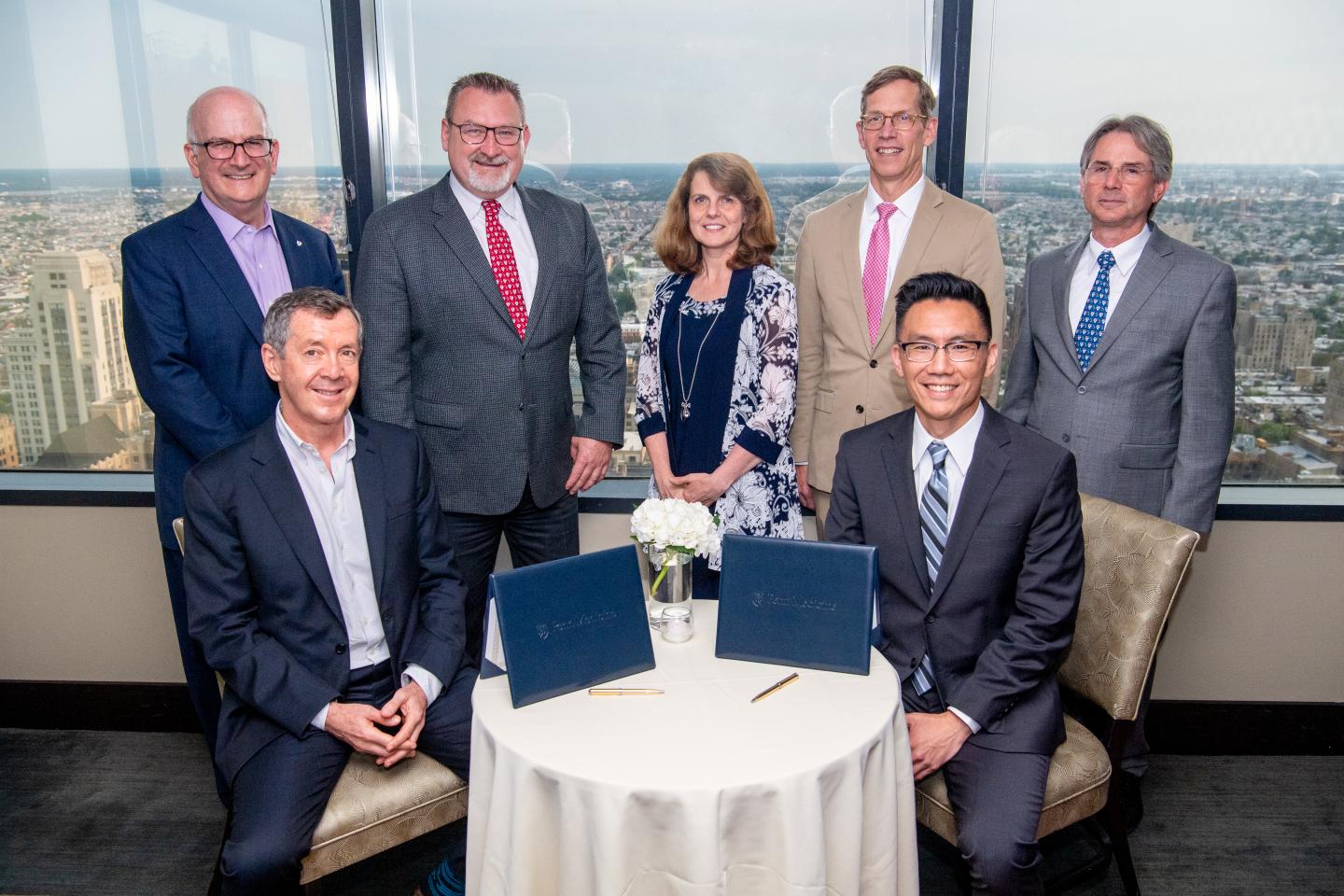
IMAGE

Standing L-R: Kevin Mahoney, James Metz, Michele Cleary, Robert Vonderheide, Jon Epstein

NEW YORK – The Mark Foundation for Cancer Research announced today that it has awarded a grant of $12 million to establish The Mark Foundation Center for Immunotherapy, Immune Signaling, and Radiation at the University of Pennsylvania.

The Center will bring together cross-departmental teams of basic scientists and clinical researchers, who will focus on better understanding the interconnected relationships between advances in radiation therapy, important signaling pathways in cancer and immune cells, and the immune system’s ability to effectively control cancer.

“The results of this exciting project could have enormous significance for cancer patients,” said The Mark Foundation CEO Michele Cleary, PhD. “This multidisciplinary effort is well positioned for success, and we expect these leading researchers will uncover novel insights into cancer biology that will substantially expand the options for treatments with better efficacy and minimal toxicities. We look forward to working with this powerhouse team over the next 5 years and beyond.”

The new center at the University of Pennsylvania follows in the footsteps of The Mark Foundation’s establishment last summer of The Mark Foundation Institute for Integrated Cancer Medicine at the University of Cambridge, as well as previously announced collaborations with Cancer Research UK and Evotec. These awards all derive from the Mark Foundation’s commitment to funding interdisciplinary research that shows significant promise to transform how cancer is prevented, diagnosed and treated.

The Mark Foundation Center for Immunotherapy, Immune Signaling, and Radiation will be led by Andy J. Minn, MD, PhD, Associate Professor of Radiation Oncology in Penn’s Perelman School of Medicine. The primary efforts of the center will comprise five key projects that converge on understanding the signaling pathways elicited by radiation therapy and how those pathways can be exploited therapeutically to enable the immune system to recognize and eradicate cancer.

“These projects have the chance to change the paradigm when it comes to cancer treatment,” said Minn. “Understanding important and potentially targetable mechanisms of immunotherapy resistance and how to use novel radiation therapies to enhance immunotherapies carries enormous benefits for patients.”

###

Specifics on the science funded by the grant can be accessed here.

About the Mark Foundation for Cancer Research

The Mark Foundation for Cancer Research is dedicated to accelerating cures for cancer by integrating discoveries in biology with innovative technology. Launched in 2017, The Mark Foundation pursues its mission by funding a global portfolio of groundbreaking research carried out by individual investigators, multi-investigator teams, and inter-institutional collaborations. Since its launch in 2017, the Foundation has awarded over $57 million in grant funding to 70 institutions across 18 U.S. states and 3 countries.

Recognizing the obstacles that can prevent scientific advances from improving patient outcomes, The Mark Foundation maintains a nimble, high-impact approach to funding research that encompasses grants for basic and translational cancer research, as well as venture philanthropy investment in companies that bridge the gap between the bench and the bedside. To learn more about the work of The Mark Foundation for Cancer Research, visit: https://themarkfoundation.org/.

Media Contact
Shawn Jain
[email protected]

Original Source

http://www.themarkfoundation.org/upennrelease

Tags: cancerGeneticsMedicine/HealthMolecular BiologyPharmaceutical Sciences
Share13Tweet8Share2ShareShareShare2

Related Posts

Strubbelig–NHL3 Receptor Complex Helps Arabidopsis Respond to Cellulose Deficiency

Strubbelig–NHL3 Receptor Complex Helps Arabidopsis Respond to Cellulose Deficiency

August 15, 2026
Bombyx mori Satellitome Analysis Reveals Evolutionary Stability, Dispersed Chromosomal Organization, Transposon Origins

Bombyx mori Satellitome Analysis Reveals Evolutionary Stability, Dispersed Chromosomal Organization, Transposon Origins

August 15, 2026

Synthetic pyrenoid reconstruction reveals EPYC1-driven carbon concentration mechanisms and evolution

August 15, 2026

Endophytic Flavobacterium boosts root hairs and drought tolerance through ERF–CEP5 signaling

August 15, 2026
Please login to join discussion

POPULAR NEWS

  • KAIST develops semiconductor neuron that harnesses noise to selectively process signals

    29 shares
    Share 12 Tweet 7
  • Imagining natural and extra robotic thumbs together strengthens kinesthetic sensorimotor networks

    29 shares
    Share 12 Tweet 7
  • PARP1 Drives Neuropathic Pain Through GPX4-Dependent Ferroptosis in Injured Mice’s Sensory Neurons

    29 shares
    Share 12 Tweet 7
  • Strubbelig–NHL3 Receptor Complex Helps Arabidopsis Respond to Cellulose Deficiency

    29 shares
    Share 12 Tweet 7

About

We bring you the latest biotechnology news from best research centers and universities around the world. Check our website.

Follow us

Recent News

KAIST develops semiconductor neuron that harnesses noise to selectively process signals

Imagining natural and extra robotic thumbs together strengthens kinesthetic sensorimotor networks

PARP1 Drives Neuropathic Pain Through GPX4-Dependent Ferroptosis in Injured Mice’s Sensory Neurons

Subscribe to Blog via Email

Enter your email address to subscribe to this blog and receive notifications of new posts by email.

Join 85 other subscribers
  • Contact Us

Bioengineer.org © Copyright 2023 All Rights Reserved.

Welcome Back!

Login to your account below

Forgotten Password?

Retrieve your password

Please enter your username or email address to reset your password.

Log In
No Result
View All Result
  • Homepages
    • Home Page 1
    • Home Page 2
  • News
  • National
  • Business
  • Health
  • Lifestyle
  • Science

Bioengineer.org © Copyright 2023 All Rights Reserved.