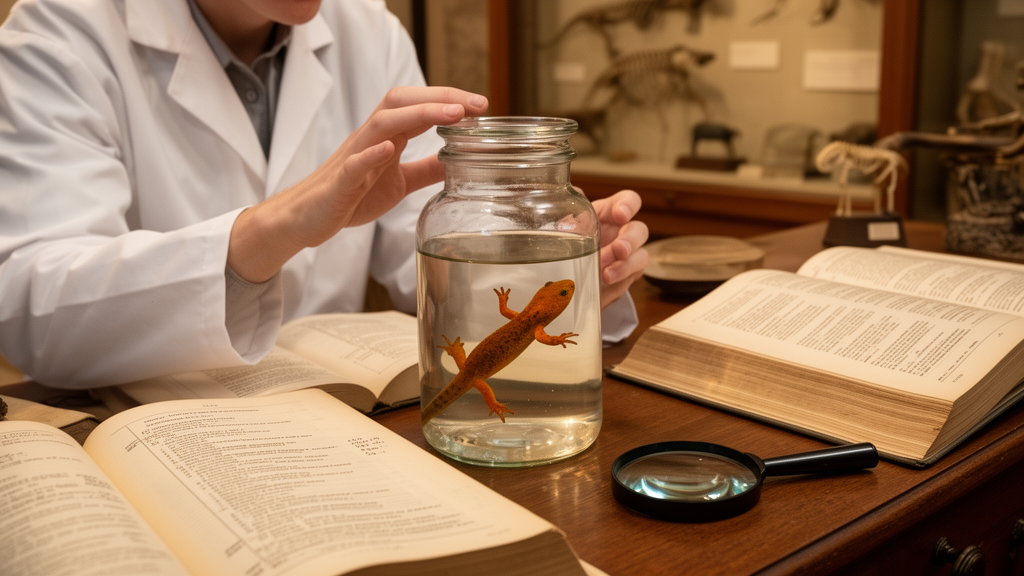
A historical and nomenclatural review concludes that Proteus tritonius, described by Laurenti in 1768 from a lake on Austria’s Ötscher mountain, is the larval form of the Alpine newt, currently called Triton alpestris. The review challenges a 2025 proposal to designate a larva of the fire salamander, Salamandra salamandra, as the neotype of Proteus tritonius.
The dispute concerns a gill-bearing aquatic caudate that Laurenti described from “lacus, qui est in alpe Etscher,” a lake on Mount Ötscher in Lower Austria. Stejneger noted in 1936 that the animal was soon recognized as the larva of Laurenti’s own Triton alpestris. Most later authorities also accepted that identification, and Ichthyosaura became the oldest available genus name for the Alpine newt when the former genus Triturus was divided into four genera.
Mutz and Böhme reopened the taxonomic debate in 2025. They argued that Proteus tritonius should not be identified with T. alpestris and designated specimen ZFMK 104202, a larva of S. salamandra collected in a creek near Nesselberg in the Ötscher region, as a neotype. This review examines their arguments and the proposed designation rather than surveying the entire history of the name. It assesses the original description, the reported type locality, climatic and ecological context, Laurenti’s own discussion, and the consistency of the proposed neotype with the original account.
The review accepts the central point underlying the renewed debate: ecological conditions during Laurenti’s lifetime may have differed from those today, making current climatic observations relevant to an assessment of the historical record. Austrian temperature records beginning in 1767 indicate, however, that it was highly improbable for more thermophilic urodeles to have occupied places that are now too cold, particularly around 1760. The authors also describe the northeastern lake below Mount Ötscher’s summit as the only lake on the mountain visible on maps or aerial photographs, and therefore identify it as the lake in Laurenti’s original locality.
Mutz and Böhme question that identification by interpreting differences in Laurenti’s phrases, including “Etschero monte” and “alpe Etscher,” and by suggesting that the muddy habitat and difficulty of access described by Laurenti point to a lower-altitude water body. The review disputes these interpretations. It argues that “alpe Etscher” more plausibly denotes the region of alpine pastures on the mountain, consistent with Laurenti’s references to cattle and herders drinking from water filled with the animals throughout summer. It also reports that the lake contains fine organic sediment and that, with a slightly higher water level, the water would extend into marginal grass. The historical condition of the lake remains unknown, but the authors note that it may have been larger and deeper, with a swampy littoral zone produced by cattle trampling.
The claim that reaching the lake was arduous is also qualified. Although a previous report described an approach from the north over a rocky ridge and scree slope, the authors state that the lake can be reached more comfortably by trails from the south. A nineteenth-century tourist guide described the surrounding rocky terrain as interrupted by rich pastures. The authors infer that the site was connected to other locations by well-trodden paths and was probably inhabited during the herding season, rather than being the inaccessible habitat proposed by Mutz and Böhme.
Laurenti’s own reasoning is central to the review’s conclusion. He explicitly considered and rejected the possibility that P. tritonius was the larva of T. alpestris, placing the animal with the olm in Proteus because it appeared permanently gill-bearing. However, his rejection was qualified: he invited anyone who could present better arguments to do so. The species epithet tritonius nevertheless indicated that he recognized similarities to newts. The review interprets Laurenti’s position as accepting that, if the animals were larvae, they would most plausibly be T. alpestris because he identified no other species in the region that fit the alternative.
Modern observations address two features that Laurenti regarded as unusual. Alpine newt larvae can overwinter, accounting for their presence in the lake in autumn and throughout the year, and the simultaneous presence of functional gills and lungs occurs regularly during development in many amphibian species. The authors also note that Laurenti’s written description places the beginning of the dorsal fin at the nape, which rules out S. salamandra and leaves T. alpestris and Lissotriton vulgaris among species known from the region. Although Laurenti’s illustration cannot be assigned unequivocally, the authors argue that its morphology remains compatible with an Alpine newt larva, including a rounded tail and a regenerating tail fin.
The proposed neotype is challenged on location, species and consistency with the original description. The authors maintain that the type locality is the lake in “alpe Etscher,” not an unspecified lower-altitude water body, and that a creek selected as a replacement locality conflicts with Laurenti’s account of herders and cattle using the lake during summer. They further argue that the salamander larva is inconsistent with the dorsal-fin description. Under article 75.3 of the International Code of Zoological Nomenclature, a neotype must be consistent with what is known of the original name-bearing type from the original description; the authors conclude that specimen ZFMK 104202 does not meet that requirement. They state that an application to the International Commission on Zoological Nomenclature to set aside the neotype under article 75.6 is in preparation.
Subject of Research: Taxonomic identity and neotype designation of Laurenti’s Proteus tritonius
Article Title: The identity of Proteus tritonius Laurenti, 1768: comments on a really doubtful case of literary interpretation
Article References: Gollmann, G., & Gollmann, B. (2026). The identity of Proteus tritonius Laurenti, 1768: comments on a really doubtful case of literary interpretation. Herpetozoa, 39, 17-21. https://doi.org/10.3897/herpetozoa.39.e178255
Image Credits: AI Generated
DOI: 10.3897/herpetozoa.39.e178255
Keywords: Proteus tritonius, Alpine newt, Triton alpestris, taxonomic review, neotype designation, Mount Ötscher, Laurenti 1768, Ichthyosaura, Salamandra salamandra, nomenclature, identity, Proteus
News Source: Drew Townsend. (October 20, 2026). The identity of Proteus tritonius Laurenti, 1768: comments on a really doubtful case of literary interpretation. Scienmag.