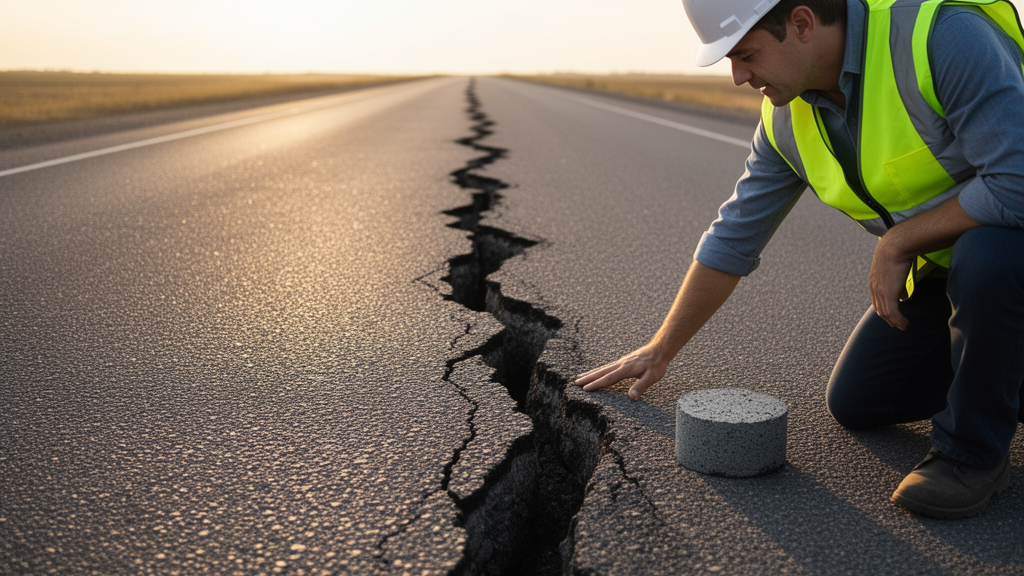
Every road surface carries a secret number, and a team of Chinese materials scientists has now shown just how dramatically that number shapes the fate of the pavement above our wheels. The figure in question is the air void content of the matrix asphalt mixture in semi-flexible pavement, a composite road material that has quietly become the go-to solution for some of the harshest spots on the network: bus stops, intersections, parking lots, and long downhill grades where ordinary asphalt simply surrenders to heat and traffic. In a systematic laboratory study published in Frontiers in Materials, researchers from the Guangxi Key Laboratory of Road Structure and Materials, Guangxi Transportation Science and Technology Group, and Changsha University of Science and Technology prepared matrix asphalt mixtures with three distinct void contents, 20.6 percent, 24.9 percent, and 29.2 percent, and then pushed the resulting composites through a gauntlet of perfusion, Marshall stability, splitting, three-point bending, rutting, and freeze-thaw tests. Their verdict is strikingly precise: 24.9 percent is the sweet spot at which the material achieves the most balanced combination of mechanical strength, high-temperature deformation resistance, water stability, and cracking resistance.
To understand why a single percentage can matter so much, it helps to grasp what semi-flexible pavement actually is. Engineers begin with an open-graded porous asphalt mixture, in this case a PAC-13 blend with a nominal maximum aggregate size of 13 millimeters and a void content typically ranging from 20 to 30 percent. Into this sponge-like skeleton they infuse a high-fluidity cement slurry, creating a hybrid that combines the smoothness, skid resistance, and ease of repair of asphalt pavement with the high strength and modulus of cement concrete pavement. The concept emerged as a direct response to a stubborn problem: asphalt is a viscoelastic-plastic material, exquisitely sensitive to temperature, and in hot summers it develops ruts earlier, more frequently, and with greater deformation depth than in cooler seasons. Semi-flexible pavement tames this weakness, but its performance hinges on how much grouting space the matrix provides, which is determined almost entirely by the void content of the underlying asphalt mixture.
The researchers left nothing to chance in controlling their variables. The grouting material was a self-developed blend of ordinary Portland cement, aluminate cement, fly ash, silica fume, fine quartz sand, latex powder, and water-reducing agent, mixed with water at a ratio of 0.3 and blended at 4,000 revolutions per minute for two minutes in a high-speed shearing machine. The slurry exhibited an initial flow cone fluidity of 12.9 seconds, a pre-hardening setting time of 188 minutes, a density of 1.919 grams per cubic centimeter, and impressive early strength, reaching 28.6 megapascals in compression within one day and 33.7 megapascals at 28 days. The matrix mixtures, meanwhile, were built from gabion coarse aggregate with an apparent relative density of 2.943 and a needle-like particle content of just 1.8 percent, limestone fine aggregate, limestone mineral powder, and styrene-butadiene-styrene modified asphalt with a softening point of 91 degrees Celsius. Three aggregate gradations, labeled G1, G2, and G3, were designed with optimum asphalt-aggregate ratios of 3.2, 3.4, and 3.5 percent, and specimens were Marshall-compacted with 50 blows per side at temperatures between 155 and 160 degrees Celsius.
The first performance indicator the team examined was the perfusion rate, defined as the ratio of the actual volume of cement slurry retained within the matrix after grouting to the connected void volume available before grouting. The measurements revealed an almost perfect linear relationship between the total void ratio and the connected void ratio, with a correlation coefficient of 0.998, confirming that the two indices move in lockstep and that either can serve as the governing design variable. As the void content increased, the perfusion rate climbed steadily, and, just as tellingly, the standard deviation of the filling rate shrank. In practical terms, higher void content does not merely let more slurry in; it lets the slurry in more uniformly. The explanation lies in the pore architecture of the matrix: as void content decreases, the available connected space and effective channels for slurry penetration narrow, raising resistance to infiltration and producing a heterogeneous, discontinuous distribution of grout that leaves weak spots scattered through the composite.
Then came the mechanical payoff, and it was spectacular. Marshall stability tests at 60 degrees Celsius and splitting tests at 15 degrees Celsius showed that grouting transformed the composites at every void level, but the magnitude of the transformation scaled dramatically with the matrix voids. At 20.6 percent void content, grouting boosted stability by a factor of 1.2 and splitting strength by 0.3; at 24.9 percent, the gains rose to 2.5 and 1.0 respectively; and at 29.2 percent, stability soared by a factor of 4.8 while splitting strength increased 1.4-fold. After grouting, the Marshall stability of the semi-flexible material ranged from 17 to 30 kilonewtons across the tested void contents. The pattern reverses when the ungrouted matrices are considered alone: the higher the void content, the weaker the bare PAC-13 mixture, yet the stronger the final composite. This inversion carries a profound design implication, because it shows that the mechanical properties of semi-flexible pavement depend mainly on the strength of the cement slurry and the filling rate, not on the strength of the underlying asphalt skeleton. Excessively high mechanical performance in the matrix is unnecessary; only sufficient stability to survive field compaction is required.
Cracking resistance, however, told a far more nuanced story, one that varied with temperature in ways that previous studies had never fully reconciled. Using trabecular specimens of 250 by 30 by 35 millimeters extracted from rut plates, the team ran three-point bending tests at both minus 10 and 15 degrees Celsius. At minus 10 degrees Celsius, the flexural tensile strength of the composites was roughly twice that measured at 15 degrees Celsius, while the maximum flexural tensile strain was far smaller, because the asphalt phase behaves rigidly and tends toward brittle failure. When the void ratio rose from 20.6 to 24.9 percent at the cold temperature, the flexural tensile strain reached its maximum of 2,020 microstrain, an 8 percent enhancement signaling better crack resistance. But pushing the void content to 29.2 percent caused the strain to plummet to 1,494 microstrain, a 26 percent decline. The physics is elegant: at low void content, incomplete perfusion leaves interconnected voids that concentrate stress and accelerate cracking; at moderate void content, more uniform grout distribution evens out internal forces; but beyond 24.9 percent, the cement slurry content becomes excessive, the asphalt mastic content too small, and the overall stiffness so high that the coordinated deformation ability of the two phases is weakened.
At 15 degrees Celsius the hierarchy flipped entirely. There, the asphalt mixture retains viscoelastic plasticity and good deformation ability, so lower void content, meaning higher asphalt mastic content and lower overall rigidity, produced superior crack resistance, with flexural tensile strain decreasing gradually as void content increased. The team noted that the higher the temperature, the more pronounced the effect of void ratio on the flexural tensile strain, and conversely, the lower the void ratio, the more sensitive the maximum flexural strain became to test temperature. This temperature-dependent reversal explains why earlier studies had reached seemingly contradictory conclusions, with some reporting that larger matrix voids monotonically improved cracking resistance while others found an optimum near 24 percent. Both camps were right, but each was describing a different thermal regime, and neither had systematically quantified the trade-off within a single complete performance framework.
High-temperature deformation resistance and water stability, the twin pillars of pavement durability, both favored higher void content. In 60-degree rutting tests, the dynamic stability of the composites climbed as matrix voids increased, with the rate of improvement fastest below 24.9 percent: raising the void ratio from 20.6 to 24.9 percent added 10,837 cycles per millimeter, a 63.6 percent enhancement, while the further increase to 29.2 percent contributed only 2,803 cycles per millimeter, a mere 10 percent gain. The freeze-thaw splitting tensile strength ratio, meanwhile, increased linearly with void content, gaining 2.1 percentage points from 20.6 to 24.9 percent and another 2.5 points up to 29.2 percent. The mechanism is straightforward: higher perfusion rates mean fewer communicating voids remain in the finished composite, so less water enters the interior during freezing and thawing cycles, reducing internal damage. The rigid cementitious skeleton, once fully formed, provides strong resistance to permanent deformation, which is why all grouted specimens exhibited relatively high dynamic stability regardless of matrix void content.
The convergence of all these threads points to a single recommendation that could reshape design practice. Current specifications merely advise a void content range of 20 to 30 percent for the matrix asphalt mixture without offering a clear optimum, leaving engineers without a scientific basis for selection. The new study fills that gap with multi-performance synergy analysis: below 24.9 percent, increasing voids significantly enhances resistance to high-temperature deformation; at 24.9 percent, the material balances mechanical properties, high-temperature performance, water stability, and cracking resistance most evenly; and beyond that threshold, further void increases yield limited high-temperature gains and actively degrade cold-temperature crack resistance. The authors suggest this shift moves semi-flexible pavement design from single-index control toward comprehensive performance balance, providing an experimental foundation for mixture design, matrix void control, and specification improvement.
For a material deployed at bus stations, intersections, and steep urban grades across China, the implications ripple outward quickly. Semi-flexible pavement still faces hurdles, including high initial construction costs from expensive grouting materials, demanding field procedures requiring strict control of grouting temperature, timing windows, curing conditions, and specialized equipment, and long-term behavior under repeated traffic and climatic loading that remains incompletely characterized. By pinpointing the matrix void content as the decisive, controllable variable, the study offers engineers a lever they can pull with confidence, one that determines the grouting space, the composite structure, and ultimately whether the pavement endures or cracks. The secret number of the road, it turns out, was hiding in plain sight all along, and now it has a recommended value: 24.9 percent.
Subject of Research: Study on the influence of matrix asphalt mixture air voids on the performance of semi-flexible pavement materials
Article Title: Study on the influence of matrix asphalt mixture air voids on the performance of semi-flexible pavement materials
Article References: Chen, J., Yang, Z., Huang, H., Lei, J., & Xuan, W. (2026). Study on the influence of matrix asphalt mixture air voids on the performance of semi-flexible pavement materials. Frontiers in Materials, 13, Article 1930537. https://doi.org/10.3389/fmats.2026.1930537
Image Credits: AI Generated
DOI: 10.3389/fmats.2026.1930537
Keywords: influence, matrix, asphalt, mixture, voids, performance, semi-flexible, pavement, materials, scientific research
News Source: Denise Maddox. (October 17, 2026). The Hidden Number That Decides Whether Roads Crack or Endure. Scienmag.